Hold vs Sell vs Exchange Decision Framework for Rental Property
A three-part framework reveals whether to hold, sell outright, or defer taxes through exchange.
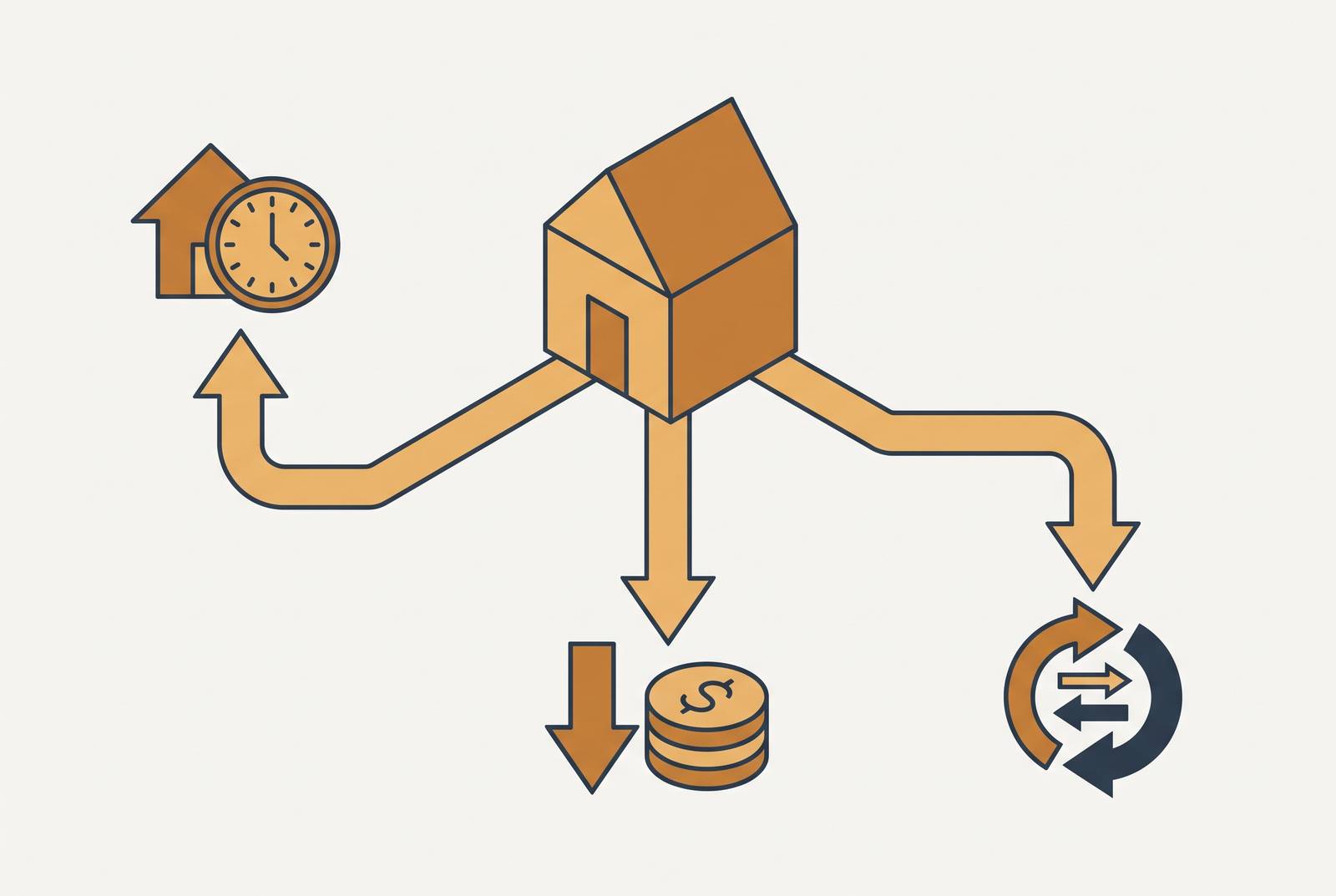
A rental property sale isn't one decision, it's three stacked on top of each other: how much tax a straight sale actually costs, whether the equity sitting in the property is still earning its keep, and whether a 1031 exchange changes the math enough to justify its own mechanics. Most owners collapse those three questions into a single gut call, hold or sell, and skip the layer that usually matters most. The exchange path gets underweighted not because it's a bad option, but because the tax cost of ignoring it appears only on the closing statement, by which point it is already signed.
What a straight sale costs: the tax stack most investors underestimate
Investors who only budget for capital gains tax on a rental sale are routinely surprised by a second bill they didn't model: depreciation recapture. Depending on how long the property was held and how much was depreciated, that surprise can run anywhere from $40,000 to $120,000 on a mid-size rental. That range isn't an outlier scenario, it's the ordinary outcome of selling a property that's been depreciated for a decade or more.
Two separate tax mechanisms trigger the moment a rental property sells. The first is long-term capital gains tax on the appreciation above the owner's basis. For 2025, that rate is 0% for taxable income up to $48,350 for single filers ($96,700 for married filing jointly), 15% up to $533,400 single ($600,050 MFJ), and 20% above those thresholds. If modified adjusted gross income clears $200,000 single or $250,000 married, the Net Investment Income Tax adds another 3.8% on top.
The second mechanism is Section 1250 depreciation recapture, and it's the one investors consistently underweight. Unrecaptured Section 1250 gain, the portion tied to straight-line depreciation, is taxed at a maximum rate of 25%, regardless of what capital gains bracket the investor otherwise falls into. Any accelerated depreciation claimed gets recaptured as ordinary income, up to 37%.
The IRS doesn't care whether an investor actually claimed depreciation each year, which is the trap inside the trap. The tax code requires basis to be reduced as if depreciation was taken, allowed or allowable, so recapture is owed either way. Skipping depreciation deductions doesn't avoid the tax, it just means paying the recapture bill without ever having gotten the deduction that caused it. Running both components, capital gains and recapture, before anything else is what makes the rest of the framework possible. Skip this step and the sell option looks cheaper than it is, which quietly biases every decision that follows.
The hold signal: when return on equity reveals whether staying put is working
Cash-on-cash return tells an investor what the property produces relative to what was originally invested. It says almost nothing about whether the capital currently sitting in the property, appreciated, paid down, sitting as equity, is still working hard. Return on equity closes that gap, and it's the correct metric for evaluating a property already owned for several years.
The formula: annual cash flow, plus principal paydown, plus appreciation, divided by current equity. A property with ROE below 6% is warehousing capital rather than deploying it. Above 9% on a conservative basis that includes capex reserves, the property is still earning its position in the portfolio and the hold case is strong.
The counterintuitive part appears in properties that look healthy on the surface. A rental with excellent monthly cash flow can still post a mediocre ROE if the property has appreciated heavily since purchase, because the denominator, current equity, has grown faster than the income it's generating. The cash flow hasn't changed; the opportunity cost of leaving that equity in place has.
ROE doesn't decide whether to sell outright or exchange. It only decides whether the capital needs to move at all. If ROE clears the hold threshold, the framework stops here, the answer is stay, and everything past this point is irrelevant. If it doesn't clear the bar, the equity needs a new home, and that's where the next layer picks up.
When the decision reaches the sell-vs-exchange layer: what the tax cost of cashing out implies
By the time an investor reaches this layer, it's already clear that the property isn't earning its keep, and the capital needs to move somewhere more productive. What's left to decide is whether that move happens with a tax bill attached or without one.
The core argument for the exchange comes down to starting balance. Reinvest full pre-tax proceeds into a new property, or reinvest whatever survives after capital gains, recapture, and NIIT take their cut first. The gap between those two starting points compounds over every year the replacement property is held, which is the entire economic case for Section 1031 in one sentence.
That doesn't mean paying the tax is always the wrong move. Several situations justify selling outright even with the full tax stack applied. An investor exiting real estate entirely, with no intention of buying replacement property, gains nothing from deferral, since deferral only postpones a tax that will eventually come due on reinvested property. Suspended passive losses accumulated over years of ownership can offset a meaningful share of the gain, sometimes enough to make the tax cost smaller than the effort of running an exchange. An investor near the end of life may prefer an outright sale, since heirs receive a step-up in basis at death that eliminates the deferred tax altogether, making the exchange's deferral pointless if there's no intention to keep exchanging through the end. And sometimes the replacement property market simply doesn't offer anything viable inside the exchange timeline, which forecloses the option regardless of the tax math.
Each of those is a legitimate exit, not a misunderstanding of how exchanges work. The purpose of this layer isn't to argue that everyone should exchange, it's to make sure the outright sale is a chosen outcome rather than a default one, arrived at without ever pricing the alternative.
How a 1031 exchange works: the mechanics an investor must understand before committing
A provision of the federal tax code allows deferral of gain on the exchange of real property held for investment or business use. There's no dollar cap, no limit on how many times an investor can use it, and the provision remains in place as of this writing.
Roughly 90% of exchanges use the delayed, or forward, structure. The relinquished property sells, and the proceeds go directly to a Qualified Intermediary rather than to the investor. The QI holds those funds while the investor identifies and then closes on replacement property. The rule that trips up first-timers: the investor can never touch the sale proceeds at any point in the process. Constructive receipt of funds, even briefly, disqualifies the entire exchange.
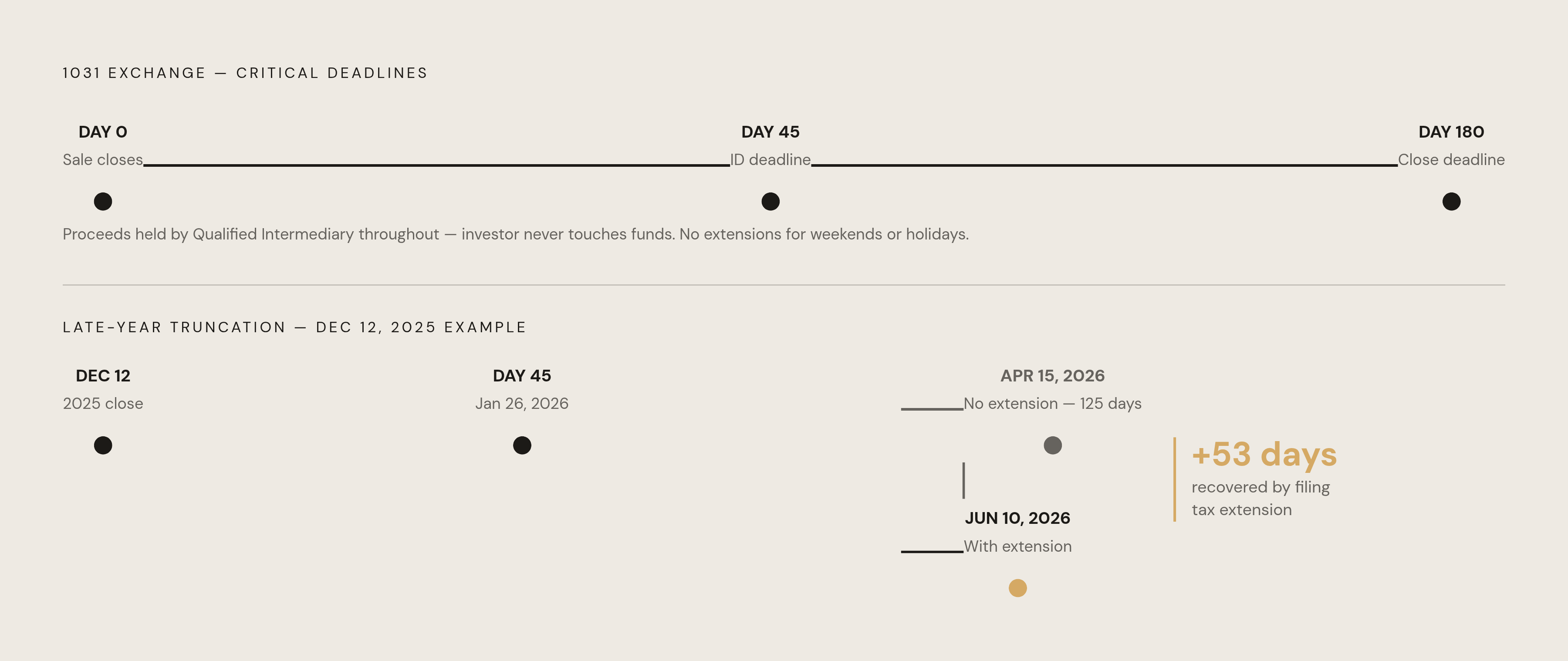
Two deadlines run simultaneously from the closing date of the relinquished property, and neither bends for weekends or holidays. The investor has 45 calendar days to identify replacement property in writing, and 180 calendar days to close on it.
There's a lesser-known wrinkle here that catches investors doing exchanges late in the year. Exchanges opened between October 17, 2025 and December 31, 2025 don't automatically get the full 180 days. Instead, the deadline truncates to April 15, 2026, the due date for the 2025 tax return, unless the investor files a tax extension. Filing that extension restores the full 180-day window. For an exchange closing on December 12, 2025, filing that extension pushes the deadline from April 15 to June 10, 2026, adding back 53 calendar days that would otherwise disappear.
Identification has to follow one of three rules, and they're mutually exclusive. The Three-Property Rule allows identifying up to three properties regardless of value. The 200% Rule allows identifying any number of properties, as long as their combined value doesn't exceed 200% of what the relinquished property sold for. The 95% Exception exists for investors who blow past both limits: the exchange still survives if the investor ultimately acquires at least 95% of the total value identified.
Like-kind, in the context of real estate, is a far looser standard than the phrase implies. An apartment building can exchange for a commercial retail space, a single-family rental can exchange for a stake in a shopping center, and farmland can exchange for a fractional interest in a Delaware Statutory Trust. Nearly any investment-grade real estate qualifies as like-kind to any other.
Partial exchanges are allowed but come with a catch called boot. If the investor receives cash back or reduces mortgage debt on the replacement property relative to the relinquished one, that difference is boot, and it's taxed immediately even though the rest of the exchange defers normally. The same taxpayer rule requires that whoever holds title on the relinquished property also holds title on the replacement property, which means entity structure has to match on both sides of the transaction. The exchange gets reported to the IRS on Form 8824, filed with the tax return for the year the exchange took place.
The Qualified Intermediary's role and the cost of choosing the wrong one
A Qualified Intermediary isn't a convenience, it's a legal requirement, and the exchange has to be opened with the QI before the relinquished property closes, and the investor can never touch the sale proceeds at any point in the process.
The QI's job covers four things: preparing the exchange documents required under Section 1031, holding the sale proceeds in a segregated account, tracking the 45- and 180-day deadlines, and coordinating with the title and closing agents on both transactions. Certain people are legally barred from serving as QI for a given exchange, including the investor's own attorney, accountant, or real estate agent, along with anyone who's acted as the investor's agent within the prior two years.
Fund security deserves more scrutiny than it typically gets. The QI is holding the investor's entire deferred tax liability in an account the investor doesn't control, and QI oversight is limited compared to federally regulated financial institutions. Vetting falls entirely on the investor. That means checking whether funds sit in a segregated account, whether that account is FDIC-insured, and what the actual coverage limits are, since a large exchange can exceed standard deposit insurance thresholds.
The traditional fee model in this industry charges a per-exchange fee, and on top of that, most intermediaries keep all or most of the interest earned on the investor's funds while they sit in escrow during the exchange period. On a seven-figure exchange held for several months, that interest isn't a rounding error, it's real money that belongs, by any reasonable logic, to the person whose capital generated it.
What should an investor actually evaluate when picking a QI? How the funds are held and insured, whether interest gets passed back to the client or retained by the intermediary, whether a fee is charged at all, how quickly the exchange can be opened (same-day and at-the-closing-table capability matters when deals move fast), whether a dedicated senior exchange officer handles the file from start to finish or whether it gets routed to a processing team after a salesperson closes the account, and how transparent the rate and fee disclosures are up front.
One firm in the space, Deferred, has built its model around a no-fee structure, sharing interest earned on held funds directly with the client. Funds are held in segregated, FDIC-insured accounts with coverage well beyond the typical account limit, exchanges can open same-day, including at-the-closing-table scenarios, and each file is handled by a single senior Exchange Officer rather than passed through a sales-to-processing handoff. Support runs seven days a week.
The broader argument for a no-fee model isn't just competitive positioning, it reflects what's actually changed in how exchanges get administered. Modern software handles the banking workflows, enforces segregation of duties automatically, and logs every fund transfer without manual intervention, which is the labor that used to justify charging investors hundreds of dollars per file. When that labor gets automated, the savings belong with the client, not with the intermediary's margin.
Long-term deferral strategies that extend the exchange decision beyond a single transaction
The exchange decision doesn't have to be a one-time event. Investors who keep exchanging at every repositioning point defer the entire tax stack indefinitely, rolling the original gain forward into each new property's basis rather than ever settling the bill.
That strategy connects directly to estate planning, because of how basis works at death. Under current law, property inherited by an heir receives a step-up in basis to fair market value as of the owner's date of death. That step-up wipes out both the depreciation recapture and the capital gains tax that would otherwise be owed, which means an investor who exchanges consistently through the end of life can pass real estate to heirs with the entire deferred tax liability erased rather than merely postponed.
A less familiar variant is what's sometimes called the "lazy" 1031: exchanging out of active rental ownership and into a Delaware Statutory Trust interest. The deferral mechanics are identical to a standard exchange, but the replacement property is a passive trust interest rather than a directly managed asset. For an investor who's tired of tenant calls and maintenance decisions but doesn't want to trigger a taxable sale, this route removes the landlord duties while keeping the tax deferral intact.
Suspended passive losses deserve a second look at this stage too, separate from the earlier mention. Investors sitting on years of accumulated passive losses against a property can apply them directly against the gain in a straight sale, and in some cases that offset shrinks the net tax bill below what the operational overhead of an exchange would justify. Model that explicitly, with real numbers, before assuming the exchange automatically wins.
None of these strategies replace the hold-sell-exchange decision covered earlier. They sit alongside it, shaping which path produces the better outcome once the investor's specific numbers, and specific timeline, are on the table.
Running the framework in sequence: a practical decision path for a real rental property
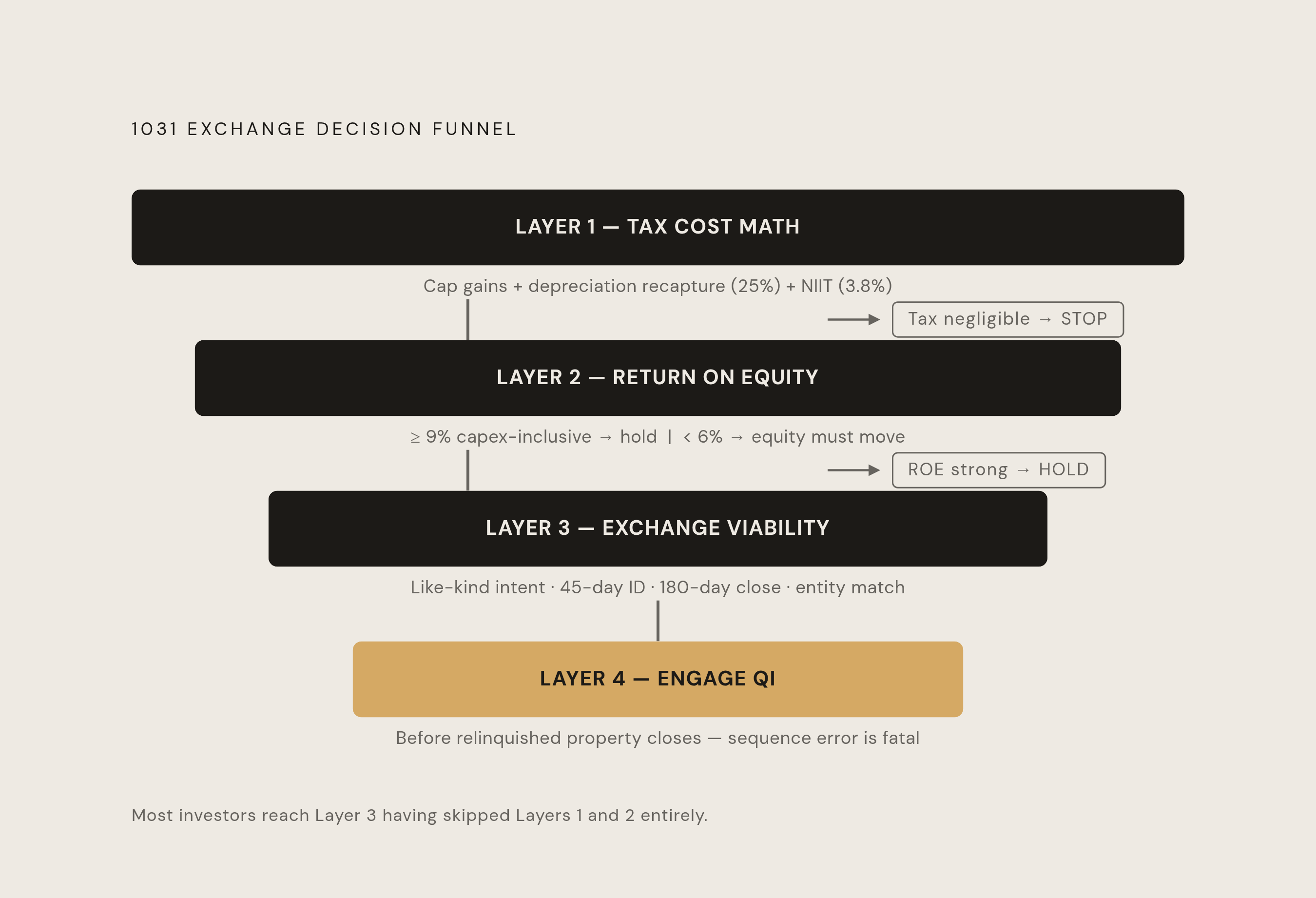
Layer one starts with the tax math on a straight sale, run in full. Calculate long-term capital gains at the applicable rate, add depreciation recapture at up to 25%, and layer in the 3.8% NIIT if AGI thresholds apply. If that total comes out negligible, because the basis is high, suspended losses are large, or appreciation has been minimal, the exchange likely isn't worth the operational lift it demands.
Layer two tests ROE on the property as it currently stands. Above 9% on a capex-inclusive basis, hold, and the framework ends there. Below 6%, the equity needs to move, and the next layer runs.
Layer three is where sell and exchange get weighed against each other directly. Is reinvestment into like-kind property actually intended, or is this an exit from real estate altogether? Can the investor realistically identify viable replacement properties inside the 45-day window? Does the 180-day close fit the timeline, and if the closing falls in the fourth quarter, has the truncation risk around the April 15 deadline been accounted for? And does the entity holding title on the relinquished property match what will hold title on the replacement, since a mismatch here breaks the exchange regardless of everything else lining up.
Layer four only matters if layer three points toward exchanging: the QI has to be selected and engaged before the relinquished property closes, not after, since there's no fixing that sequencing error later. That selection should weigh fund security, fee structure, how interest on held funds gets treated, how fast the exchange can open, and whether a dedicated exchange officer is handling the file.
Each layer only runs because the one before it didn't resolve the question. Most investors who reach layer three carrying real tax exposure, in a market with viable replacement inventory, will find the exchange wins on after-tax math, not narrowly, but by a wide enough margin to justify the paperwork. The exchange gets overlooked for reasons that have nothing to do with the law's complexity. It's underweighted because investors skip the sequence, engage a Qualified Intermediary too late to matter, or pick one without ever asking what its fees and retained interest are actually costing them.