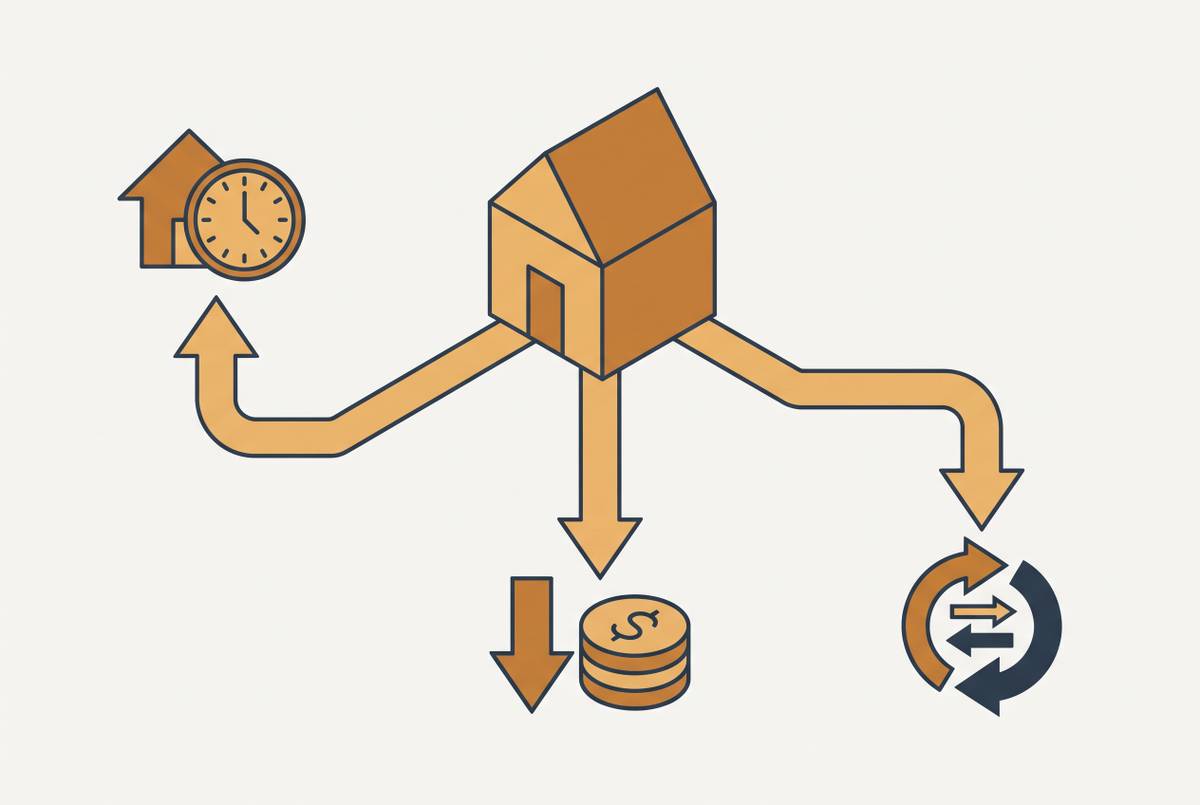
Liquidity Risk in Delaware Statutory Trust Investments
The investment's tax benefits mask a structural lock that makes early exits nearly impossible.
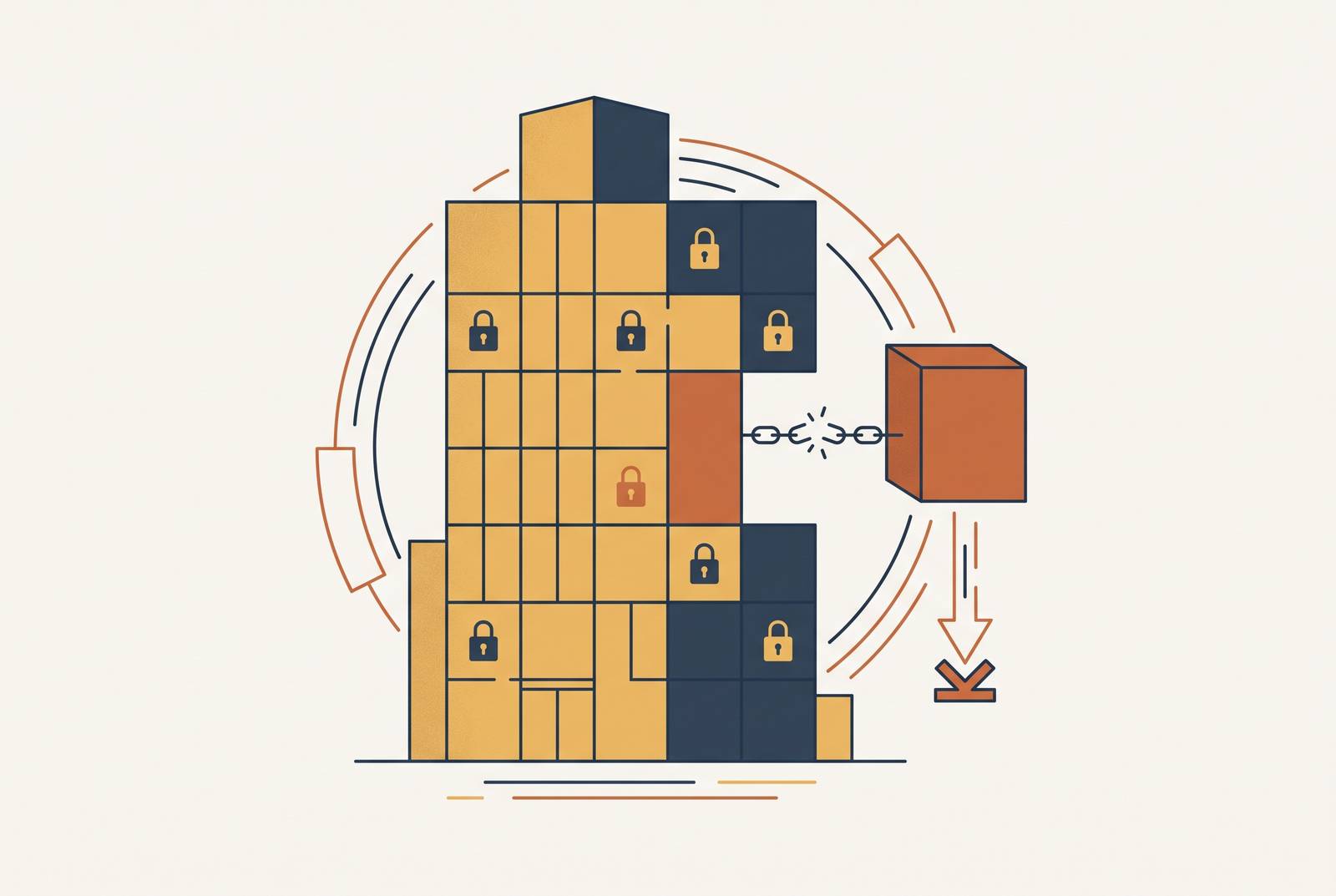
A Delaware Statutory Trust lets investors buy into institutional-grade real estate, defer capital gains taxes through a 1031 exchange, and hand off management to a professional sponsor. What the marketing rarely dwells on is that the same structure making DSTs convenient also makes them nearly impossible to exit early. Liquidity risk in a DST is a compounding, structurally engineered condition, not the ordinary illiquidity of owning a building. It is a compounding, structurally engineered condition, and its mechanics determine how the investment actually behaves under the seven deadly sins' constraints, while the tax benefit is the part everyone already explains.
A DST is a legal entity formed under Delaware law that holds title to real property on behalf of investors, who buy beneficial interests in the trust rather than the property itself. That distinction sounds like a technicality. That distinction is not a technicality. Investors don't hold a deed, don't sit on title, and don't own a controlling stake in anything, they own a fractional, non-controlling claim on a trust's income and eventual sale proceeds. For tax purposes, the DST acts as a pass-through: income flows to investors, and the trust itself doesn't file at the entity level. Crucially, under IRS guidance the DST interest qualifies as like-kind real property that counts as valid replacement property in a 1031 exchange. That single qualification is the entire reason the DST industry exists.
DSTs emerged in the late 1990s as a way to pool capital from individual investors into assets, multifamily complexes, self-storage portfolios, industrial parks, triple-net retail, medical office buildings, that most people could never buy on their own. Minimum investments often run as low as $50,000 to $100,000, compared to $1.5 million or more for a comparable triple-net property bought outright. That accessibility is the pitch. The trust is fully passive: a sponsor handles leasing, maintenance, financing, and disposition, and the investor gets none of the votes and none of the phone calls. Passivity is marketed as a benefit. It's also the precondition for every liquidity problem that follows.
How the DST's IRS compliance rules, the "seven deadly sins," freeze the investment in place
Revenue Ruling 2004-86 laid out seven conditions a DST must satisfy to preserve its 1031 eligibility, informally known across the industry as the seven deadly sins. They exist to keep the IRS comfortable classifying the DST as a fixed investment trust, not to protect investors from anything.
Four of the restrictions do most of the work. Once the offering closes, no new capital comes in, from existing investors or new ones, so ownership percentages are locked at closing. The trustee can't renegotiate the terms of existing debt or take out new loans. Sale proceeds can't be reinvested by the trustee into other assets or improvements. And capital expenditures are capped at normal repair and maintenance, minor non-structural fixes, and legally mandated items like zoning compliance, nothing that amounts to a real repositioning of the asset. Three additional operational constraints round out the list, further narrowing what the trustee is allowed to do without investor input or new capital.
Put together, these rules mean the trust can't adapt. If a DST-owned office building loses its anchor tenant, the trustee may not have the authority to restructure the lease, bring in capital for tenant improvements, or refinance to bridge the income gap. The property just underperforms, for as long as the hold period lasts, with no structural remedy on the table. That's the system working exactly as the IRS designed it. It's the system working exactly as the IRS designed it, to protect the tax classification, not the investor's financial flexibility. Regulatory compliance and illiquidity turn out to be the same mechanism wearing two names.
The lock-up period: why DST capital is typically committed for 7-10 years with no exit ramp
Most DSTs run on a 7 to 10 year lifecycle. Distributions flow to investors during the hold, but the capital itself doesn't come back until the sponsor sells the property or winds the trust down. There's no exchange, no marketplace, no secondary trading venue where a DST interest can be listed and sold the way a REIT share trades on a public stock exchange. The only paths to liquidity, a property sale or a refinance that returns capital, are all triggered by the sponsor. The investor doesn't get a vote.
Consider an investor who commits $500,000 to a DST projected to hold for 7 to 10 years and later faces an urgent, unexpected need for cash. There's no early redemption window, no mechanism to sell out early, and no sponsor obligation to accommodate the request. The money is committed, full stop.
Compare that to owning a rental property outright. A direct owner decides when to list it, negotiates the timeline, refinances on their own initiative if cash is needed, and controls every lever in the process. None of that discretion exists for a DST investor. So the guidance from advisors and DST sponsors alike is consistent: only invest capital that isn't needed for the length of the hold, and keep a separate reserve of liquid assets for life's actual emergencies. Some DST programs verify this liquidity cushion before accepting an investor at all. The lock-up isn't a risk that occasionally materializes, it's the default condition of the investment from day one.
Four compounding layers of liquidity risk that separate DSTs from direct real estate
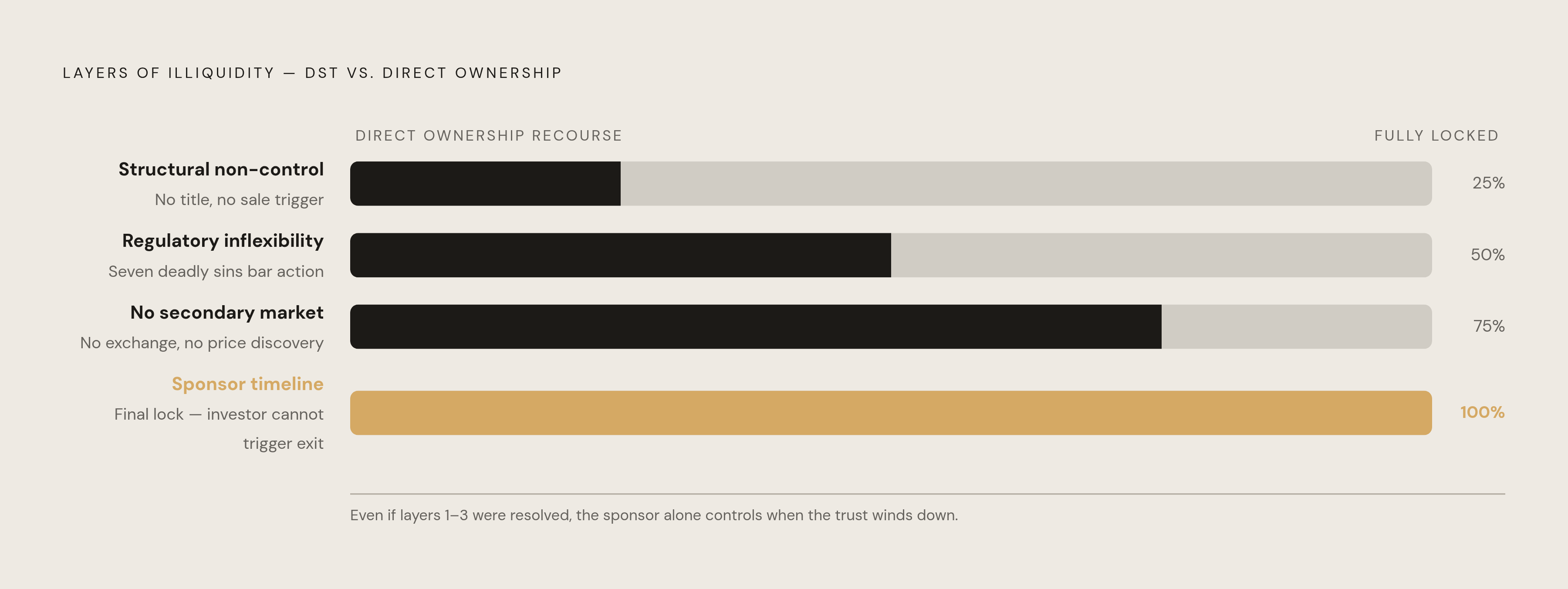
Direct real estate illiquidity is a single-layer problem: it takes time to find a buyer, negotiate a price, and close. DST illiquidity stacks four separate layers on top of each other, and each one closes off a different avenue of recourse.
The first layer is structural non-control. The investor owns a beneficial interest, not title, and can't initiate a sale, negotiate with a tenant, or redirect capital toward a better use. Kiplinger frames this as a backseat-driver problem: an investor who notices a deteriorating anchor tenant at a DST-owned shopping center has no lever to pull, no call to make, no vote to cast.
The second layer is regulatory inflexibility, courtesy of the seven deadly sins discussed above. Even if the sponsor wanted to reposition the asset in response to a market shift, the rules preventing new capital, new debt, and major capital improvements often stand in the way.
The third layer is the absence of a secondary market. No exchange exists for these interests, no clearinghouse, no standardized price discovery. An investor who wants out has to find a private buyer willing to step into an illiquid, non-controlling position, or wait for the sponsor to act.
The fourth layer is dependency on the sponsor's own timeline. The trust winds down when the sponsor decides it's time, based on the sponsor's fund lifecycle and market read, not the individual investor's need for cash.
Any one of these layers, alone, would be a manageable inconvenience. Together, they leave an investor with no practical recourse. The 2008 crash tested this directly: DST investors holding properties that lost significant value were left, as Kiplinger describes it, with diminished returns and in some cases substantial losses, their capital essentially locked up with no active secondary market to exit through. That's the piece's central point made concrete. DST illiquidity runs deeper than "real estate takes a while to sell."" It's a distinct category of risk with its own architecture, and it behaves differently under stress than plain vanilla property ownership does.
How fees erode the return buffer that investors implicitly rely on to compensate for illiquidity
Illiquidity is supposed to be compensated somehow, usually through a higher expected return relative to liquid alternatives. Fees quietly undercut that logic before the compensation ever shows up.
Upfront broker commissions on DST offerings commonly run 7 to 10 percent of invested capital, taken right at entry and immediately shrinking the effective capital base working on the investor's behalf. Layered on top of that are acquisition fees, ongoing asset management fees, and disposition fees at the back end. A DST projecting an 8 percent annual return that carries 2 percent in annual fees delivers an actual return closer to 6 percent, and across a 7 to 10 year hold, that gap compounds into a meaningful sum on any investment large enough to matter.
High upfront commissions drive this: they give brokers a reason to recommend DSTs regardless of whether the illiquidity profile actually fits the client sitting across from them. High upfront commissions give brokers a reason to recommend DSTs regardless of whether the illiquidity profile actually fits the client sitting across from them. And unlike a publicly traded REIT, where expense ratios appear in a standardized disclosure format, DST fee structures vary sponsor to sponsor and are not presented in a standardized disclosure format.
The interaction between fees and illiquidity is where the real damage happens. In a liquid investment, an investor who discovers fees are eating more than expected can sell and redeploy. A DST investor locked in for 7 to 10 years has no such option, so underperformance just compounds quietly in the background with no exit valve. Tax deferral is real and valuable, but it isn't automatically larger than the combined cost of fees and lost flexibility, and treating it as though it is amounts to skipping the actual math.
Where DSTs genuinely help, and the specific investor profiles for whom the illiquidity trade-off is rational
None of this means DSTs are a bad product. It means they're a specific tool for a specific problem, and the problem is usually time.
Under 1031 exchange rules, an investor has 45 days from the sale of relinquished property to formally identify replacement property. DSTs typically close within 3 to 5 business days, far faster than direct property acquisitions, which carry financing contingencies and inspection periods. That makes DSTs a useful fallback: an investor can list a DST as a backup identification alongside a primary direct-property target, cutting the risk of a failed exchange if the main deal falls apart at the last minute.
There's also a real case for investors who've built equity over decades and are simply done being landlords. Aging owners focused on preserving wealth rather than chasing return often value freedom from tenant calls and roof repairs more than they value control, and that's a rational trade, not a naive one. DSTs also open the door to institutional-grade assets, large multifamily portfolios, industrial buildings, national-tenant triple-net retail, that an individual investor with a modest amount of capital could never touch directly. And DSTs financed with non-recourse debt can satisfy the debt-replacement requirement in a 1031 exchange without the investor personally underwriting a new loan, which matters for anyone who wouldn't qualify for new financing on their own.
Some DST structures also include a built-in conversion option under Section 721 of the tax code: at wind-down, investors can exchange their DST interest for units in a broader REIT's operating partnership, gaining diversification across many properties without triggering a tax bill. That pathway doesn't eliminate the 7 to 10 year lock-up, but it does soften the endpoint by offering something more liquid on the other side.
The investor for whom this trade-off makes sense has liquid reserves sitting outside the DST, no expectation of needing that capital during the hold, a genuine desire to step back from active management, and a tax deferral benefit large enough to clearly outweigh fees and illiquidity combined. That profile is becoming more relevant, not less: the wealth transfer expected across generations in the coming decades, projected around $80 trillion by 2045 according to Plante Moran, is putting more capital in the hands of exactly this kind of investor, people looking to simplify holdings, defer gains, and hand off management without taking on new burdens.
What to scrutinize before committing capital: sponsor quality, fund structure, and the liquidity disclosures that matter
Since the investor can't control the asset, can't exit early, and can't renegotiate the trust's terms, the single most important decision is who gets trusted with all of that discretion. Sponsor vetting isn't a nice-to-have here, it's the primary risk-management lever available.
Look for sponsors with a track record that includes periods of market stress, such as the 2008 real estate downturn, when many DST investors experienced substantial losses. How a sponsor managed properties through that downturn says more about future behavior than any pro forma projection, because that's exactly the moment when the seven deadly sins start constraining what the trustee can actually do. Sponsors with deep experience in a specific property type, self-storage, multifamily, industrial, bring sharper operational judgment than generalists spreading thin across asset classes. And transparency isn't optional. A sponsor unwilling to lay out fees, timelines, and exit scenarios clearly in the offering documents is a red flag precisely because the investor has so little recourse once capital is committed.
The offering documents themselves deserve a close read on a handful of specific points. What actually triggers a liquidity event, a fixed date, a market condition, or pure sponsor discretion? Does the structure include a 721 conversion option at wind-down, or does the investor simply get handed sale proceeds and nothing else? What's the full fee stack, upfront commissions, annual management fees, disposition fees, and what does the net projected return look like once all of that is subtracted? And what happens, mechanically, if the property loses its anchor tenant or a major income source, given the limits the seven deadly sins place on the trustee's ability to respond?
DST investments are restricted to accredited investors, meaning individual income above $200,000 (or $300,000 jointly) or net worth above $1,000,000 excluding a primary residence. That threshold is a regulatory floor, not a liquidity analysis, and clearing it says nothing about whether an investor can actually withstand a decade of locked capital. The liquidity reserve conversation has to happen separately, and some DST programs require proof of it before accepting a subscription at all.
One more piece of the machinery sits upstream of the DST itself: the Qualified Intermediary handling the surrounding 1031 exchange. The QI holds exchange funds between the sale of the relinquished property and the DST closing, and how that firm operates, fund security, speed of opening the exchange, experience closing DST transactions specifically, determines whether an investor can actually capture that 3-to-5-day DST closing advantage inside the 45-day identification window. A QI that opens an exchange in minutes, keeps funds in segregated, FDIC-insured accounts, and has handled DST closings before removes a layer of execution risk that has nothing to do with the DST's own structure but can derail the whole exchange anyway. Deferred operates this way as a no-fee QI, sharing a portion of interest earned on held funds with the client and holding funds in individual FDIC-insured accounts with coverage well beyond what a typical exchange would require, which matters because none of the DST's speed advantages help an investor whose exchange infrastructure can't move at the same pace.