Qualified Intermediary Failure Risk and How to Protect Exchange Funds
Segregated accounts and dual-signature approval protect exchange funds when intermediaries fail.
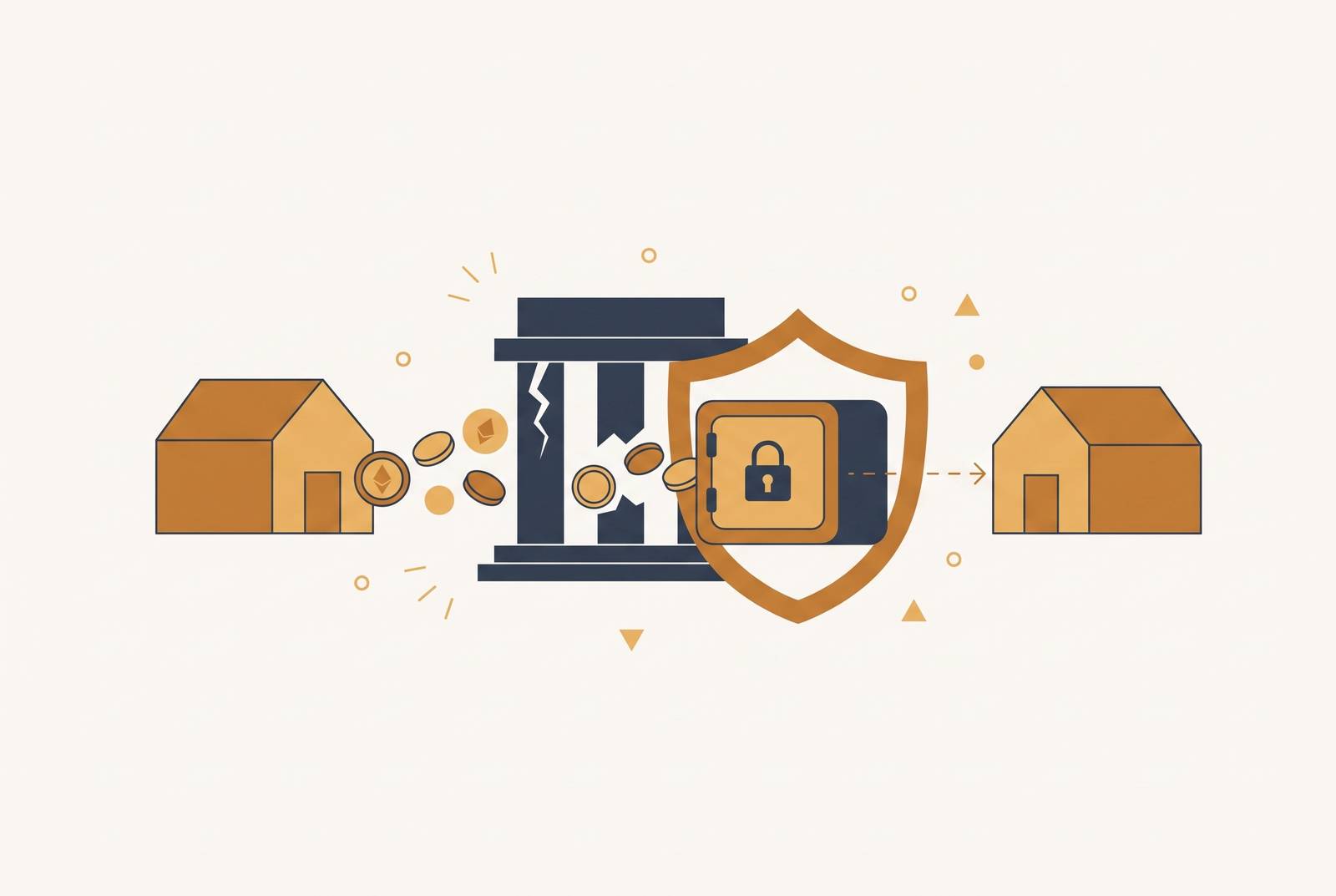
A qualified intermediary can open a 1031 exchange on the same day the property closes, but setup must be complete before closing. If the sale has already closed without an exchange in place, there is no retroactive cure. Speed alone is not protection. Before sale proceeds leave the closing table, investors need safeguards for fund custody, insurance, transparency, and accountability in case the qualified intermediary fails.
Why a QI failure is categorically different from other real estate risks
A qualified intermediary failure can destroy both the money intended for the replacement purchase and the tax deferral that made the exchange worthwhile. The investor suffers a doubled loss, owing tax on a gain that can no longer be reinvested.
The distinction comes from how exchange proceeds are held. In a standard exchange, funds pass directly from closing to the qualified intermediary, or QI, and remain there until the replacement purchase closes. One third party therefore controls the entire proceeds of an appreciated property sale. Overpaying or choosing a weak property can leave an investor with an asset whose performance may recover over time. A fund-level failure can leave no asset to recover, which makes its low probability a poor measure of its consequence.
How the IRS requires the exchange to be structured, and what that means for fund exposure
Treasury Regulation 1.1031(k)-1(g)(4) establishes four conditions for the QI safe harbor. The intermediary must not be a disqualified person and must enter into a written exchange agreement limiting the taxpayer’s rights to the funds. It must also acquire and transfer the relinquished property, then acquire and transfer the replacement property on the investor’s behalf. Financial strength requires assessment beyond these conditions of the exchange structure. Actual or constructive receipt of sale proceeds defeats the deferral and makes the gain taxable in the year of sale.
Treasury Regulation 1.1031(k)-1(k) prevents disqualified persons, including the investor’s own CPA, attorney, broker, or employee, from serving as QI. The investor must therefore entrust proceeds to an independent party with whom there may be no prior relationship. The exchange agreement restricts access to those proceeds. Signs of financial distress do not give the investor an unrestricted right to retrieve the money mid-exchange.
Both the 45-day identification period and the 180-day exchange period start when the relinquished property transfers. An attorney or QI cannot extend them, and ordinary transaction difficulties do not provide relief. Revenue Procedure 2018-58 provides specified postponements for circumstances including federally declared disasters and terroristic or military actions.
What the regulatory gap actually looks like — and why it persists
No federal agency licenses or oversees qualified intermediaries as custodians of exchange funds. There is no federal minimum capital requirement. A firm can enter the business without demonstrating solvency, experience, or capital adequacy to a federal QI regulator. A handful of states require registration, fidelity bonds, or proof of solvency, but most impose no requirements at all. How well the funds are protected depends largely on which firm the investor chooses.
The IRS defines the procedural conditions for the safe harbor. It does not prescribe how a QI must protect the cash, what reserves it must maintain, or whether it may invest exchange funds. Procedural compliance and custodial safety are separate questions. Under these rules, an exchange can have all the right documents while an unsafe institution holds its proceeds.
Investors selecting a QI today face the same absence of federal oversight that investors faced in 2008. The Federation of Exchange Accommodators provides voluntary standards, but membership is optional and enforcement is self-regulatory. Investor-level due diligence supplies the protection that the federal framework does not.
What LandAmerica's collapse demonstrated about commingled funds
LandAmerica Financial Group filed for bankruptcy on November 26, 2008. Its subsidiary, LandAmerica 1031 Exchange Services, Inc., or LES, filed the same day. LES had invested a portion of client exchange funds in auction rate securities. When that market froze, a substantial portion of the funds became illiquid, preventing timely completion of exchanges. Money needed for property purchases was no longer available when required.
Five months later, a bankruptcy court ruled that the vast majority of customer funds legally belonged to LES. Those funds would be distributed among creditors of the bankruptcy estate. The investors became general unsecured creditors, entitled only to a pro-rata share with other unsecured claimants. Most of the 450 exchanges failed. Investors who had not requested segregated accounts recovered only a fraction of their funds after taxes, attorney fees, and interest costs.
Investors with segregated funds did not depend on acting faster after the bankruptcy or making a more forceful claim. Their protection arose because those funds were not on LES’s balance sheet in the first place.
The four structural safeguards that would have protected LandAmerica's investors
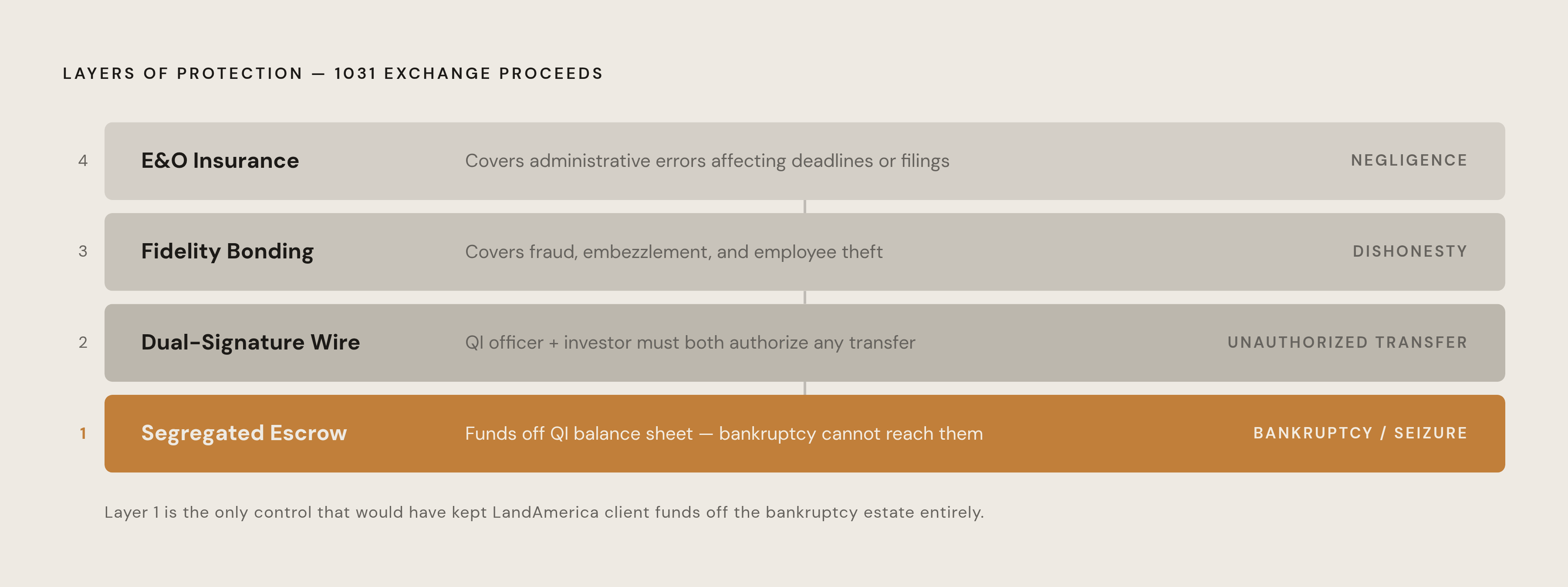
The lesson for investors is to require protections that work as a system. Segregated qualified escrow accounts keep funds held separately under the investor’s name or exchange identifier off the QI’s balance sheet and out of the firm’s assets in bankruptcy, preventing those funds from becoming the intermediary’s property as they did at LES. Commingled accounts instead pool funds with operating cash or other clients’ money. Investors should require segregation in writing before signing, with funds held at an FDIC-insured institution.
Bank insurance requires its own examination. Standard FDIC coverage is far below the proceeds of many commercial exchanges, so the bank’s insured status alone does not establish full protection. Investors should check whether sweep programs or other qualified escrow structures cover their funds above the standard limit. The relevant figure is coverage for the investor’s funds. Segregation and deposit insurance address different exposures and should not be treated as interchangeable.
Dual-signature wire authorization closes a different gap. Requiring both a QI officer and the investor, or the investor’s counsel, to approve a wire prevents an employee from redirecting funds unilaterally. Investors should ask whether this control is standard or available on request. Fidelity bonding then addresses losses from dishonest acts, including fraud, embezzlement, and employee theft. Investors should check the bond amount, carrier, and per-claim coverage against the size of their exchange to see how much protection the bond offers.
Errors and omissions insurance addresses negligence. It covers a separate class of failures, including administrative errors affecting deadlines, contract assignments, or filings. A fidelity bond does not replace E&O coverage. Investors should check that both policies are in place, how much they cover, and whether they are up for renewal. Their voluntary status in most states makes absence a disqualifying signal.
How to vet a QI's financial stability and institutional accountability before signing
Investors should distinguish legal eligibility from broader financial independence when assessing a QI. Ownership by, or financial entanglement with, a brokerage, lender, or title company raises questions about conflicts and shared exposure to the real estate market. An affiliation is not a substitute for financial strength. Investors should assess whether distress elsewhere in the organization could undermine confidence in the intermediary holding exchange funds.
Financial history helps frame that assessment. Investors should ask about regulatory actions, shortfalls in client funds, and civil judgments involving exchange proceeds. A firm that has worked through several market cycles has shown it can survive stress, while a newer firm has yet to build that record. FEA membership adds a voluntary commitment to ethics and continuing education. Investors still need to check how the funds are held and what the insurance covers.
Transparency should be available before the agreement is signed. A credible QI should identify the bank, explain the account structure, and disclose the interest rate earned on the funds throughout the exchange. Evasive answers about location, investment, or return are warning signs. The same scrutiny applies to setup speed, particularly for a same-day or at-closing opening. Investors should confirm that the QI can complete setup before the relinquished property closes, because processing documents afterward cannot repair the timing failure.
Speed also depends on who owns the file. A commissioned salesperson handing work to a processing team introduces handoffs at sensitive procedural points. Investors should establish whether one dedicated Exchange Officer will handle the exchange from first call through closing. That officer’s experience and accessibility help catch problems before they become failures.
The hidden fee structure that misaligns most QIs with the investors they serve
Most firms charge $750 to $1,500 for a standard delayed exchange and substantially more for a reverse exchange. That quoted fee may not be the largest cost. At most firms, the QI retains all or most of the interest earned while it holds the proceeds. For a large commercial exchange using the full exchange period, retained interest can dwarf the administration fee.
This model creates an incentive to keep rates opaque. An investor who knows what the account earns can compare terms and negotiate, while an investor shown only the flat fee cannot evaluate the full economics. Investors therefore need to ask both where the funds are held and what they earn. They are different scales of the same information imbalance. Concealing either leaves the investor unable to assess how custody arrangements serve the QI’s revenue interests.
Investors should evaluate the quoted service price alongside the rate earned, whether it is published or negotiated, and how much interest the firm retains or passes through. Interest sharing also has a tax consequence. Interest credited to the investor is taxable income in the year received even when the property gain remains deferred. Investors should confirm that treatment with their tax advisor when comparing arrangements.
What investors can verify before, during, and after handing over exchange funds
Before signing, investors should get the proposed safeguards in writing. The immediate priority is confirmation that setup will precede the relinquished property closing. The agreement should establish segregated custody and dual-signature wire authorization, supported by the bank’s identity and applicable FDIC or sweep coverage. Proof of insurance should name the fidelity carrier and show the bond amount, E&O limits, and whether the policies are up for renewal. Before funds move, investors should also ask about past fund disputes, who gets the interest, who handles the file, and who can be reached outside standard business hours.
After funds move, oversight should remain active. Investors should confirm the identification deadline in writing and submit a written, signed identification notice on or before day 45. Under Treasury Regulation 1.1031(k)-1(c), oral identifications do not count. For a fourth-quarter relinquished-property closing, investors should file a tax return extension to preserve the full exchange window, because the period ends at the earlier of the statutory deadline or the return due date. Account statements or a portal should show the fund balance and location throughout that period.
Access for advisors strengthens that ongoing review. A real-time portal lets a broker, wealth manager, or attorney examine fund status without relying solely on the QI’s verbal account. A firm unable to provide continuing visibility presents a warning signal. The original selection decision is not enough.
Cancellation terms also belong in the advance review. Investors should establish how funds will be returned and whether accrued interest will be paid to them or retained by the QI. California FTB rules require QI withholding when an exchange fails and no exemption applies, so California investors should confirm the firm understands the withholding and form obligations. Failure does not erase the tax liability, and the gain becomes taxable in the year of the relinquished sale. Treating QI oversight as an ongoing responsibility gives investors a practical way to maintain control over the risks they can examine before the next deadline arrives.
Sources
- Qualified Intermediary: 2026 Complete Guide to QI Role, Selection, and Bond Requirements
- Qualified intermediary
- Qualified Intermediary 1031: 2026 QI Selection, Fees, and Compliance Guide
- What Is a Qualified Intermediary in a 1031 Exchange? - FedLaws
- 1031 Exchange Explained: Rules, Timeline, and Guide for Property Owners