Using Reverse 1031 Exchanges to Acquire Before Selling
Buying property first requires a titleholder, tight coordination, and careful timing to qualify.

A reverse 1031 exchange lets an investor buy a replacement property before selling the relinquished property and still keep tax deferral. Doing so takes a separate legal structure as well as a change in the order of closings. Clean execution requires the intermediary, titleholder, financing, and documents to be in place before the purchase moves ahead.
The competitive-market problem a reverse exchange solves
An investor finds the right property but has no buyer for the asset being sold. The seller will not wait for that sale. Multiple offers or a demand for a quick close can make the usual forward-exchange sequence impractical, because it requires the relinquished sale to precede the replacement acquisition. An improvement exchange has a similar timing problem when construction or renovation must take place before the investor takes title.
A reverse exchange bridges that gap through an independent third party that acquires and holds property while the investor completes the other side. The opportunity need not wait for a buyer. In return, the investor must arrange for title to be held, provide funding, and do more to keep everyone working together. That work starts before the purchase, while the investor still has time to set up the transaction correctly.
The legal foundation: what Rev. Proc. 2000-37 actually authorizes
Revenue Procedure 2000-37 establishes the IRS safe harbor for reverse-exchange parking arrangements. The statutory text assumes a forward exchange and leaves its reverse without explicit authorization. Before 2000, taxpayers had to rely on facts-and-circumstances arguments, and Tax Court results varied. The procedure supplied predictable conditions under which a separate titleholder could hold property pending completion of the exchange.
The safe harbor is not the only possible route to qualification. An exchange outside it may qualify under general like-kind exchange principles, but the taxpayer must do more to show intermediary independence and tax ownership. That distinction has direct consequences for transaction risk. The Tax Cuts and Jobs Act of 2017 also limited Section 1031 to real property, effective January 1, 2018. For practical planning, the safe harbor is the reliable path, and the mechanics that follow are designed to remain within it.
The two structures: parking the replacement vs. parking the relinquished property
In Exchange-last, the replacement property is parked with an Exchange Accommodation Titleholder, or EAT. The investor then sells the relinquished property, and the EAT transfers the replacement to the investor at completion. This is the more common structure in practice. It preserves the investor’s ability to use traditional financing on the new asset and avoids an interim deed transfer of income-producing relinquished property. The acquisition is funded through a documented investor loan to the EAT or independent third-party financing secured by the EAT.
Exchange-first instead parks the relinquished property with the EAT, while the investor acquires the replacement directly. The parked property is then sold to a third-party buyer within the 180-day window, with proceeds passing through the qualified intermediary, or QI. Improvement arrangements have another rule for who holds title when work must be done before the investor receives the replacement. Completed improvements count toward exchange value only when the work is substantially complete before transfer.
Step-by-step mechanics of the exchange-last structure
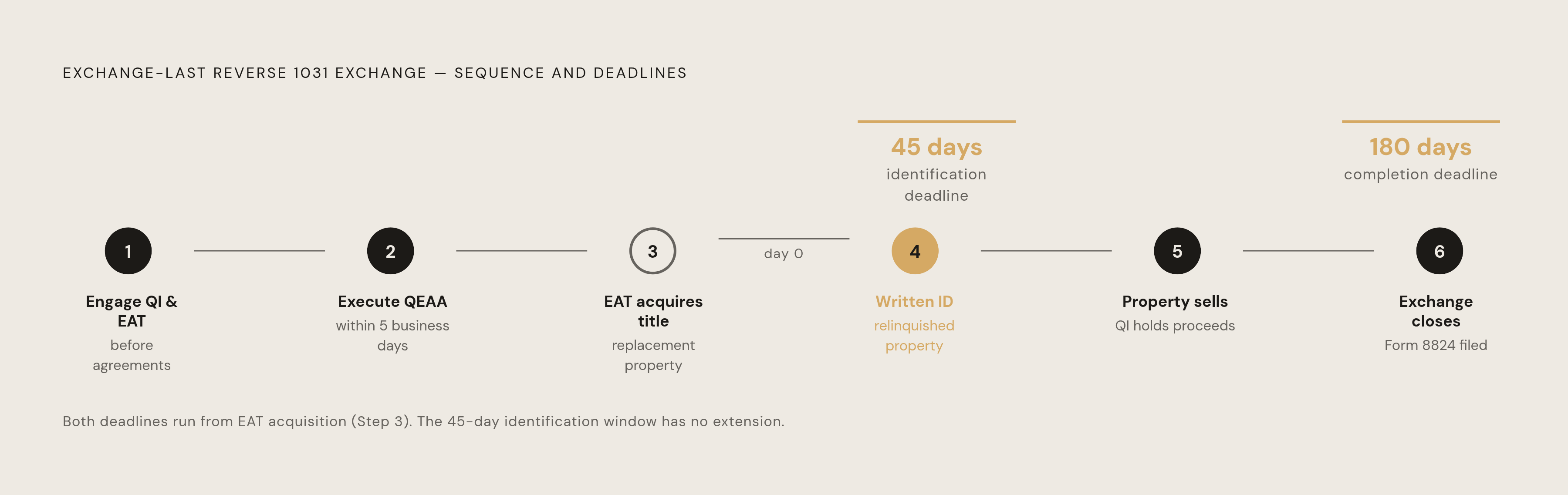
The first step is engaging a QI and arranging an EAT before signing replacement purchase agreements. The QI prepares the exchange documents and coordinates the titleholder, typically a single-purpose LLC formed for the transaction. Signing in the investor’s own name before arranging the exchange creates the risk that the purchase will be treated as a direct acquisition.
The second step is preparing and executing the Qualified Exchange Accommodation Arrangement, or QEAA. It must state that the EAT holds the property as an accommodation party and that the arrangement is intended to qualify under the safe harbor. Execution is required within five business days of acquisition. The agreement should therefore be drafted and ready before closing.
The third step is the EAT’s acquisition of legal title to the replacement. Funding moves through a documented loan from the investor or third-party financing, with the loan structure addressed in the QEAA. The fourth step is written identification of the relinquished property to the QI within 45 calendar days of that acquisition, even when the intended sale property has always been clear.
The fifth step is selling the relinquished property to a third-party buyer, with the QI holding the proceeds. The investor cannot receive or control those funds directly without triggering tax recognition. The sixth step completes the exchange through the EAT’s transfer of the replacement and the QI’s application of the sale proceeds. The transaction is reported on IRS Form 8824 with the return for the year of relinquishment. These steps are interdependent, so a failure in an earlier document, title transfer, or funds movement can undermine the later closing.
The 45-day and 180-day deadlines and the traps inside them
The identification window begins when the EAT acquires the parked replacement property and lasts 45 calendar days. Within it, the investor must identify the relinquished property in writing to the QI. The completion window starts on the same purchase date and runs for 180 days. Completion requires the sale, application of proceeds, and transfer of the replacement.
The most immediate trap is using the wrong starting point. Weekends and holidays do not extend the identification period, and knowing which property will be sold does not replace written identification. Investors should confirm with the QI and tax counsel how the identification is documented in their structure. Missing the completion deadline by a single day defeats the safe-harbor timetable.
The tax return deadline requires separate attention. When the relinquished sale closes in the fourth quarter, the return due date may arrive before the exchange period ends. Filing an extension on Form 4868 for individuals or Form 7004 for entities preserves the full 180-day window. Without it, the available period can end early. The reverse sequence makes this easy to overlook because the sale may occur much later in the year than the initial acquisition.
Boot, basis, and the same-taxpayer rule applied to a reverse exchange
For full deferral, the replacement value must be at least as much as the relinquished value, and cash or non-like-kind property the investor keeps can create taxable boot. Reverse timing adds a particular exposure because replacement value is locked at the EAT acquisition date. A later sale above the expected price can therefore create a shortfall that was not apparent when the replacement closed.
Debt must be worked out on its own, especially when the investor funds the EAT with cash while the relinquished property still has a mortgage. Debt relief on that sale must be offset to avoid mortgage boot. The funding plan cannot stop at the purchase price. All relinquished proceeds must also be reinvested. Boot is taxable in the year of exchange under the same principles that apply to a forward exchange.
The same-taxpayer rule likewise survives the change in sequence. The taxpayer selling the relinquished property must acquire the replacement when the EAT transfers it. An ownership restructuring during the parking period can break that continuity. Basis also carries forward from the relinquished property, with changes for boot, and does not reset to replacement fair market value. The deferred gain remains a future liability, recognized on a later taxable sale or eliminated at death through the IRC Section 1014 step-up.
Why reverse exchanges cost more and how to evaluate what you're paying
Reverse exchanges need a second legal entity, more title work, and more time to bring everyone’s work together. Their QI fees are consequently often a substantial multiple of forward-exchange fees. Those fees should be budgeted before the deal is committed. The quoted service charge covers only part of the cost, since who keeps the interest and how the purchase is funded can add costs of their own.
Interest retained by the intermediary can exceed the quoted fee on a large transaction. Under a conventional retention model, the QI keeps the interest on proceeds it holds, and the investor may get no share of that interest or be told how much it earned. Investors should ask what rate the account earns, who retains the interest, and whether any portion is shared. The answer belongs in the cost comparison. The relevant holding period is the time the QI actually holds proceeds, rather than the entire period during which the EAT owns the replacement.
The EAT must fund the replacement purchase first. That can require a short-term loan or an injection of investor capital while the relinquished property remains unsold. The interest expense on that bridge should be modeled against the tax deferral benefit, rather than treated as incidental to the exchange fee.
Selecting a QI experienced in reverse exchanges — what to verify and what disqualifies
Investors should start by ruling out candidates who have no reverse-exchange experience. Those who have worked only on forward exchanges still need experience with EAT structures and accommodation documents. Disqualified-person rules also exclude specified advisers who served the investor during the prior two years, including attorneys, accountants, real estate agents or brokers, and investment bankers or brokers. The rules also exclude related parties above the ownership threshold that applies, as well as employers and employees.
Credentials come next, with attention to the person responsible for the file. Investors should require a lead officer with the Certified Exchange Specialist designation, active Federation of Exchange Accommodators membership, and demonstrable reverse-transaction experience. EAT formation and QEAA preparation deserve particular scrutiny.
Fund protection then requires direct verification. Proceeds should be held in segregated, named-client accounts rather than mixed with other client funds or operating capital. Investors should check that federal deposit insurance goes beyond the standard single-account limit and that fidelity bond and errors-and-omissions coverage is enough for the transaction. The QI industry has no federal licensing or regulation. Because some states impose bonding or registration requirements, state compliance also belongs in the review.
The service model must support a shared timeline among the investor, EAT, QI, lenders, title companies, and relinquished-property buyer. Repeated staff handoffs introduce coordination risk at each transfer. A single senior officer handling the file from initial engagement through closing avoids that handoff exposure. Selection should begin before the replacement is under negotiation, so that vetting and the QEAA framework do not compete with the seller’s closing schedule.
The five execution mistakes that disqualify reverse exchanges
The first failure scenario begins with an investor signing the replacement purchase agreement in their own name before engaging the QI or arranging the EAT. The exchange team is then asked to retrofit a parking structure onto a direct purchase. The order of events creates the problem. If the investor is treated as having acquired the replacement directly, the intended exchange structure is lost.
The second occurs when the EAT closes successfully but the QEAA is still unsigned after five business days. A completed purchase does not cure the missing agreement. The arrangement falls outside the safe harbor, so it must qualify under general like-kind exchange principles. That is a substantially more uncertain position than compliance with the accommodation procedure.
The third occurs when everyone knows which asset will be sold, so no one submits written identification within 45 calendar days. Familiarity with the property substitutes for the required document. There is no extension for that omission. The failure arises from treating an agreed commercial plan as if it were completed tax documentation.
The fourth occurs when ownership is reorganized during the parking period and a different taxpayer receives the replacement from the one that sold the relinquished property. An LLC conversion, partnership change, or trust restructuring can create that mismatch. The closing documents may otherwise be ready to proceed. They cannot repair a break in taxpayer continuity.
The fifth occurs when a fourth-quarter sale leaves the exchange unfinished at the return deadline and no extension is filed. The investor has planned around 180 days but has not preserved the full period. Once the filing deadline passes, that mechanical omission has no cure. These failures share inadequate preparation before the acquisition opportunity appears. The QI relationship belongs in place before the investor enters the market.