Compound Deferral Across Multiple 1031 Exchanges
Reinvesting tax bills as equity lets gains compound across multiple property swaps.
The deferred tax balance as an interest-free loan that compounds over time
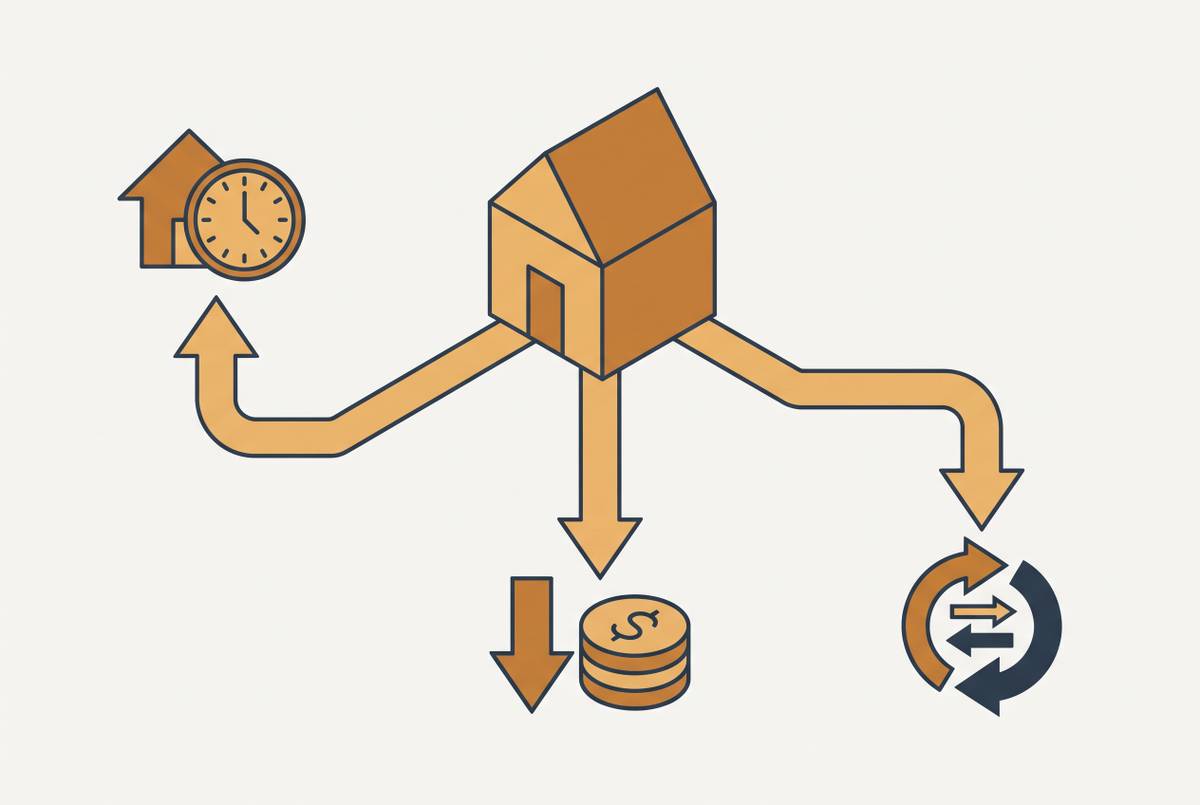
A 1031 exchange doesn't erase a gain. It defers it by folding the gain into the replacement property's adjusted basis. Take a property that sells for $2,000,000 against an adjusted basis of $900,000, after years of depreciation have worn that basis down. Sell it outright, and the investor owes capital gains tax and depreciation recapture at closing, due immediately, no negotiation possible. Running it through a 1031 exchange instead moves the entire embedded gain into the new property's basis, with depreciation on the replacement calculated off that lower, blended number going forward.
The dollars that would have gone to the IRS stay invested instead. They keep earning appreciation, keep throwing off cash flow, keep generating depreciation deductions, and none of it costs the investor a cent in interest. The IRS charges nothing for the deferral. It just waits. Set the two paths side by side: the investor who sells outright loses a real chunk of proceeds to capital gains tax, depreciation recapture, and often state tax, then reinvests whatever's left. The investor who exchanges reinvests the whole amount, tax bill included, because the tax bill hasn't come due.
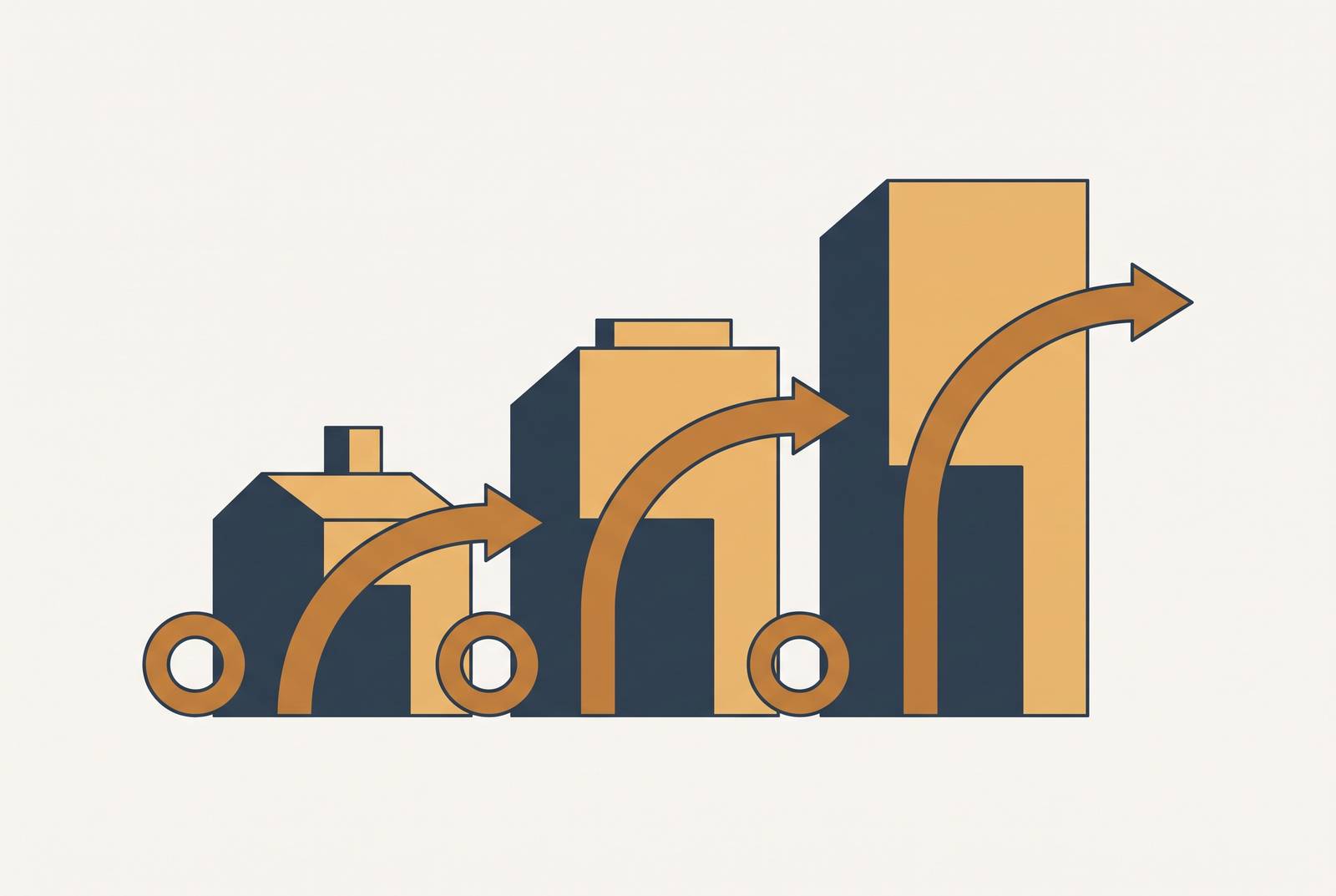
Running that twice makes the effect multiplicative. It's multiplicative. The deferred tax from the first exchange becomes part of the equity funding the second exchange, so a bigger base produces more absolute appreciation than the first property did. The deferred balance going into exchange three is larger still, not just in dollar terms but as a share of the whole portfolio. Reported industry figures put the annual scale of this activity at $13.2 billion in tax deferrals nationally. This is a mainstream tool sitting in plain sight in the tax code, used routinely rather than confined to a handful of sophisticated investors. It's a mainstream tool sitting in plain sight in the tax code, and most people who qualify for it never use it because nobody explained the mechanics clearly enough.
Federal deferral is universal, but states don't all play along, and anyone assuming otherwise is setting up a bad surprise. Some states impose their own conditions that can trigger deferred gains under circumstances that wouldn't matter at the federal level, and not every state conforms fully to the federal deferral. Anyone building a multi-decade chain needs to track state rules with the same discipline as federal ones, because a single state-level miss can undo years of careful deferral.
As for what qualifies: since the Tax Cuts and Jobs Act of 2017, Section 1031 only covers real property, not personal or intangible property. But "like-kind" within real estate is broader than most people assume. A rental home can exchange into raw land. A shopping center can exchange into an office building. Farmland can exchange into an industrial warehouse. As long as both properties are held for investment or business use, the IRS doesn't care that they look nothing alike. As of 2026, the full deferral remains available with no dollar cap, which is the current state of the law as this goes to print.
The timelines that govern each link in the chain, and the traps that break it
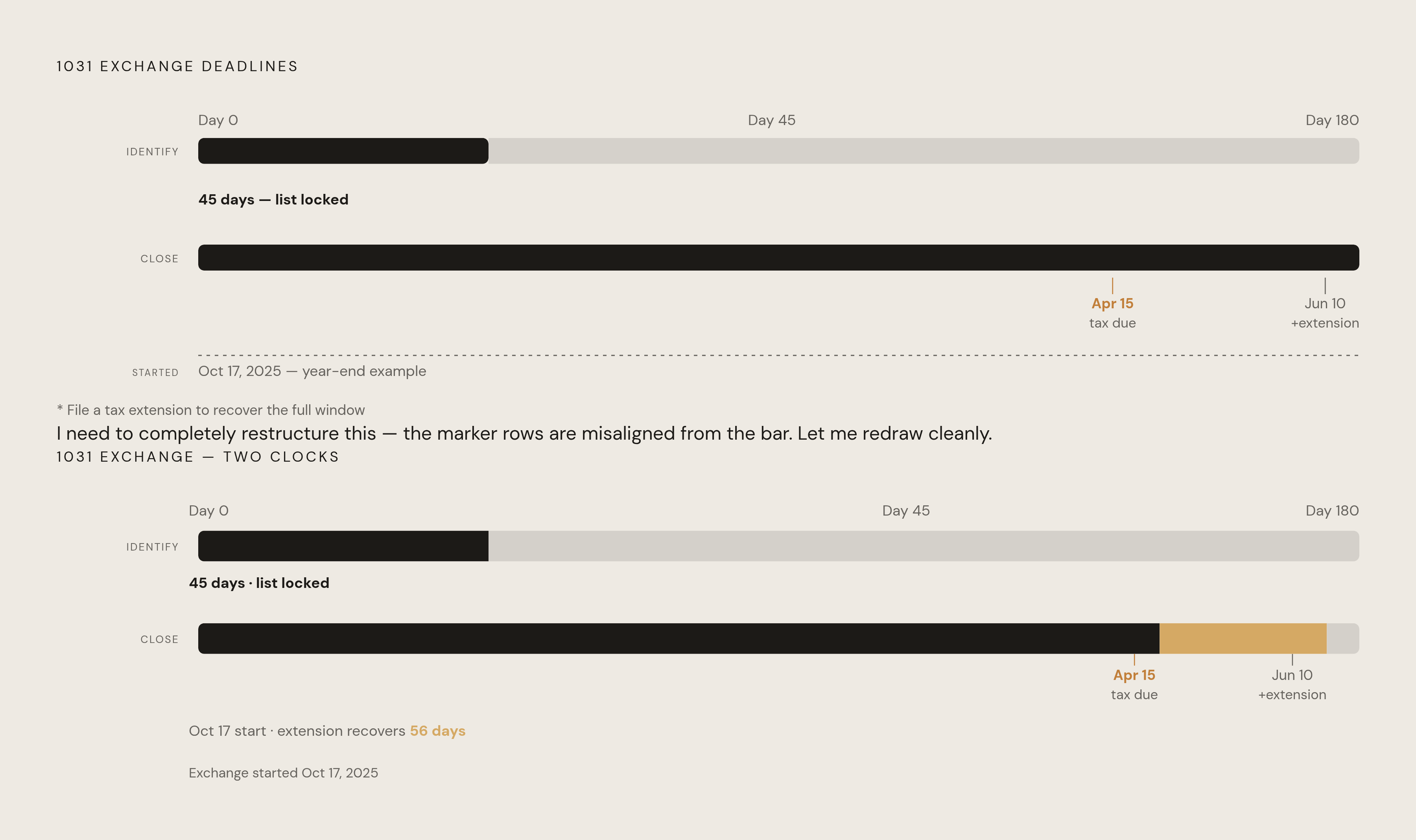
Every exchange runs on two clocks, and both start the moment the relinquished property closes, a date the rules call Day 0. The investor has 45 days to identify replacement candidates and 180 days total to close on one. Every calendar day counts, weekends and holidays included, and there's no rounding in the investor's favor.
Identification carries its own rules inside that 45-day window. Standard practice allows up to three replacement properties to be named. An alternative rule allows more than three, as long as the combined value of everything on the list stays within a defined ceiling relative to the value of the property just sold. A third rule drops the count restriction entirely, provided the investor actually closes on substantially all of the total value identified. In every case, the properties have to be named precisely, by address, not described loosely as "a commercial property in the Denver metro." The list can be revised freely until day 45, and after that the investor is locked into whatever's on paper. Get the identification notice to the qualified intermediary before the deadline expires on day 45, leaving no time to fix a last-minute mistake.
Year-end sales carry a trap that catches experienced investors off guard: the 180-day window gets cut short if the investor's tax return comes due first, and whichever date lands earlier controls. Exchanges started on or after October 17, 2025 and through the end of that year face a completion deadline of April 15, 2026, not the full 180 days, shaving weeks off the window. The prior tax year shows the same pattern. An investor closing a relinquished property on or after October 18, 2024 had to close the replacement by April 15, 2025, well short of the full 180-day window, with the 180-day date falling as late as June 29, 2025 for some year-end closings. Filing a tax extension before the return's due date recovers the lost time; for a 2025 exchange, an extension pushes the deadline out to June 10, 2026.
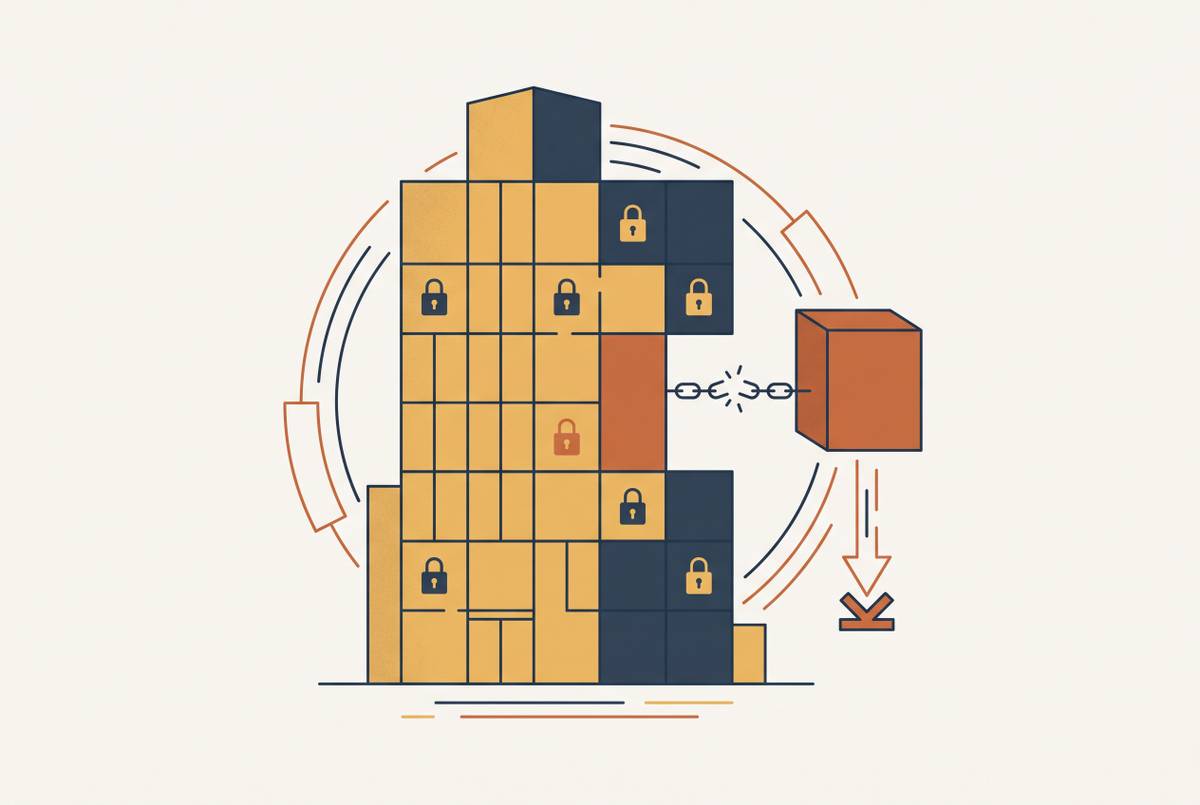
The rule that ends more exchanges than any deadline is constructive receipt. The investor can never touch the sale proceeds, not even briefly, not even by accident. A wire that lands in the investor's own bank account for a single day disqualifies the whole exchange and makes the entire gain taxable immediately, with no way to undo it. The IRS reads "receipt" broadly: money that's technically accessible through an attorney, an escrow agent, or an entity the investor controls counts the same as money in the investor's own hands. That's why the exchange agreement and the qualified intermediary's paperwork have to be signed before the relinquished property closes. Trying to convert a completed sale into an exchange after the fact doesn't work, no matter how fast someone moves.
Title has to stay consistent too: whoever sold the relinquished property has to be the one who buys the replacement. And any boot, meaning cash not reinvested, net debt relief where the old mortgage exceeds the new one, or other non-real-estate value received, becomes taxable even inside an otherwise valid exchange. Boot narrows what's deferred rather than blowing up the whole transaction, but in a chain, boot leakage at any single link shrinks the capital base compounding through every exchange after it. A small mistake early costs far more than the same mistake made on exchange one.
Disaster relief occasionally serves as a release valve. In 2025, the IRS extended both deadlines for taxpayers in Los Angeles County with a deadline falling on or after January 7, 2025, pushing the 45-day deadline to October 15, 2025, and the 180-day deadline to the later of October 15, 2025 or 120 days past the original date. That relief exists for defined circumstances only. Nobody should plan a chain around the assumption that relief will show up when needed.
How sequential exchanges accumulate equity across decades
One illustration circulating in the industry lays out the arc: an investor buys an apartment building in 1995 for a relatively modest sum, exchanges it multiple times over the following decades, defers gains through each transition, and ends up holding a portfolio worth roughly $3 million by the time of death. At that point, heirs inherit at a stepped-up basis, and the entire deferred tax liability, built up across every exchange in the chain, disappears.
No single transaction in that chain produced the outcome. Each exchange let the investor redeploy the full appreciated value, tax bill included, into a bigger asset, and because a bigger asset generates more appreciation in absolute terms, the deferred balance grew faster with each cycle than the one before it. That's the compounding at work: not a fixed rate applied repeatedly, but a base that gets larger every round, producing bigger gains on a bigger base each time.
The chain also opens up flexibility that a buy-and-hold strategy doesn't offer. Property type can shift at every exchange: raw land into income-producing multifamily, single-family rentals into commercial, retail into industrial, driven by market conditions and income goals rather than tax consequences, since the tax consequences are deferred either way. Geography can shift too. A property in a slowing market can become a property in a growing one without triggering a taxable event. Each exchange doubles as a chance to upgrade asset quality, improve cash flow, or simplify management, so the wealth compounds and the operational picture improves at the same time.
Acquiring a replacement property through a 1031 exchange doesn't block a cost segregation study on that same property. Under the One Big Beautiful Bill Act, 100% bonus depreciation is back, so an investor can claim accelerated depreciation on the new property in the very year it's acquired. Stack that against the reduced basis coming in from the exchange, and two distinct tax benefits sit on the same asset: deferred gain lowering the basis, and fresh accelerated depreciation generating new deductions. The recapture on those accelerated deductions becomes part of the liability carried into the next exchange, so this stacking approach favors investors who plan to keep exchanging rather than sell outright somewhere down the line. Selling instead of exchanging after stacking bonus depreciation brings the recapture bill all at once, defeating the purpose of stacking.
Some investors layer in borrowing against the appreciated portfolio alongside the exchange chain, pulling out liquidity without triggering any gain. That runs as a separate track alongside the exchanges themselves, and it should be treated as its own decision rather than folded into exchange strategy.
Why the step-up in basis is the intended exit when the chain ends
Under current law, an heir who inherits real estate gets a basis reset to the property's fair market value on the date of the owner's death. Since taxable gain is just sale price minus basis, an heir who turns around and sells at that fair market value owes no capital gains tax at all, and the entire deferred liability built up over however many exchanges came before it vanishes in that instant.
That's deliberate design, meant to encourage long-term investment in real estate and the transfer of wealth between generations. It also means the compounding chain and the step-up aren't two separate strategies bolted together. They're one strategy: the bigger the deferred balance sitting in the estate at death, the more tax gets eliminated at the moment of inheritance. Anyone treating the chain and the step-up as unrelated decisions is missing the point of building the chain.
For investors who want out of active property management without breaking the chain, there's a pathway through a Delaware Statutory Trust. A 1031 exchange moves the investor into a DST, and a later exchange mechanism may allow that DST interest to convert into a more passive real estate holding structure. That route offers institutional, passive exposure to real estate while still preserving the step-up considerations at death, and it hands beneficiaries more flexibility than they'd get inheriting a building directly. The direction of the market is toward lower friction and more transparency, with the 1031 exchange functioning less as a single reinvestment decision and more as a running piece of estate planning.
Lawmakers have floated capping the amount eligible for deferral, with proposed thresholds that would limit the amount eligible for deferral per taxpayer. As of 2026, no such cap has passed. Investors sitting on long exchange chains should watch legislative movement and talk to tax counsel before assuming the current rules hold indefinitely. Administratively, Form 8824 has to be filed with the tax return for every year an exchange happens. This requires keeping a careful log of every sale date, identification date, and closing date across what might be a chain running twenty or thirty years.
Choosing a Qualified Intermediary for an exchange chain, and what the stakes are
None of this works without a qualified intermediary. Without a QI holding the sale proceeds under an exchange agreement signed before closing, the money reaches the investor's constructive receipt and the whole exchange fails, permanently, with no fix available afterward.
The QI's job runs through the entire transaction: preparing the exchange agreement and assignment documents before the relinquished property closes, holding the proceeds in an account separate from the investor's own funds for the full exchange period, tracking the 45-day and 180-day deadlines, and coordinating with the closing agent or title company on the replacement purchase. Certain people are barred from serving as QI by law, including the investor, anyone who has recently acted as the investor's agent in a capacity such as attorney, accountant, real estate agent, or broker, and related parties, including family members and any entity where the investor holds more than a 50% stake.
QIs operate with no federal oversight, and in most states, no licensing requirement and no bonding requirement, despite routinely holding sums that run into the millions of dollars for weeks or months at a time. Banks answer to federal banking regulators. Brokers answer to securities regulators. Insurance companies answer to state regulators. QIs answer to nobody until something has already gone wrong, and by then the money is usually gone. That gap between the money at stake and the regulation covering it is the single biggest risk in the entire chain, and closing it falls entirely on the investor.
Confirm a few things before handing over funds. Are they held in a segregated account set up for that specific exchanger alone, which protects the money if the QI runs into financial trouble? Is the QI fidelity bonded against fraud, theft, or forgery? Does it carry errors and omissions insurance in case something goes wrong procedurally during the exchange period? The funds should sit in FDIC-insured accounts, with the investor aware of the coverage limit and confirming that the structure maximizes protection per depositor.
Service quality matters just as much as fund security, and it's harder to check in advance. Is there a dedicated, experienced person handling the file from open to close, or does it get handed off to whoever's available that week? Is that person paid on commission, an arrangement that can push incentives away from getting the exchange done correctly and on time? What are the actual support hours, particularly for a closing that lands near a deadline or in a time zone the QI doesn't normally operate in? And can the exchange be opened same-day, even at the closing table, if the timeline gets tight?
Fee structure is easy to overlook and deserves close scrutiny. QIs typically charge a fee for their services, and then retain other economic benefits from the held funds for the entire exchange period. Since that period can run up to 180 days, and the amounts held can be substantial, that interest is real money, and in a fair reading of the arrangement, it belongs to the investor who's taking on all the risk, not to the intermediary holding the funds for a few months. Anyone building a chain of exchanges across a career should ask a prospective QI directly how it handles that interest. The answer says a lot about who the arrangement is actually built to benefit.
Sources
- 1031 Exchange Explained: Rules, Timeline, and Guide for Property Owners
- 1031 Exchanges Started In 2024 Dont Ruin Your 1031 Exchange | Security 1st
- The 1031 Exchange Timelines
- Navigating Interest Income in 1031 Exchanges: Strategic Considerations for Tax Deferral
- realized1031.com
- realized1031.com
- lawpensacola.com
- getequity1031.com