Depreciation Recapture and the 1031 Exchange Shield
A 1031 exchange defers all recapture tax, not just capital gains.

Depreciation recapture is the tax bill most real estate investors don't see until it's already due. It's assessed at a flat 25% federal rate, separate from and stacked on top of capital gains, and after a decade of ownership it often outweighs the gains tax. A properly structured 1031 exchange is the only mechanism in the tax code that defers it, but "properly structured" is doing a lot of work in that sentence, and most of the ways an exchange goes wrong trace back to a misunderstanding of what recapture actually is.
How depreciation accumulates and is recaptured at sale
The IRS lets owners of investment or business-use property deduct a portion of the building's value every year, on the theory that the structure is wearing out. That deduction isn't free money. Each year it's taken, the property's adjusted basis drops by the same amount, and the gap between what the investor eventually sells for and what the IRS considers their "basis" in the property grows wider with every tax return filed.
At sale, that gap gets split into two pieces, taxed two different ways. Under Section 1250, the portion of gain attributable to depreciation already claimed gets pulled out and taxed at a flat 25% federal rate. The rest is ordinary long-term capital gain, taxed at the standard 15% or 20% rates depending on income.
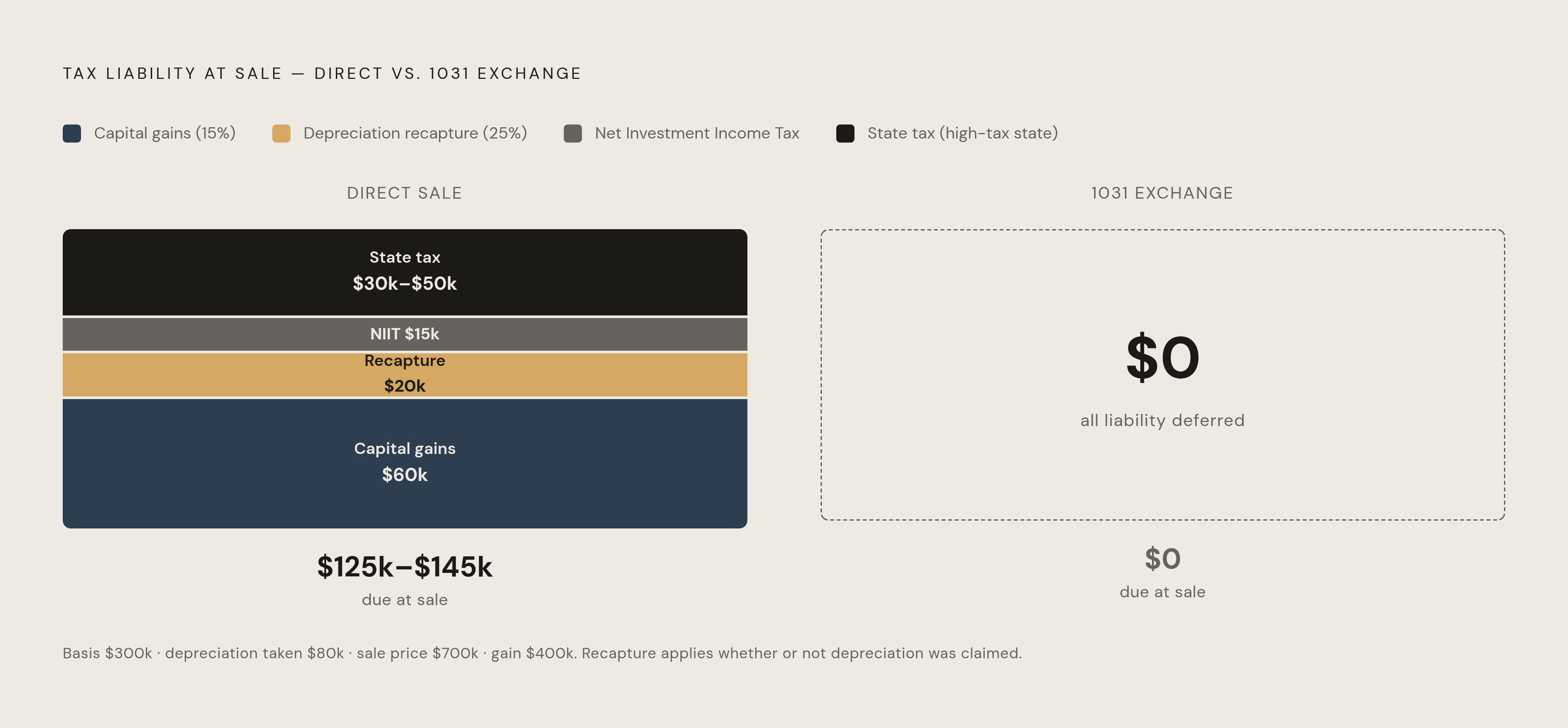
Run the numbers on a property bought for $300,000, held long enough to rack up $80,000 in depreciation, then sold for $700,000. That's a $400,000 total gain, but $80,000 of it gets carved out for recapture. Federal tax alone comes to roughly $60,000 on the capital gain (at 15%), $20,000 on the recapture (at 25%), and another $15,000 if the Net Investment Income Tax applies, for $95,000 in federal liability. Adding state tax brings another $30,000 to $50,000 in a high-tax state. Total exposure: $125,000 to $145,000, on a sale most investors mentally priced at a fraction of that.
The recapture piece is a fixed cost that applies regardless of a tax preparer's efforts at closing. It's a fixed cost of having taken the deduction in the first place, and it applies whether the investor actually claimed the depreciation or not. The IRS uses an "allowed or allowable" standard: if a property qualified for depreciation, the recapture applies to what could have been deducted, regardless of what was filed. Skipping the deduction just means paying the tax without ever having gotten the benefit. It just means paying the tax without ever having gotten the benefit.
The only way to avoid paying that bill at the point of sale is deferral, and the only vehicle built for that is a 1031 exchange.
What a 1031 exchange defers, and the full scope of the tax shield
A provision of federal tax law tied to real estate exchanges traces back to a statute passed in 1921, though it's carried its current numbering since 1954. The mechanism is simple to state: sell investment property, roll the proceeds into another qualifying investment property, and defer the tax that would otherwise be due.
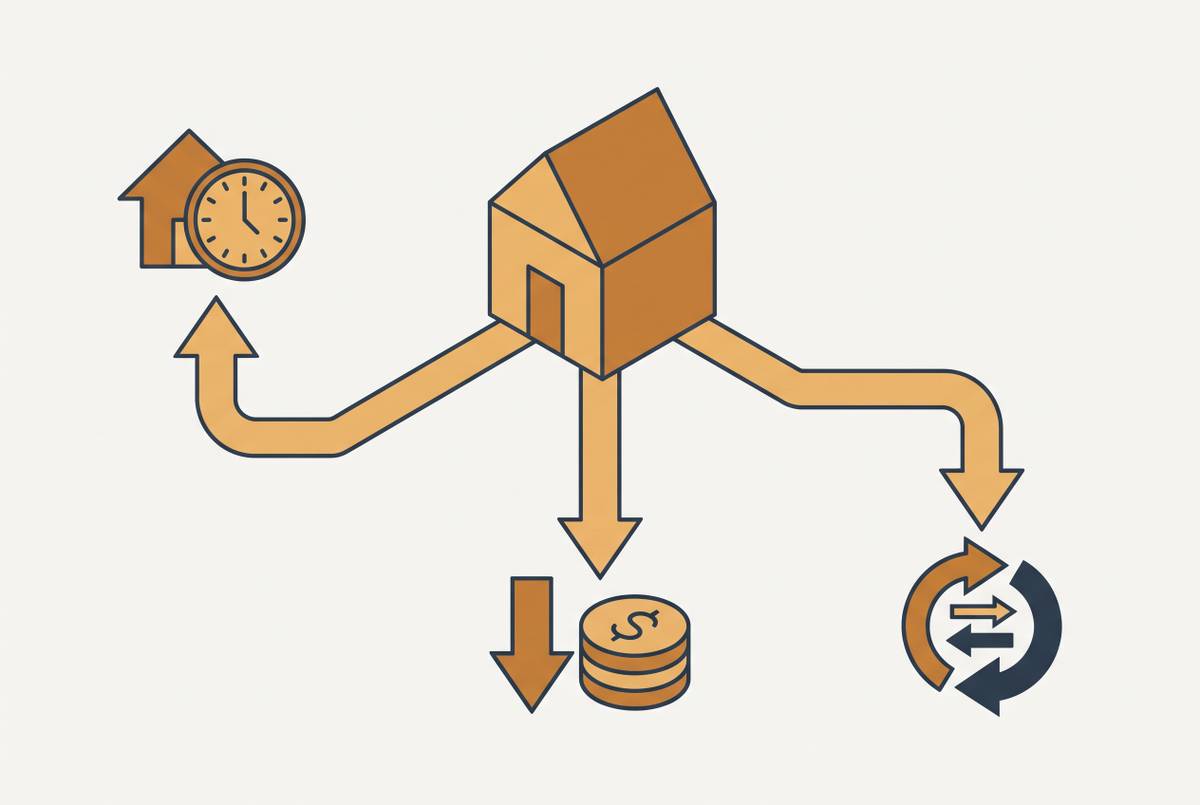
What gets deferred is broader than most investors assume. A properly structured exchange defers the long-term capital gains tax, the 25% Section 1250 depreciation recapture, the 3.8% Net Investment Income Tax, and, where applicable, state tax as well. Applied to the earlier example, an investor who exchanges instead of sells defers the full $95,000 in federal liability and the $30,000 to $50,000 in state tax, all of it, not just the capital gains slice.
Deferral is not forgiveness. The tax doesn't disappear, it moves. It rides forward into the replacement property's basis and becomes due whenever the investor eventually sells without exchanging again. Investors can chain exchanges indefinitely, pushing the liability forward property after property, and if they hold until death, heirs inherit the replacement property at a stepped-up basis. That step-up can erase the deferred liability entirely; the exchange-until-death strategy is central to long-term real estate tax planning for this reason.
The legislative ground under 1031 has shifted before and could again. The One Big Beautiful Bill Act, signed July 4, 2025, left exchanges intact without the dollar caps that had circulated in earlier drafts. Proposals to limit or cap 1031 exchanges have surfaced repeatedly since 2021, and nothing about the current law's survival should be treated as permanent. As of now, real estate held for investment or business use can be exchanged for like-kind real estate anywhere in the country. Personal property exchanges lost eligibility back in 2018, so this is a real-estate-only mechanism today.
The conditions that must be met to defer recapture, not just gains
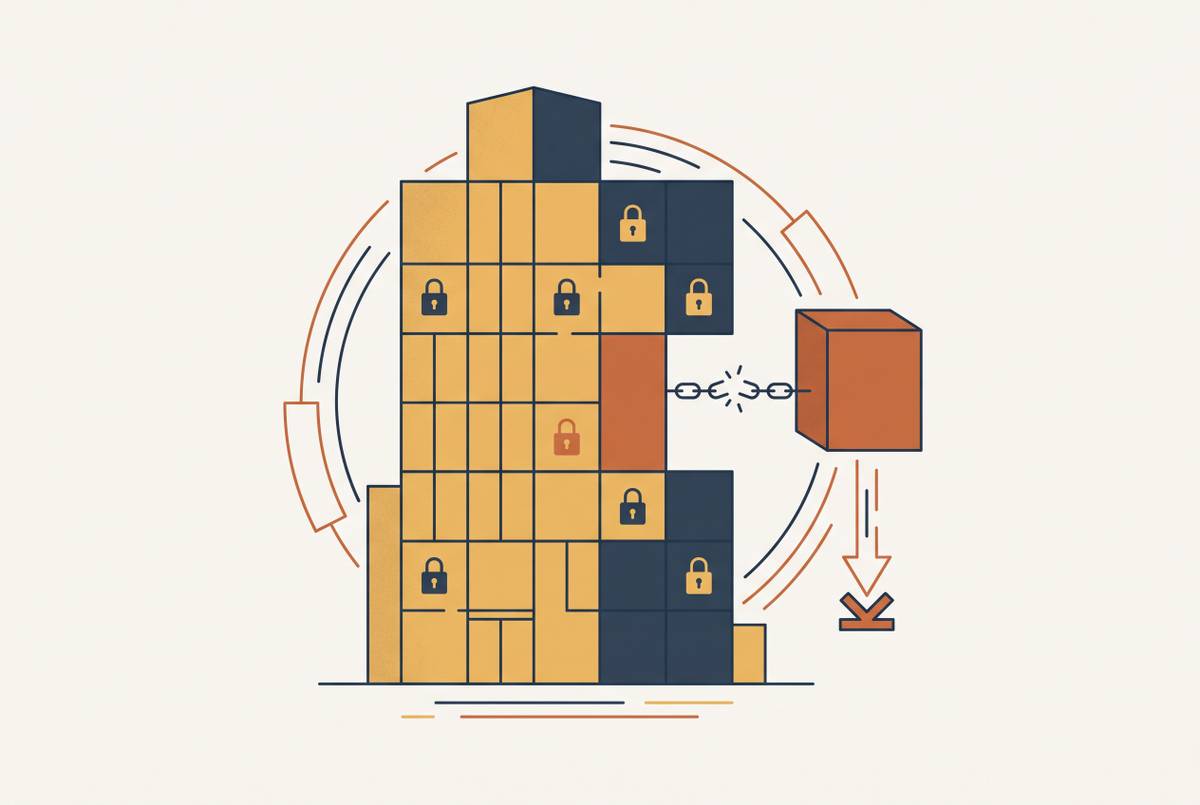
Full deferral, recapture included, depends on three conditions holding at once. The replacement property has to be equal to or greater in value than the one sold. Every dollar of exchange proceeds has to go back into the replacement property, none pocketed. And any debt paid off on the relinquished property has to be replaced, either with new debt of equal or greater size or with additional cash, because reducing overall leverage creates what's known as mortgage boot.
Boot matters because of how the IRS orders the tax hit. When an investor receives boot, cash, or debt relief, depreciation recapture is the first tax applied against it, before capital gains, up to the full amount of depreciation previously taken. Only boot beyond that amount gets capital gains treatment. And recapture tax on boot is due in the year of sale regardless of how much of the rest of the proceeds get reinvested. Boot cannot be deferred, full stop.
Cost segregation adds a wrinkle that catches sophisticated investors off guard. That strategy reclassifies parts of a building, HVAC systems, fixtures, specific finishes, into shorter depreciation schedules, generating bigger deductions sooner. It works well until the exchange stage, when the replacement property needs to contain enough of the same category of reclassified components to absorb the recapture tied to what was accelerated. Exchange an improved commercial building that's been cost-segregated for raw land, and recapture on those accelerated components can trigger anyway, even though the rest of the exchange qualifies cleanly. Anyone who's used cost segregation needs to check the replacement property's composition before assuming the exchange shields everything.
None of this works if the investor ever touches the sale proceeds, even briefly. An uncashed check sitting on a desk, a wire that lands in a personal account before moving on, either one breaks the exchange through constructive receipt. Funds have to move from the closing of the relinquished property straight to a Qualified Intermediary, and the exchange agreement has to be signed before that closing happens. A completed, already-closed sale cannot be reclassified as an exchange after the fact.
How the carryover basis carries the deferred liability into the replacement property
Buying a property outright sets the tax basis at the purchase price, plain and simple. Depreciation starts fresh from that number. An exchange doesn't work that way. The replacement property inherits a carryover basis from the relinquished property, its old adjusted basis, which works out to the replacement property's fair market value minus the gain that got deferred.
That has a real, ongoing effect on future depreciation. The investor can't depreciate the replacement property as if it were bought new at full purchase price, because the basis is lower than that. Annual deductions come out smaller than they would for someone buying the identical asset without an exchange behind it. This surprises a lot of investors who assume the basis resets clean at the new purchase price. It does not reset clean at the new purchase price.
Sell the replacement property later in a taxable transaction, and gain gets calculated off that carryover basis, so the original deferred gain, recapture included, resurfaces in full. Chain enough exchanges together and the liability compounds: each property adds its own layer of deferred gain on top of what carried over from before, so a property at the end of a long exchange chain can carry an enormous accumulated liability, one that only disappears through a stepped-up basis at death. Modeling out the carryover basis before signing on to another exchange isn't a nice-to-have. It needs to happen before closing, not after.
The 45-day and 180-day deadlines, and the year-end trap that compresses the exchange window
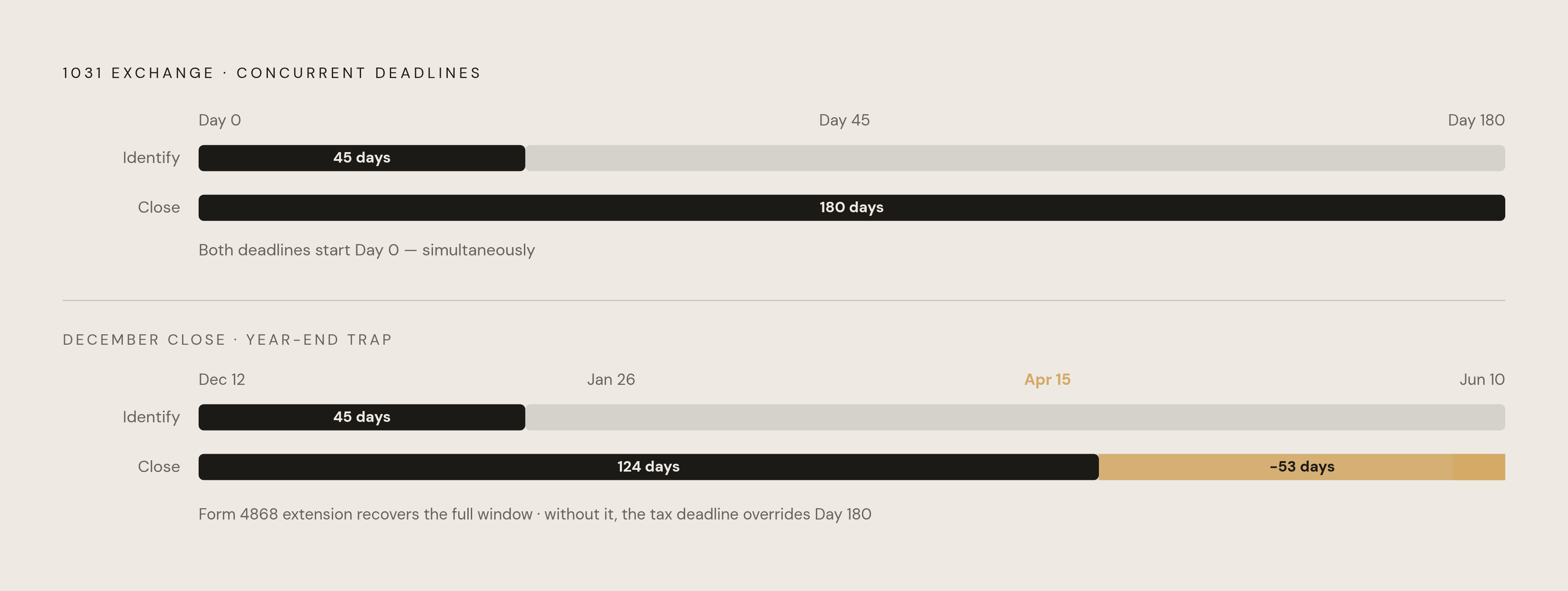
The exchange clock starts the moment the relinquished property closes, and it runs on two tracks at once, not one after the other. From day one through day 45, the investor has to identify replacement property in writing, signed and delivered to the Qualified Intermediary by midnight on day 45. From day one through day 180, the investor has to actually close on the replacement property. Both clocks start on day zero and run concurrently.
None of this bends for a bad week. Financing falls through, a broker drops the ball, something personal comes up, the deadlines hold anyway. Weekends and holidays don't shift them either. The only standard relief comes under a numbered procedural ruling from the tax authority. Proc. 2018-58, which covers federally declared disasters, combat-zone military service, and certain military or terroristic actions, not garden-variety bad luck.
The trickiest failure mode occurs at year-end. The 180-day period is capped at the earlier of 180 days or the due date of the investor's tax return for the year the relinquished property sold. Close a relinquished property on or after October 17, 2025, and the individual return due date of April 15, 2026, arrives before the full 180 days would. An investor who closes December 12, 2025, has a 45-day identification deadline of January 26, 2026, but without filing Form 4868 for an extension, the exchange has to close by April 15, 2026, not June 10, 2026, the date the 180-day math would otherwise suggest. That's 53 days lost, simply for closing in December instead of filing an extension.
Most exchanges that fail, fail at the 45-day mark, not at closing. Identification is where the deadline actually bites. Investors get three ways to satisfy it: the Three-Property Rule, naming up to three properties regardless of value; the 200% Rule, naming any number of properties as long as their combined value doesn't exceed 200% of what was sold; or the 95% Exception, which allows over-identification if at least 95% of the total identified value actually gets acquired by the end of the exchange period. Missing all three means the IRS treats the exchange as though nothing was ever identified. That's a full failure, not a partial one.
What the Qualified Intermediary does, and how choosing the wrong one can trigger the liability a 1031 was meant to avoid
The Qualified Intermediary exists to prevent the investor from taking constructive receipt of the sale proceeds. Proceeds from the sale go to the QI, never to the investor directly, and the QI applies those funds to the replacement property purchase on the back end. The exchange agreement naming the QI has to be signed before the relinquished property closes; there's no retroactive fix once that ship has sailed.
Not everyone can serve as QI. An investor's own attorney, accountant, real estate broker, or investment advisor, if that person has served in that role within the prior two years, is disqualified from acting as QI, even if the investor is fine with it. The rule exists because those relationships give a person control over funds, and constructive receipt is designed to prevent exactly that kind of control.
The QI industry carries no federal licensing requirement. Unlike a bank or a broker-dealer, a QI doesn't answer to a federal regulator, and most states don't require QIs to be bonded or insured. The IRS requires that a QI be used, but it has never built out a supervisory framework for the industry itself. That gap means investor protection rests almost entirely on due diligence at the point of hiring; there's no deposit-insurance-style backstop by default.
The consequence of getting this wrong is severe. If a QI misappropriates exchange funds or simply loses them to insolvency, the investor can end up owing the full tax bill, recapture included, with no replacement property to show for it. The exchange collapses and the liability the whole structure was built to defer comes due anyway. The Federation of Exchange Accommodators, a trade association, lists QIs who've committed to a set of industry standards, and membership signals professional seriousness even though it isn't legally mandatory. The Certified Exchange Specialist designation works similarly: it's a practitioner credential that indicates training specific to exchanges, beyond general real estate or tax background.
What to evaluate when selecting a Qualified Intermediary, beyond price
Fund security should sit at the top of the list, above fees, above turnaround time, above everything else. Segregated accounts matter most: each client's exchange funds should be in their own account, not pooled with other clients' money or with the QI's own operating cash. Segregation is what protects an investor's funds if the QI runs into financial trouble. FDIC coverage is another factor to check, specifically the limit that applies and whether the QI uses a pass-through or custodial structure that extends coverage beyond the standard per-account cap. Fidelity bonding is a third layer, protecting against outright fraud, theft, or forgery, a real risk given how little federal oversight exists in this industry.
Experience counts for more than it might seem on paper. A QI with a decade or more of exchange work behind it has seen timing conflicts, boot traps, cost segregation complications, and related-party rules that snag less experienced firms. Ask, too, whether one dedicated person handles a file start to finish, or whether it gets passed between departments and sales staff whose incentives may not line up with the client's outcome. Because the 45-day and 180-day deadlines don't move for holidays or weekends, availability outside standard business hours affects whether an investor can meet those deadlines.
Fee structure deserves scrutiny most investors skip. The traditional model charges an exchange fee and keeps all interest earned on the investor's own funds while they sit with the QI during the exchange period, so the investor pays a fee and earns nothing on capital that, in some cases, sits parked for months. Some newer models flip that arrangement, sharing interest income back with the investor. Given how large exchange balances often run and how long the 180-day window can stretch, that structural difference affects the cost of the exchange and should be priced into the decision, not treated as a footnote.
Sources
- IRS 1031 Exchange Rules for 2026: Everything You Need to Know
- 1031 Exchange Timeline: Deadlines, Rules & Expert Answers | JTC
- Depreciation recapture tax: Overview and FAQs
- Depreciation Recapture on Sale of Rental Property 2026
- Depreciation Recapture: Rates and How It Works | R.E. Cost Seg
- deferred.com
- anchor1031.com
- bassets.net