After-Tax IRR Comparison for 1031 Exchange vs Taxable Sale
Deferring taxes through a 1031 exchange compounds wealth more than paying capital gains today.
The after-tax internal rate of return is the number that separates a 1031 exchange from a taxable sale on equal footing, and when you run it side by side, the exchange doesn't just delay a tax bill. It structurally enlarges the base of capital compounding inside the portfolio, and that gap widens every year the deferral holds. The pre-tax returns in both scenarios are identical. The divergence comes entirely from tax timing: how much of the sale proceeds survive the closing table and keep working.
That's the frame for what follows. Federal capital gains up to 20%, depreciation recapture at 25%, the Net Investment Income Tax at 3.8%, and state tax on top (California surfaces below as a working example) can combine into a tax drag approaching 40% of the gain. This piece traces where that 40% goes: whether it exits the portfolio permanently at closing, or stays inside it and compounds forward. None of it substitutes for advice from a tax professional working from an investor's actual numbers. It's a model, not a projection for any specific portfolio.
Why the tax drag on a taxable sale is larger than most investors expect
Taxable gain is calculated from adjusted basis, not from what an investor paid for a property. It's calculated from adjusted basis, and adjusted basis is purchase price plus capital improvements, minus accumulated depreciation. Decades of depreciation deductions, the same deductions that made the property attractive to hold in the first place, quietly pull that basis down year after year. By the time of sale, the basis is often far lower than intuition suggests, and the taxable gain sitting on top of it is correspondingly larger.
Consider a California investor with $400,000 in total gain, $60,000 of which is depreciation recapture. Consider a California investor with $400,000 in total gain, $60,000 of which is depreciation recapture: run through the combined federal and state stack, the tax bill can easily clear $120,000, or roughly 30 cents on every dollar of gain, and that's real capital the rest of this analysis turns on. That's real capital, roughly 30 cents on every dollar of gain, and it's the capital the rest of this analysis turns on: does it leave the portfolio at closing, or does it stay invested through an exchange? That's real capital, and it's the capital the rest of this analysis turns on: does it leave the portfolio at closing, or does it stay invested through an exchange?
A related example from the same body of case work: a property sold for $2,000,000 against an adjusted basis of $900,000. Held long enough for the asset to appreciate substantially, the embedded gain is enormous, and it stays invisible right up until the closing table forces the issue. Investors who haven't sat down and actually calculated their adjusted basis tend to underestimate what a 1031 exchange is protecting them from. The math is more consequential than most assume, and it's worth doing before, not after, a sale is under contract.
The mechanics that make the compounding possible
The exchange works because of one structural rule: sale proceeds go to a Qualified Intermediary, not to the investor. The IRS does not treat funds held by a QI as received by the taxpayer, so gain recognition is deferred and the full purchasing power of the sale, not the after-tax remainder, rolls into the replacement property.
Nothing here eliminates the tax. Nothing here eliminates the tax. The deferred gain gets preserved through carryover basis, a reduced basis on the replacement property that carries the tax liability forward rather than erasing it. Depreciation recapture rides along the same path, deferred alongside the capital gain when the exchange satisfies every requirement.
To defer the entire gain, the replacement property has to equal or exceed the relinquished property's value, and all the equity has to go back into real estate. Any shortfall, commonly called boot, gets taxed immediately, no exceptions. The guardrail that makes all of this legally real rather than a paperwork formality is constructive receipt: the moment an investor can touch or direct those proceeds, even briefly, the exchange fails. The QI's role is the legal hinge the entire deferral swings on. It's the legal hinge the entire deferral swings on.
As of 2026, 1031 exchanges remain fully intact under current law. The One Big Beautiful Bill Act did not touch them. Full deferral, no dollar cap, applies exactly as it did before. The one hard constraint that actually governs the IRR model operationally is the 180-day clock: the exchange has to close within 180 calendar days of the relinquished property's sale, or by the investor's tax return due date, whichever comes first.
Side-by-side IRR model: one sale, one exchange, 20 years out
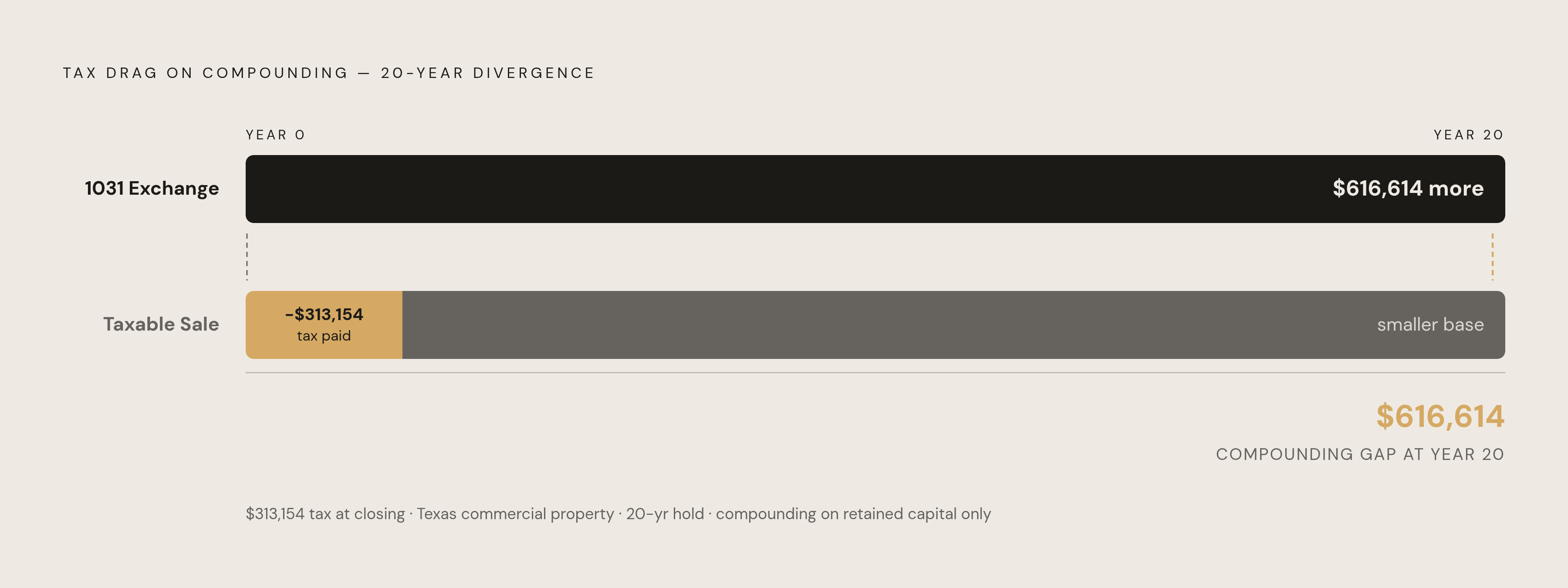
A Texas commercial property makes a clean anchor case, clean because Texas levies no state capital gains tax, so the federal math stands on its own. In that model, the exchange defers $313,154 in tax. Left invested rather than paid out, that capital generates an additional $616,614 in portfolio value over a 20-year hold.
That $616,614 is the compounding return earned on capital that never left the portfolio to begin with, and it only exists because of what happens at Year 0. It's the compounding return earned on capital that never left the portfolio to begin with, and it only exists because of what happens at Year 0. In the taxable sale path, the investor nets proceeds minus tax and reinvests whatever's left, a smaller base earning returns from day one. In the exchange path, the investor reinvests the full pre-tax amount, a larger base earning the identical rate of return from day one. The IRR gap opens immediately at closing and widens every year after, because the advantage is compounding against itself, not against some external benchmark.
There's a second-order effect that amplifies the gap further: leverage. Because exchange proceeds are intact rather than reduced by a tax payment, an investor can typically carry more debt on the replacement property. One modeled scenario replaces the original loan with a somewhat larger amount of financing on a $2 million replacement property. That extra $500,000 funds a property yielding $120,000 a year at a 6% return, against $77,500 on the tax-paid path, a $42,500 annual edge that itself compounds forward year over year.
Paying the tax today locks in a known rate, 20% federal as things stand now, while an exchange defers into a future rate environment nobody can guarantee. Paying the tax today locks in a known rate, 20% federal as things stand now. An exchange defers into a future rate environment nobody can guarantee. If rates rise substantially before the eventual taxable event, the IRR advantage modeled here could narrow. The rule of thumb that emerges from this kind of analysis: the exchange favors deferral when the combined tax rate clears 20%, the replacement property is equal or greater in value, the deadlines are realistically achievable, and the cash isn't needed elsewhere. The crossover where deferral stops being worth the complexity is around $15,000 to $20,000 in deferred tax.
How the IRR gap compounds across multiple exchanges
Chain exchanges together and the effect doesn't just repeat, it accelerates. Each successive exchange defers not just the new gain but the accumulated gain from every prior exchange, so the deferred tax base grows, and the capital compounding on the investor's behalf grows right along with it.
A representative path: a $300,000 property bought in 2005, exchanged into a $600,000 property in 2015, exchanged again into a $1,200,000 property in 2025. Across those two exchanges, cumulative deferred tax is somewhere in the range of $200,000 to $350,000, capital that stayed at work in real estate instead of being handed over at two separate closing tables.
Running that same $1.2 million property through a hold-to-death strategy instead of a third exchange changes the outcome: heirs inherit at a stepped-up basis, and the deferred gain never resurfaces as taxable. Heirs inherit the property at a stepped-up basis equal to its fair market value at death, and every dollar of gain accumulated across both exchanges simply disappears for tax purposes. A multi-decade deferral converts into a permanent exclusion. No taxable-sale IRR model, run at any hold period, can replicate that outcome, because the taxable path has no equivalent mechanism.
Even absent an estate plan, the compounding logic holds. Each exchange lets the reinvested tax capital keep working uninterrupted, while every taxable alternative resets the clock and takes its cut of a base that had been compounding for years. And there's no ceiling on this under current law: no dollar cap on the value deferred. The strategy scales with the portfolio, for as long as the investor keeps exchanging.
What the 45-day and 180-day deadlines mean for the IRR model in practice
Both deadlines run from one date only: the closing date of the relinquished property. Not the listing date, not the date the purchase contract was signed. Day 45 is when written identification of replacement property has to reach the QI. Day 180 is when the replacement property closing has to occur.
The 180-day window has a mechanism that catches investors off guard: the true deadline is 180 days or the investor's tax return due date for the year of sale, whichever comes first. A property that closes December 12, 2025 carries a 45-day identification deadline of January 26, 2026, straightforward enough. But without a filing extension, the effective exchange deadline is April 15, 2026, a meaningful number of calendar days earlier than the June 10, 2026 date a naive 180-day count would suggest. File an extension and the full window to June 10 comes back.
The IRS grants no extensions for financing delays, a seller who defaults, title problems, or ordinary bad luck. A narrow disaster-postponement provision exists under a specific tax-agency revenue procedure. Proc. 2018-58, but it's the exception, not something to plan around. Missing either deadline by even one day makes the entire gain taxable in the year of sale. There's no partial credit, no proration. The IRR simply collapses to the taxable sale scenario.
Investors do have some room to maneuver inside the 45-day window, thanks to three identification rules under a federal tax regulation. Reg. §1.1031(k)-1(c). The Three-Property Rule lets an investor identify up to three properties regardless of value, and it's the one used most often. The 200% Rule allows identifying any number of properties as long as their combined fair market value doesn't exceed 200% of the relinquished property's value. The 95% Exception permits identifying unlimited properties at unlimited value, but only if the investor actually closes on at least 95% of what was identified, a standard few investors attempt given the execution risk involved.
The takeaway for the IRR model is straightforward: the exchange's superior return only exists on paper until execution is clean. That's why QI selection and pre-close planning aren't procedural footnotes. They're decisions that either capture the modeled return or let it slip away.
How QI selection affects whether the IRR advantage is captured
Qualified Intermediaries face no federal licensing requirement and no federal supervision, unlike banks or broker-dealers. Most states don't license or bond them either. Nevada is the only state requiring QI licensing, while California, Nevada, Idaho, Colorado, Oregon, Virginia, and Washington impose registration or insurance requirements. Outside those states, the qualifications resting on a QI's shoulders are largely whatever the QI chooses to hold itself to.
That gap has real teeth. Exchange proceeds sitting in a commingled account, mixed with other clients' funds rather than held separately, have cost investors their entire exchange balance when a QI became insolvent. That's not a footnote risk. It converts the entire IRR advantage modeled above into a total loss overnight.
Before signing an exchange agreement, check that funds are held in segregated accounts rather than commingled, that disbursement requires the investor's own signature, and that accounts are parked at highly rated domestic banks. banks, errors and omissions insurance running into seven figures or beyond, a fidelity bond covering employee theft, and documented internal audit controls. On the experience side, a decade or more of exchange work matters, because seasoned QIs anticipate how tight a 45-day identification window actually feels in practice, in a way newer intermediaries sometimes miss. The Certified Exchange Specialist designation is a recognized credential worth looking for, and the Federation of Exchange Accommodators serves as a resource for locating member firms.
There's also a quieter economic dimension to QI selection: interest. During the exchange period, the QI is holding the investor's money, sometimes for months, and how that interest gets handled is a real dollar difference, not a technicality. Traditional QI arrangements charge a fee, often $800 to $1,500 or more, and keep the interest earned on the held funds for themselves. Deferred's model runs differently: no fee, funds held in segregated FDIC-insured accounts, and interest earned on exchange balances shared directly with the client, even if the exchange ultimately falls through. Rates are published openly in a public table, with nothing negotiated behind closed doors. On a large exchange, that interest is a real figure, and it belongs inside the investor's after-tax IRR model, not siphoned off as the QI's revenue.
Service model is the last piece, and when a 45-day clock is running, it determines how the file gets handled under pressure. A dedicated senior Exchange Officer, with a decade or more of experience, handling a file start to finish is a different risk profile than a commissioned salesperson who hands the file to a processing team after the sale. Deferred structures its service around the former: exchanges that can open in a matter of minutes, including same-day openings at the closing table itself, support available seven days a week until midnight in a specific US time zone, and a real-time portal for both the investor and their advisors to track the file as deadlines approach.
When the taxable sale path wins
The exchange isn't the correct answer for every seller, and treating it as automatic misreads the actual decision. If an investor needs liquidity, actual cash in hand rather than more real estate, the exchange is the wrong tool. It requires every dollar of proceeds to stay inside real property. Needing cash for a business, a medical expense, or simply wanting out of the asset class entirely means paying the tax and taking the money is the right call, full stop.
Small gains change the math too. Below roughly $15,000 to $20,000 in deferred tax, the time, planning, and QI coordination an exchange demands can outweigh the benefit being modeled. And if a credible replacement property can't realistically be identified inside the 45-day window, pursuing the exchange anyway is a mistake: a failed exchange means the investor pays the tax regardless, having spent the added effort for nothing.
There's a rate-lock argument too, and it deserves to be taken seriously rather than dismissed. Paying tax today at a known 20% federal rate closes the door on the risk that rates climb higher before some future taxable event forces the issue anyway. Deferral is, at bottom, a bet that today's rate environment holds or improves. It usually does work out in the investor's favor over long hold periods, based on the modeling above, but it isn't a certainty, and any honest IRR comparison has to say so rather than presenting deferral as a sure thing.