Real Dealer Status Risk for Active Real Estate Investors
The IRS reclassifies active investors as dealers based on transaction patterns, not labels.

What the IRS and courts look at when deciding dealer versus investor
Dealer status is the single riskiest tax outcome an active real estate investor can walk into, and it has nothing to do with how that investor thinks of themselves. The IRS doesn't care what label someone puts on their own activity. It looks at how the pattern of buying and selling actually behaves, and if that pattern resembles a trade or business, Section 1031 disappears entirely, along with capital gains treatment. That distinction between holding property for investment and holding it for sale to customers decides whether a transaction gets taxed at 15 to 20 percent or at ordinary income rates that can run more than double that, stacked on top of 25 percent depreciation recapture and possibly the 3.8 percent net investment income tax.
For an investor running a handful of exchanges a year, one bad reclassification doesn't stop at costing money on that single sale. It can call into question every other property in the portfolio, because the IRS doesn't evaluate this in the abstract. Examiners look property by property, transaction by transaction, not averaged across a tax year. One flip gone sideways, reclassified as dealer inventory, can taint how the rest of the portfolio gets read.
No single fact settles the question, and that's precisely what makes this area so dangerous: there's no checklist to satisfy. Courts and the IRS weigh a cluster of factors together, and the burden sits on the taxpayer to prove investment intent. The government doesn't have to disprove it.
Purpose at acquisition sets the starting point. Did the taxpayer buy the property to hold for rental income or appreciation, or to flip for a quick profit? Holding period matters too, since a longer hold supports investor treatment and a shorter one supports dealer treatment, though no bright-line minimum exists. A property sold after eleven months looks different from one sold after five years, but neither number by itself guarantees an outcome.
Frequency and regularity of sales carry more weight than most investors assume. A single sale rarely raises a flag. A pattern of repeated sales of similar property types starts to look like a business rather than a portfolio, and that's often where investors get blindsided, because each individual sale felt reasonable in isolation.
Improvement activity pushes the needle too. Substantial development, or subdividing a parcel, moves the classification toward dealer, and so does marketing behavior: running ads, keeping a sales office, using a sales force. The IRS also asks what the taxpayer does for a living. If buying and selling real estate is the day job, the presumption shifts hard toward dealer status, and investors need to show intent through actual documentation built at the time, not an explanation constructed after the fact.
Activity patterns that put active investors at highest risk
Fix-and-flip sits at the top of the list, and it isn't close. Buying a distressed property, renovating it, and reselling within months is close to the textbook definition of dealer activity. The more of these an investor runs in a single year, the harder it gets to argue any one of them was a long-term investment play. One flip in a given year might be explainable. Five of the same property type in the same year starts to look like a business model, and the IRS reads that pattern as a trade or business rather than investment activity.
Subdivision and land development sit in their own risk category, arguably the least forgiving one. Case law has consistently treated breaking a parcel into individual lots and selling them piece by piece as strongly dealer-like activity, even when the raw land had been held for some time before the subdivision began.
Wholesaling carries exposure that surprises a lot of investors who don't think of themselves as dealers. Assigning a purchase contract for a fee, or buying and reselling with no meaningful holding period in between, resembles brokerage more than investing, and the IRS reads it that way.
High-volume portfolio turnover is the quieter risk, and probably the one most underestimated by investors who think they're playing it safe. An investor who sells a large number of stabilized rental properties in a short window can find that sheer frequency used as evidence against them, even when every single property was rented out and cash-flowing right up until the sale.
How courts have drawn the line in practice
Courts generally look at the taxpayer's primary purpose at the time of sale, though acquisition intent and the broader course of conduct still factor in. Intent isn't frozen at the moment of purchase, which is the detail most investors miss. A property bought for long-term rental income can slide into dealer territory mid-hold, if the owner starts actively renovating and marketing it for a quick resale instead of continuing to lease it.
Duration alone doesn't save anyone, and treating a long holding period as a guarantee is a mistake. A long holding period alone does not guarantee investor treatment, because factors like frequency of other sales, the extent of improvements, and active marketing can outweigh the length of the hold. On the other side, investor status is more defensible for taxpayers who held property passively, collected rent, and sold infrequently, particularly when flipping or development activity is kept in a genuinely separate entity.
The line runs through what someone did with that specific property, full stop. Not with their portfolio, not with their career, not with their other entities.
Structural strategies that protect investment intent before the sale
Entity separation is the foundation, and it has to be real, not cosmetic. Flip and development properties belong in a different legal entity from long-term holdings, with separate bank accounts, separate books, separate financing arrangements, separate operating agreements. Two LLCs with different names but a single checking account and no arm's length documentation between them won't hold up to scrutiny. Any transactions between the entities need pricing and documentation the way unrelated parties would handle them.
Holding period discipline helps, even though no specific number of months or years guarantees investor treatment on its own. Setting an internal policy, a defined minimum hold before considering a sale, and actually following it builds a pattern that supports the intent argument over time.
Renting the property before selling it is one of the strongest pieces of evidence an investor can produce. A property with tenants and a lease history looks like an income-producing asset, not inventory sitting on a shelf waiting for a buyer. Documentation created at the time of purchase, investment memos, notes between partners laying out acquisition rationale and intended holding period, carries far more weight than an explanation written after the IRS starts asking questions. Waiting to build the paper trail until the IRS sends an audit letter is close to the worst version of this mistake.
The 1031 exchange timeline and process when dealer risk is already managed
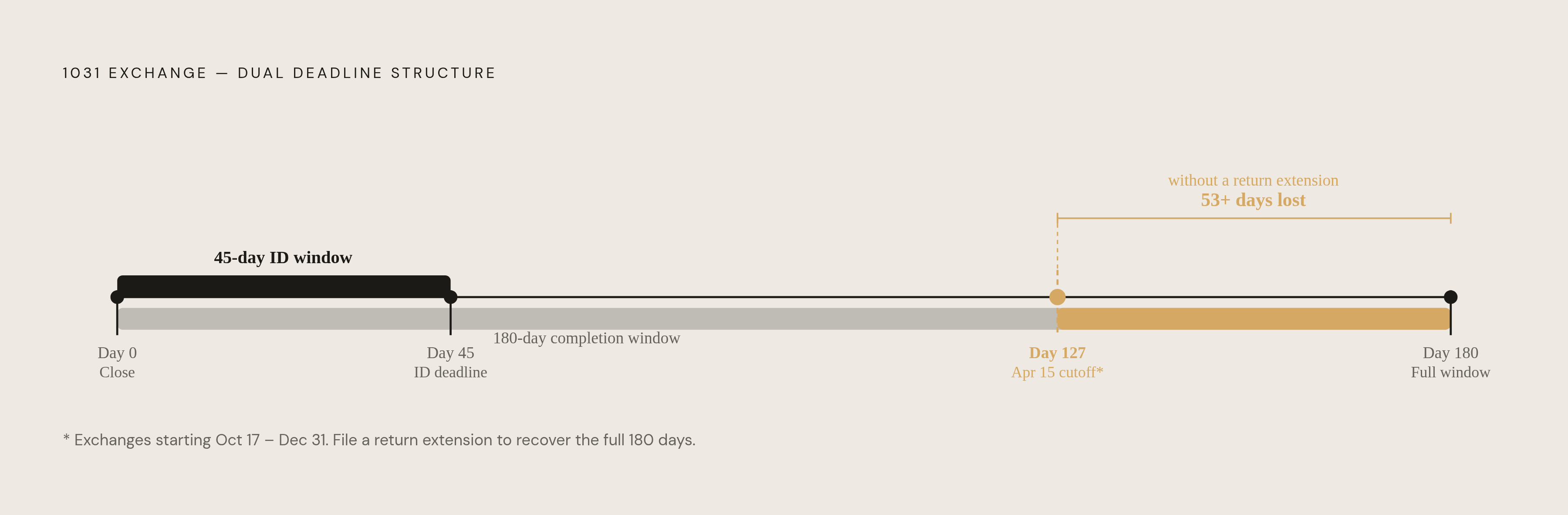
Getting the structure right on the front end doesn't relax the exchange mechanics on the back end. The 45-day identification deadline starts running from the closing date of the relinquished property. The 180-day completion deadline runs at the same time, ending at whichever comes first: 180 days, or the tax return due date, including extensions, for the year of the sale.
That second deadline creates a specific trap for anyone selling late in the year. An exchange starting between October 17 and December 31 has to close by the following April 15 unless the investor files a return extension. Skipping the extension costs an investor 53 or more calendar days off what would otherwise be a full 180-day window, which is not a small margin when replacement properties are still being sourced.
Constructive receipt is the other disqualifying trap, and it's absolute. The exchange is voided in full the moment the investor gains control over, or even the legal right to access, the sale proceeds. That's why the qualified intermediary holds all proceeds under an exchange agreement signed before the relinquished property even closes, not after.
Identification runs under one of three rules. The Three Property Rule allows up to three replacement properties at any value, and it's the one most investors use. The 200% Rule allows any number of properties as long as their combined value doesn't exceed 200% of the relinquished property's sale price. The 95% Exception exists for investors who exceed both limits, but it comes with a harsh penalty: an investor who identifies too many properties without qualifying for that exception has the identification treated as if none had been made. For an active investor juggling several replacement targets, that 45-day window doubles as a sourcing window, and the strength of an investor's off-market pipeline often decides whether the exchange closes on time or falls apart.
What to look for in a Qualified Intermediary when dealer status risk is part of the picture
The qualified intermediary industry has no federal licensing body, no mandatory bonding requirement, and no federal supervisor watching over it, which surprises investors who assume some agency is checking credentials. At least nine states, including California, Colorado, Connecticut, Idaho, Maine, Nevada, Oregon, Virginia, and Washington, have passed some form of QI oversight legislation, and Nevada is the only one that actually requires licensing. Everywhere else, the vetting burden sits entirely with the investor, and treating QI selection as a formality is a mistake active investors can't afford.
That matters more when dealer status risk is already part of the picture, because the QI needs to understand complex exchange structures and move fast when an exchange has to open on short notice. Who's legally permitted to serve matters just as much. Anyone who acted as the investor's agent within the prior two years, CPAs, attorneys, brokers, real estate agents, is disqualified from serving as QI on that exchange. So are family members and any entity the investor or their family controls more than 10 percent of.
Fund safety deserves its own line of questioning, especially on large exchanges. Commingled accounts, where an investor's exchange funds sit pooled with other clients' money, create real bankruptcy exposure. If the QI fails, an exchanger in a commingled account becomes an unsecured creditor, typically recovering pennies on the dollar. Segregated, FDIC-insured accounts are the standard worth insisting on, and investors should ask directly about account structure, online access to view the account, and how often statements arrive, before signing anything.
Credentials narrow the field further. The Federation of Exchange Accommodators' Certified Exchange Specialist (CES) designation requires at least three years of full-time QI work before an applicant can even sit for the exam. For a multi-property exchange running against a tight 45-day clock, paying for more years of hands-on experience than that bare minimum is money well spent.
Preserving 1031 eligibility in the 2026 legislative landscape is more valuable now than a year ago
The One Big Beautiful Bill Act, signed July 4, 2025, left Section 1031 untouched. No dollar cap made it into the final law, despite a proposed $500,000 cap floated during the legislative process. No income limit, no cap on the number of transactions. The exchange mechanism, part of the tax code since the Revenue Act of 1921, came through more than a century of tax reform still fully intact, and that continuity is the whole point: 1031 has survived every prior round of reform talk, and this round was no different.
The same bill permanently restored 100% bonus depreciation for property acquired and placed in service after January 19, 2025. Paired with an unrestricted Section 1031, that combination makes exchanging into new acquisitions more valuable than it's been in at least a decade. An investor can defer the gain on the sale and immediately write off a large share of the replacement property's cost in the same year, a pairing that makes exchanging into new acquisitions more valuable than it's been in at least a decade.
The dollars at stake aren't abstract. A properly executed exchange defers federal capital gains tax at 15 to 20 percent, depreciation recapture at 25 percent, whatever state tax applies, and the 3.8 percent net investment income tax, all at once. On a large transaction, that combined liability, deferred rather than paid, can represent a meaningful share of the entire gross sale price. Losing 1031 eligibility to a dealer reclassification doesn't just raise the tax rate on one sale. It erases the mechanism an active investor was counting on to keep capital compounding into the next deal, and the next one after that.
Sources
- 1031 Exchange Guide 2026: Rules, Timelines, DST Options
- 1031 Exchange Rules 2026: Every Deadline and Deal Breaker
- The Ultimate 1031 Exchange Guide (2026)
- Real Estate Dealer vs. Investor: IRS Tax Rules
- Real Estate Dealer vs. Investor Status | Weaver
- Real Estate Investors: This IRS Classification Could Cost You 32% More in Taxes
- The dilemma of dealer or investor classifications for real estate
- 1031exchange.com