State Capital Gains Tax and 1031 Exchanges Across State Lines
States can tax deferred gains years later if you buy replacement property outside their borders.
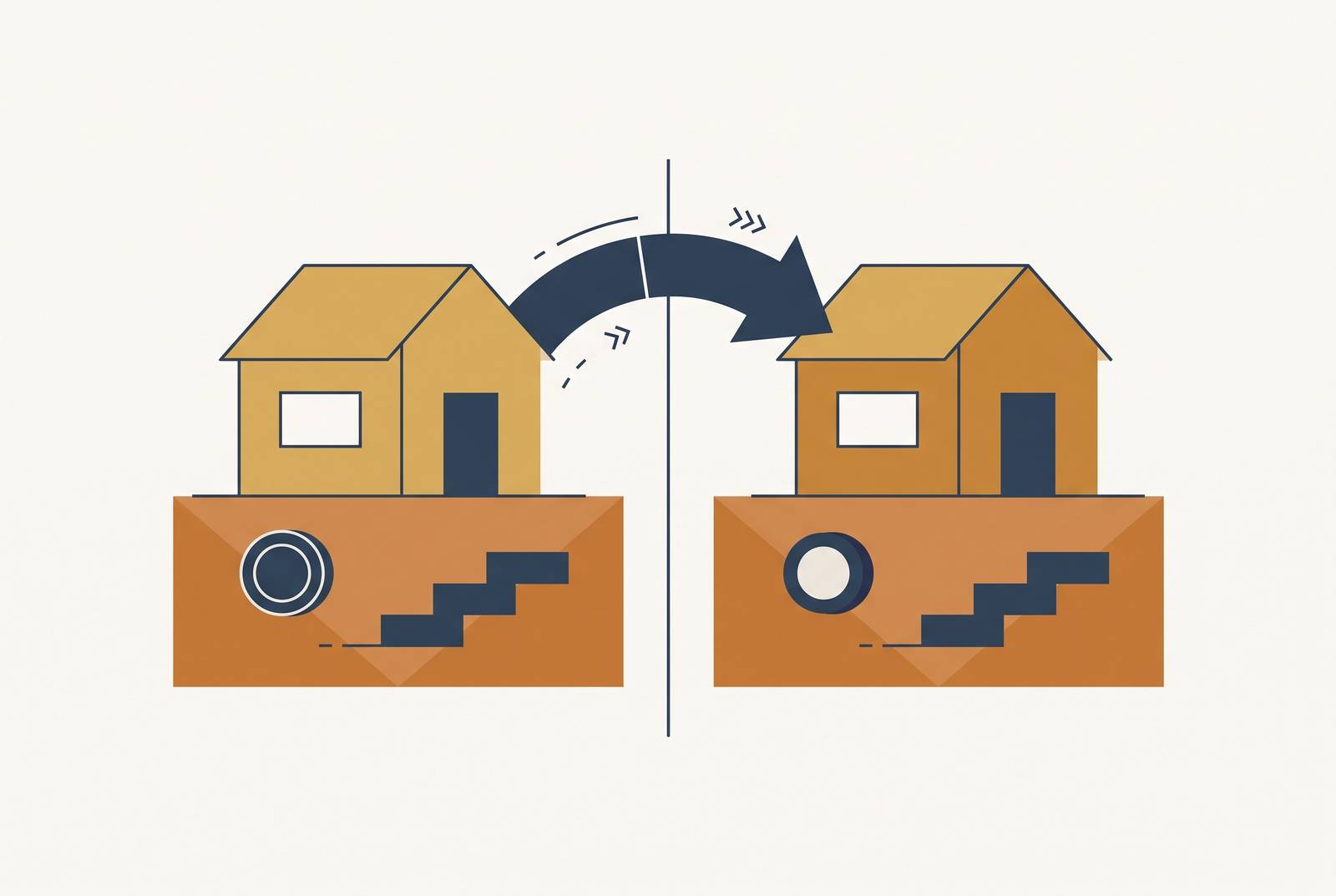
Section 1031 of the Internal Revenue Code lets an investor defer federal capital gains tax by rolling proceeds from a sold property into a like-kind replacement, and it has worked this way for over a hundred years. What it doesn't do is defer state tax automatically, and the gap between those two facts is where investors get hurt. The July 4, 2025 signing of the "One Big Beautiful Bill" left Section 1031 untouched at the federal level, so deferral itself isn't in danger. The danger sits one level down, in the fifty separate tax codes an investor has to clear once a relinquished property in one state gets exchanged for a replacement in another.
The IRS doesn't care where either property sits. Relinquished property in one state, replacement property in another, no problem, the federal mechanics run exactly the same. States each write their own income tax rules, unlike the federal system. Each one writes its own income tax rules, and the fact that the IRS agreed to defer a gain places zero obligation on, say, California or Oregon to do the same. Some investors assume one exchange means taxes deferred everywhere. That assumption is wrong often enough, and expensively enough, to warrant a full accounting of how conformity, clawbacks, and withholding actually work.
How the federal exchange mechanics create the state tax question in the first place
The exchange itself runs on a fairly rigid skeleton. An investor sells the relinquished property, and the proceeds go straight to a Qualified Intermediary, a third party who holds the money because the investor is legally barred from touching it. From there, the investor has 45 days to identify replacement property and 180 days total to close. Both counts run continuously from the date of sale. The IRS doesn't pause the clock for a long weekend or a holiday closing.
For a sale that closes after mid-October, the exchange period actually ends at whichever comes first: the full 180 days, or the investor's tax return due date. Anyone who sold after October 17, 2025 needed to close by April 15, 2026, unless they filed for an extension. That deadline collision doesn't just affect the federal return, either. It interacts with state filing obligations too, particularly in states that require their own exchange-related forms.
None of this forgives the gain, and that's the part investors sometimes misunderstand. The tax isn't erased, it's embedded, folded into the replacement property's reduced cost basis, and depreciation recapture rides along with it. Any boot received in the deal, cash, debt relief, or property of unequal value, gets taxed immediately, both federally and, depending on the state, at the state level too. Reporting happens on IRS Form 8824 (there is no form actually numbered "1031," despite how often investors go looking for one).
That embedded gain is the whole ballgame for cross-state exchanges. It accrued on an asset sitting in one state, got deferred at the federal level, and might eventually get recognized somewhere else. Each state has its own answer for who gets to tax it when that day comes, and the answers don't match.
How state conformity to Section 1031 works, and where it breaks down
Most states with a broad income tax start their calculation from federal taxable income. When the IRS defers a gain, the state's starting number reflects that deferral too, a relationship called conformity. Broad outright non-conformity with Section 1031 is generally not the primary threat investors face at the state level.
Conformity comes in different flavors, though, and the flavor matters. Some states update automatically whenever the federal code changes, so-called rolling conformity. Others peg themselves to a fixed date in the IRC and can lag behind current federal law until their legislature catches up. A state can conform to 1031 in principle and still trip an investor up with its own reporting form, its own non-resident withholding rule, or its own method for tracking the deferred gain going forward.
The clawback poses the bigger risk: a mechanism some states use to defer the gain up front but reserve the right to tax it down the road, sometimes years after the investor has moved states, sold the replacement prope... It's the clawback, a mechanism some states use to defer the gain up front but reserve the right to tax it down the road, sometimes years after the investor has moved states, sold the replacement property, or simply forgotten the original transaction ever happened.
Two separate exposure categories are worth distinguishing, because they trip different wires at different times. One is the withholding obligation a state may impose when a non-resident sells property within its borders. The other is the clawback itself, the liability that can follow the investor and the gain regardless of where either one ends up.
States with no income tax on real estate gains, and one exception investors misread
Seven states charge no personal income tax at all: Alaska, Florida, Nevada, South Dakota, Tennessee, Texas, and Wyoming. There is no state-level bite on real estate capital gains either. New Hampshire belongs in that group now too. Its separate tax on interest and dividends was fully repealed in 2025, and real estate gains were never part of that tax to begin with, so New Hampshire property carries no state capital gains exposure.
Washington State needs more careful handling, and this is where a fair number of investors get confused. Washington has no personal income tax, true. It does, however, levy a 7% capital gains excise tax, and it's easy to assume that tax applies here. Real estate is explicitly excluded from that excise tax. What Washington does apply to a property sale is a real estate excise tax, a transfer tax charged on the transaction itself, and a 1031 exchange does nothing to defer it. Investors selling Washington property should keep those two taxes separate in their heads: the capital gains excise tax that doesn't touch real estate, and the transfer tax that applies regardless of exchange status.
Selling out of a no-tax state is about as clean as this process gets. Federal deferral captures essentially all the meaningful tax exposure, and there's no state clawback lurking to chase the deferred gain later. That clean setup, though, creates a trap on the other side of the transaction: the trap appears the moment the investor buys into a high-tax state instead of another no-tax one.
The clawback mechanism: how California, Massachusetts, Montana, and Oregon track deferred gain across state lines
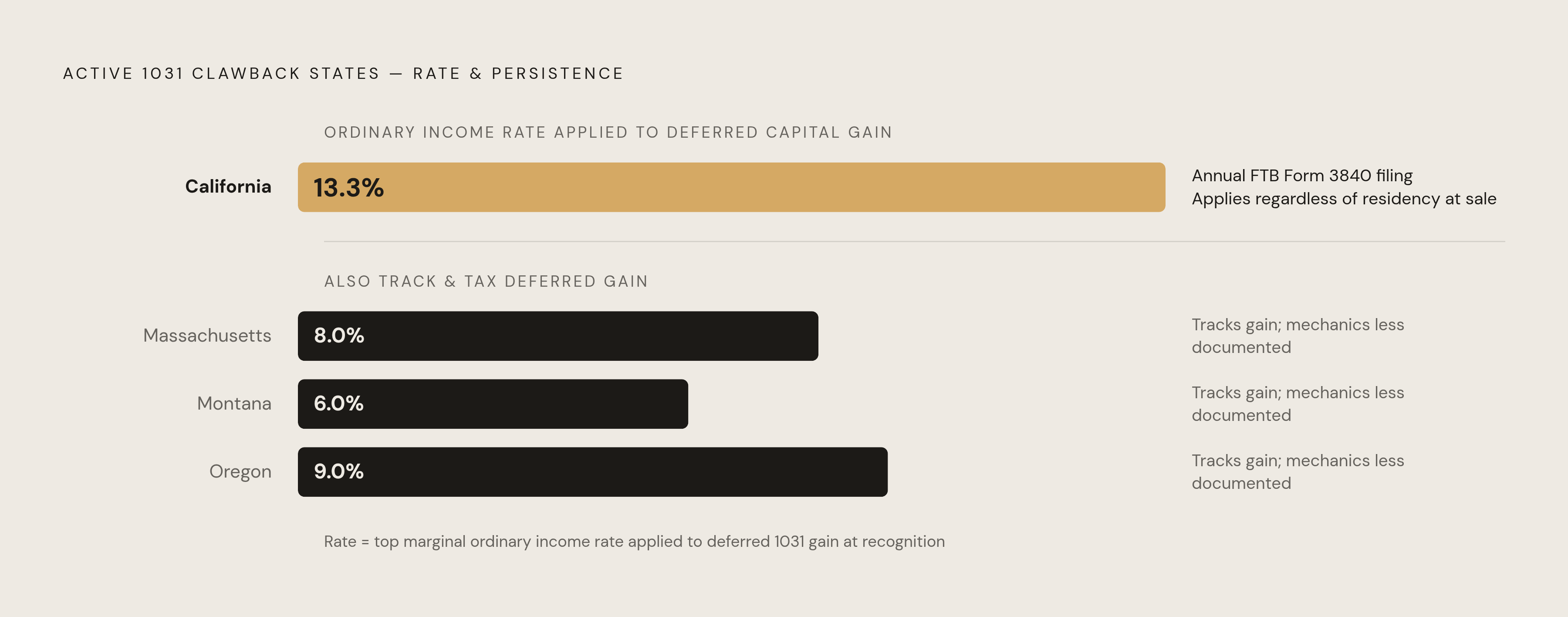
Four states run genuine clawback regimes: California, Massachusetts, Montana, and Oregon. The logic is consistent across all four. When property located in one of these states gets exchanged for replacement property somewhere else, the state doesn't just wave the deferred gain goodbye. It tracks it, and it taxes that portion of the gain when the replacement property eventually sells in a taxable event, no matter how much time has passed or where the investor is living by then.
California runs the most detailed version of this. Anyone exchanging California property for out-of-state replacement property has to file FTB Form 3840 with their California return, starting in the year of the exchange and continuing every single year after that until the deferred gain finally gets recognized. When that recognition event happens, whether it's ten years later or thirty, and whether the investor still lives in California or has long since moved to another state, California taxes its share of the gain. The rate isn't gentle, either: California taxes all capital gains as ordinary income, topping out at 13.3%, with no preferential rate for long-term holdings. That is among the highest state capital gains rates in the country, and the clawback applies regardless of the investor's residency at the time of the eventual sale.
Massachusetts, Montana, and Oregon are also identified as states with clawback provisions on deferred gain. The specifics of their mechanics are not as fully documented as California's, and investors dealing with property in any of those three should confirm the current filing requirements directly with each state's revenue department before assuming the rules mirror California's exactly.
A related but separate issue is non-resident withholding. California and Oregon both require mandatory withholding when a non-resident sells real estate within their borders, typically calculated as a percentage of the sale price rather than the gain itself. Oregon's version applies to non-resident individuals and to C corporations not registered to do business in the state, but it generally exempts pass-through entities like partnerships and multi-member LLCs. In both states, an investor pursuing a 1031 exchange can often claim an exemption from withholding, but that exemption has to be actively claimed. It isn't automatic, and missing the paperwork window can mean sitting through an unnecessary withholding hold on funds that should have flowed straight into the exchange. Given how often these forms and procedures get updated, verifying current requirements with the state revenue department, or with tax counsel, before closing isn't optional diligence, it's the baseline.
The direction-of-travel problem: why the state you're moving into matters as much as the one you're leaving
Most of the attention in a cross-state exchange lands on the state being left behind. That's a mistake, or at least an incomplete instinct, because the replacement state's tax regime is what determines the fate of the entire accumulated deferred gain once it finally gets recognized.
Consider an investor exchanging Florida property, no state income tax at all, for California property, where the rate on that same gain eventually hits 13.3%. That exchange locks the accumulated deferred gain into California's tax environment permanently. In a case like that, paying the federal capital gains tax while the property is still in Florida, taking the net proceeds to California, and starting fresh without a shadow of deferred gain trailing behind, might genuinely be the better financial outcome. Deferral isn't automatically the smarter move. Deferral is smarter only when the destination state's tax rate doesn't erase the benefit of deferring.
The reverse scenario carries its own trap, and it's one investors sometimes think they can dodge. Moving out of a clawback state doesn't release the clawback. An investor who exchanges California property for property in Nevada, then later sells that Nevada property, still owes California tax on the portion of gain that originated in California. Relocating doesn't erase the liability, it just delays the moment it comes due.
Deferral is almost always possible. It almost always is. The all-in state tax cost at the point of eventual recognition, and which state's revenue department is waiting to collect it, is what matters. Successive exchanges, chaining one deferral into the next instead of ever cashing out, can push that recognition date indefinitely into the future. But the liability doesn't shrink while it waits. It compounds, and at some point it has to be weighed against whatever exit the investor actually has in mind.
Mapping your specific cross-state exposure before the exchange closes
Start with the relinquished property's state. Is it one of the four clawback states? Does it impose non-resident withholding on the sale, and if so, does the 1031 exemption apply, and has it actually been claimed on the correct current-year form?
Then turn to the replacement property's state. What's the capital gains rate there, and does that state tax gains at a preferential long-term rate or lump them in as ordinary income the way California does? Is the replacement state itself a clawback state, which would mean any future cross-state exchange out of it triggers the same tracking headache all over again? And does that state conform to Section 1031 on a rolling basis or a fixed date, since a fixed-date state can occasionally lag behind a federal law change in ways that matter?
From there, model the full picture, including the state piece alongside the federal piece. What's the total accumulated deferred gain across however many prior exchanges led here? What state tax rate will actually apply whenever recognition finally happens? And is that accumulating liability growing faster than any benefit the investor is getting from deferring it further?
Filing obligations need their own line item. California requires ongoing reporting of the deferred gain, and investors should confirm the current Form 3840 filing schedule with the Franchise Tax Board or tax counsel. The other three clawback states carry their own reporting requirements, and those should get confirmed directly with each state's revenue department rather than assumed.
Last, check the calendar. If the relinquished property sale closes after mid-October, figure out whether a tax return extension is needed to preserve the complete 180-day window, since that deadline has both federal and state filing consequences. None of this analysis works retroactively. Once the relinquished property sells, the 45-day clock starts running immediately, and the range of structural choices available to the investor narrows fast.
What to look for in a Qualified Intermediary for a cross-state exchange
A Qualified Intermediary isn't optional in any 1031 exchange, cross-state or not. The investor can never take constructive receipt of the sale proceeds at any point in the process, so routing the funds through a neutral third party is a hard requirement.
QIs aren't federally supervised the way banks or brokers are, and most states don't require them to be licensed or bonded. Nevada and Maine are among the few that do. That regulatory gap makes the selection of a QI a genuinely consequential decision, and it matters more, not less, once state lines enter the picture.
Experience across jurisdictions counts for a lot here. A QI handling a California-to-Texas exchange needs to actually understand California's Form 3840 obligation, the timing on Oregon or California's withholding exemption, and how clawback tracking works in practice, not just the federal 45-and-180-day mechanics that apply everywhere. A file passed between different team members loses institutional memory about state-specific filing requirements exactly when that memory is needed most, so a single dedicated point of contact matters, too. Look for a QI who assigns one senior Exchange Officer, ideally with a decade or more of experience, to a file from the first phone call through closing.
Speed matters at the margins as well, particularly around state withholding exemption windows and escrow deadlines that don't wait. A QI able to open an exchange same-day, or even at the closing table itself, closes off one more way for a state exemption deadline to slip past unnoticed. Segregated accounts, deposit insurance, and a published interest rate remove a layer of opacity from a transaction that's already carrying enough complexity from the state tax side alone. Whether the interest earned on those held funds belongs to the investor or gets retained, in whole or in part, as part of the QI's fee depends entirely on that QI's contract, so it's worth reading closely rather than assuming.
A standard forward exchange often carries a QI fee somewhere in the neighborhood of $750 to $1,500, sometimes more, layered on top of a deal that's already carrying state tax complexity. Some intermediaries, including Deferred, run a no-fee model instead, sharing a portion of the interest earned on larger held balances with the client rather than charging a flat fee up front. Extended support hours matter in a cross-state deal too, since the parties involved are often sitting in different time zones with a closing deadline bearing down. Deferred positions itself specifically around these features: no upfront fee, interest sharing on balances above $1 million, segregated FDIC-insured accounts, a single senior Exchange Officer with a decade or more of experience assigned to each file, exchange openings in as little as five minutes including at the closing table, seven-day support until midnight ET, and a published rate table with no negotiation involved.
None of that replaces the underlying analysis, though. Choosing the right intermediary handles the mechanics of the exchange. Understanding the conformity rules, the clawback exposure, and the direction-of-travel math between the state being left and the state being entered, that's the work an investor has to do first, and it has to happen before the 45-day clock starts, not after.