721 UPREIT Exchange After DST Ownership
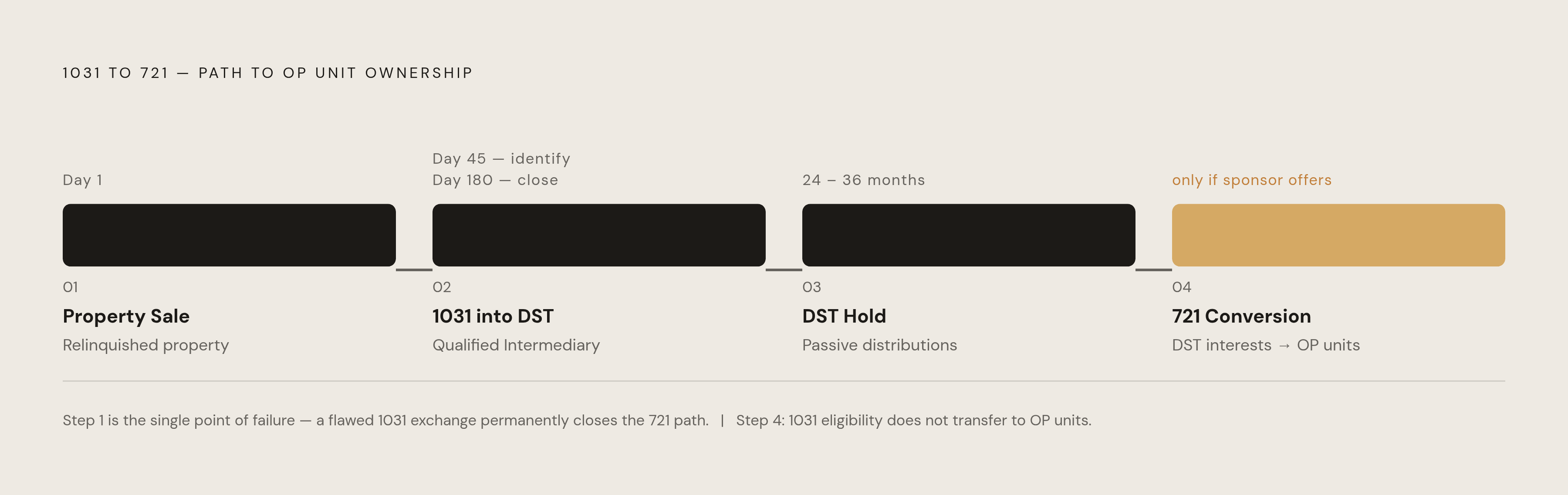
The DST-to-UPREIT path requires executing a rigid sequence of tax-deferred steps in exact order.
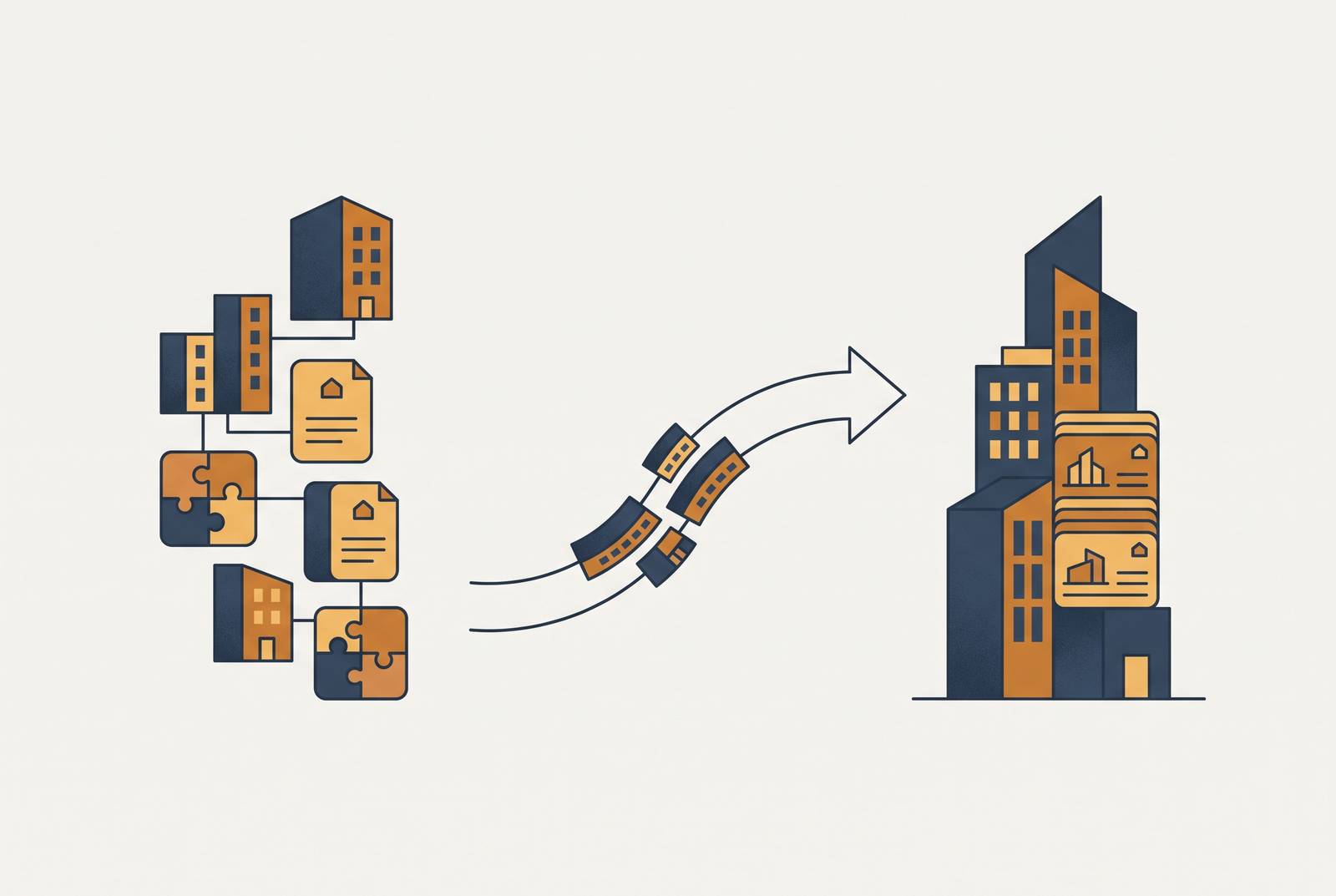
Investors who assume the exit from a Delaware Statutory Trust "takes care of itself later" are working from a bad assumption. The DST-to-UPREIT path is an ordered sequence of fixed, tax-deferred steps. It is an ordered sequence of tax-deferred steps, and the order is fixed. Each step builds the legal and structural precondition for the one that follows. Skipping ahead simply is not possible.
Consider why a 721 exchange cannot happen at the moment a property is sold. A 721 exchange requires the investor to already hold a qualifying real estate interest that can be contributed to a partnership, and at the point of an original sale, no such interest exists yet. Only a 1031 exchange can defer the capital gains and depreciation recapture at that moment, and it comes with its own clock: replacement property has to be identified within 45 days under IRS rules. That is why the DST exists as the connective piece in the middle. Individual properties are rarely sized or structured in a way that lets them be contributed directly into an institutional operating partnership, so the DST does that aggregation work, pooling multiple investors and properties into something that meets institutional scale and structural requirements.
Nothing about that last step is automatic, and nothing earlier in the chain is skippable. If the initial 1031 exchange is not executed correctly, the 721 option never opens up at all, full stop. The entire path has exactly one point of failure, and it sits at the very beginning.
Conditions for the Path to Remain Open
The 1031 exchange is a 180-day event, and every deadline inside it is hard. None of them move for weekends, holidays, or a market that suddenly turns against the investor. Getting this step right is what keeps the 721 option alive downstream, so it deserves to be treated with the seriousness of a closing, not a formality.
Day one is the sale of the relinquished property, and the clock starts the instant that sale closes. From there, the investor has 45 calendar days to formally identify replacement property, and three rules govern how many properties can be named on that list: the three-property rule, the 200% rule, and the rarely used 95% rule. After identification, the investor has until day 180 to actually acquire the replacement property. Year-end sellers need to watch a specific trap here: the purchase has to happen by the earlier of 180 days after the transfer or the due date of that year's tax return, including extensions. Sell in November without filing an extension, and the 180-day window quietly shrinks to something much tighter.
None of this happens without a Qualified Intermediary. Every 1031 exchange requires one: the QI holds the sale proceeds, stands in for the seller's contractual interest in the relinquished property and the buyer's interest in the replacement property, and the investor must never touch that money directly. Constructive receipt, even briefly, blows up the exchange. DST beneficial interests happen to qualify as like-kind real property under 1031, which is the specific legal hook that lets a DST serve as replacement property in the first place. If the relinquished property carried debt, the replacement DST has to allocate a proportionate share of that pre-existing non-recourse debt to the investor, otherwise part of the transaction becomes taxable boot. All of it gets reported on Form 8824.
Choosing the right Qualified Intermediary at step one, and its effect on the entire downstream exchange
A QI is not just someone who holds paperwork until the deal closes. The competence, security practices, and service model behind that QI determine whether the 1031 step closes cleanly, and whether the investor has a knowledgeable guide through what can turn into a years-long transaction. This is a decision made once, at the front of the sequence, with consequences that reach all the way through the DST hold period and into the 721 conversion, if one ever comes.
Federal oversight of QI entities is thin. Nevada is the only state that requires a QI to be licensed. Due diligence on this choice falls entirely on the investor. The safety and security of the exchange funds, and the competency of the staff handling the file, matter more than any other factors. On the security side, look for segregated client accounts that are never commingled, FDIC insurance on the funds, multi-factor authentication, and verbal-plus-written approval on every transfer. The IRS also imposes a conflict-of-interest rule: an attorney, accountant, or anyone who has served the investor in a similar capacity within the prior two years cannot act as QI, because neutrality is a requirement, not a courtesy.
There is a real divide in how the industry actually delivers this service. Some firms run on a volume model, with a salesperson at intake and little continuity afterward. Others assign a dedicated Exchange Officer who owns the file from the first phone call through closing. Nothing in federal law requires the second model, but the practical consequences of the first, for a transaction that can run many months, are significant. Fee structures diverge too. Traditional QIs charge standard delayed exchange fees that can run into the thousands for complex exchanges, and on top of that, most retain all the interest earned on funds while they're held, which on a large exchange adds up to real money. Deferred takes a different approach: no exchange fee for a standard 1031 exchange, and it shares a portion of the interest earned with the investor instead of keeping all of it. For an investor entering a path that may not resolve for years, that kind of continuity is not a minor convenience.
Why the 721 conversion is never guaranteed
The hold period is active work. It is the stretch in which the sponsor either builds toward a UPREIT transaction or does not, and investors who treat this phase as a waiting room are missing what actually determines the outcome. Most DSTs built with a 721 conversion in mind target a hold of roughly 24 to 36 months, a window shaped by the tax structure and safe-harbor rules that support the eventual UPREIT transaction. During that stretch, investors keep receiving passive income distributions while the sponsor manages the property and, if a conversion is planned, prepares for it.
A 721 exchange occurs only if and when the sponsor offers it, following the sequence of sale of relinquished property, 1031 exchange into DST(s), and continued ownership during the DST hold period. It requires the sponsor to actually offer it, market conditions to support it, portfolio scale to exist, and the investor to still meet eligibility requirements at the time of the transaction. Not every sponsor has the capability to run a UPREIT transaction, and not every DST is designed with that outcome in mind. The 721 path has to be evaluated when the DST is selected, before the money is already committed. That is the misconception that trips up otherwise careful investors: treating a possible future event as a scheduled one.
Exiting early does not offer much of an escape hatch. There is no secondary market for DST interests, and while a sponsor may occasionally offer a position to other investors within the same deal, an early sale will typically come at a discount to fair market value. These are accredited-investor-only vehicles, restricted to individuals who meet net worth or income thresholds under SEC Regulation D, which is itself a signal of how illiquid and specialized this corner of real estate investing is. DSTs typically have defined holding periods that can last several years for non-721-targeted structures, with the shorter window being specific to DSTs designed with a UPREIT transition in mind.
The 721 Conversion Event
When a sponsor does exercise the UPREIT option, the mechanics follow a specific, repeatable sequence that converts DST interests into operating partnership units on a tax-deferred basis.
The decision itself belongs entirely to the sponsor. The REIT's operating partnership elects to acquire the DST properties, and the investor has no say in the timing or the decision to proceed. In exchange, DST investors receive operating partnership units equal to the value of the DST properties, adjusted for transaction costs, distributions, and reserves. If the DST carried non-recourse mortgage debt, the UPREIT assumes that debt outright: the investor gets OP units for the full value of the appreciated equity and is released from the debt at the same time. The whole contribution stays tax-deferred under Section 721, meaning capital gains and depreciation recapture remain deferred at the moment of contribution, with basis and built-in gain tracked forward.
JLL Income Property Trust shows this in practice. Announced August 18, 2026, the REIT completed a full-cycle UPREIT of assets owned by JLLX Diversified Portfolio III, DST, a two-property portfolio syndicated between November 2023 and May 2024 consisting of one light industrial property and one medical outpatient building, fully leased to two tenants with 7.5 years of weighted average lease term remaining. The REIT exercised its option to acquire the DST properties, and investors received OP units of JLL Income Property Trust valued according to the DST properties, adjusted for costs, distributions, and reserves. JLL Income Property Trust runs a multi-billion-dollar portfolio of equity and debt investments, and its JLL Exchange platform has offered exchange solutions across 30 DST offerings since it launched in 2019; as of the August 2026 announcement, the REIT had completed 20 full-cycle UPREIT transactions totaling $1.5 billion.
ExchangeRight offers a second, structurally distinct example. On May 30, 2024, ExchangeRight's Operating Partnership amended its limited partnership agreement to create two new unit classes, Class ER Common Units and Class A 721 Common Units, issued specifically in connection with the Operating Partnership's acquisition of properties through a tax-deferred 721 exchange or through the acquisition of DSTs from investors holding interests in them. Different sponsor, different unit structure, but the same underlying mechanism: DST interests going in, OP units coming out, tax deferral preserved throughout.
What the investor owns after the 721 conversion
Once the conversion happens, the investor's relationship to real estate changes in a way that is structural and largely impossible to undo. This is the distinction that separates investors who use OP units deliberately from those who discover the constraints only after the fact.
Before conversion, the investor holds a passive beneficial interest tied to specific properties inside the DST. That interest counts as like-kind real property, which means it remains eligible for a future 1031 exchange. After conversion, the investor holds OP units backed by a diversified REIT portfolio instead of specific properties, and those units are personal property, not real property. They no longer qualify for 1031 treatment, and the exchange cycle that began with the original sale is permanently closed. There is no swapping an OP unit into another exchange later. Income keeps flowing, but it is generated at the portfolio level rather than tied to any single asset, and distributions may carry some depreciation shelter depending on the sponsor and the portfolio's composition. Decision-making authority narrows further too: choices about property management, leasing, or disposition sit entirely at the partnership level, out of the investor's hands. Liquidity is not something to count on either. Some sponsors run OP unit redemption programs, but none of it is guaranteed, and terms, gates, and holding periods all apply, so an investor who needs cash in the near term should not be entering this structure at all.
The differences are cleanest laid out side by side. DST interests qualify for like-kind treatment outright; 721 UPREIT units only qualify by virtue of the DST structure that preceded them. DST interests continue as real property ownership; after conversion, ownership becomes personal property in the form of REIT shares or OP units. Both structures can satisfy debt-replacement requirements when they're built around pre-existing non-recourse debt. Regarding whether it can be exchanged again via 1031, the answer is yes for the DST and no for the 721 UPREIT. Regarding liquidity, the DST offers no liquid secondary market, while the 721 UPREIT offers possible liquidity via redemption programs, though a sale may trigger taxes.
The DST-to-UPREIT Path for Estate Planning and the "Swap Till You Drop" Strategy
For an investor whose real goal is passing wealth to the next generation without handing over a chunk of it to accumulated deferred gains, this path is the most structured answer current law provides. That is a strong claim, but it holds up against the mechanics already laid out above.
Under IRC Section 1014, heirs receive a stepped-up basis at the decedent's death. The deferred gain built up across the entire 1031-into-DST-into-UPREIT sequence effectively disappears for the person inheriting it. The "swap till you drop" strategy works at more than one point in this sequence: an investor can keep holding the DST and continue exchanging indefinitely, or convert into OP units and hold those through death instead. Either way, the UPREIT conversion functions as the structured off-ramp from the active exchange cycle, one that preserves the deferral without forcing a taxable event along the way.
OP units carry a practical advantage here that individual properties and DST interests do not: they divide cleanly among multiple beneficiaries, with no partition process and no forced property sale required at death. Under current U.S. law, OP units are generally eligible for that same step-up in basis at death that other real estate interests receive. Put together, this path suits a specific kind of investor: someone who does not need near-term liquidity, who is comfortable ceding day-to-day control to institutional management, who wants diversification over property-level involvement, and who is thinking in terms of decades and heirs rather than the next deal cycle.
Sources
- JLL Income Property Trust, Inc. - Form 8-K - FY2026
- 721 Exchange UPREIT Strategy Explained for DST Investors
- ExchangeRight Income Fund - Form 10-K - FY2025
- DST & 721 UPREIT | 1031 Exchange Alternative Investments
- 721 Exchange (UPREIT) Guide for High‑Net‑Worth Investors
- 721 Exchange: The Tax-Deferred Exit for DST Investors
- Rolling a DST Into an UPREIT via Section 721: Typical Holding Periods and Tax Trade-Offs
- 721 UpREIT: How a 721 Exchange & 1031 Exchange Compare