Cash-Out Refinance vs 1031 Exchange for Accessing Equity
Two strategies for freeing equity have different tax and timing implications.

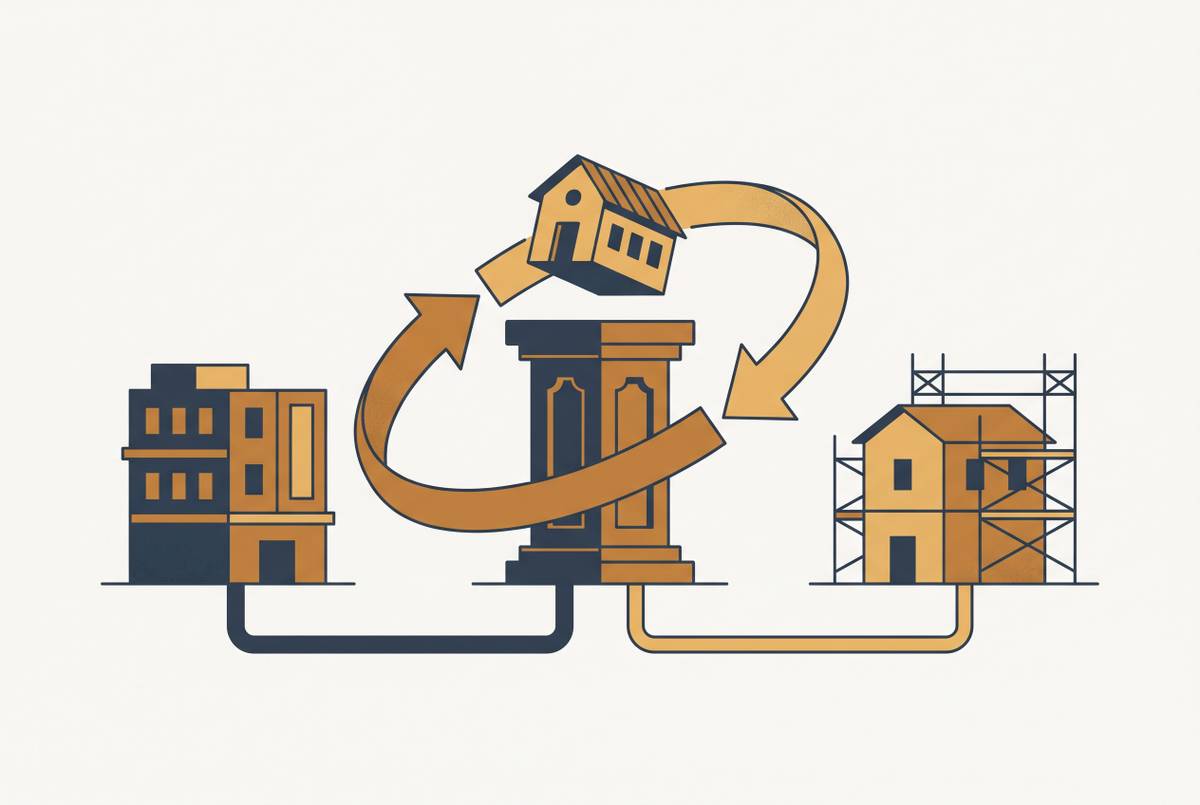
Most real estate investors reach for the same phrase when they start looking at trapped equity: they want to "access" it. But accessing equity is not one problem with one best answer. A cash-out refinance converts equity into debt while the investor keeps the asset. A 1031 exchange repositions the entire capital stack through a sale, and does so without triggering an immediate tax bill. In the exchange, a Qualified Intermediary holds all of the sale proceeds, the IRS does not treat those funds as belonging to the investor during the process, and the investor reinvests into a replacement property of equal or greater value. Landsberg Bennett's 2026 guide describes this as the IRS treating the sale and the purchase as a single continuation of ownership rather than as a taxable event, and that framing explains why proceeds sitting with a QI are never counted as received by the investor. The structural difference between the two tools, one creating liquidity through new debt and the other repositioning capital through a qualifying sale, is what drives every trade-off discussed in the sections that follow.
What a cash-out refinance costs the investor over time
A cash-out refinance lets an investor borrow against equity that has built up in a property, and the cash received is not taxable income because it comes with a repayment obligation and default risk attached to it. The property itself doesn't change hands and its tax basis, often heavily depreciated after years of ownership, stays exactly where it was. No sale occurs, so no tax event occurs, but nothing about the asset's position in the portfolio changes either.
The cost of this liquidity begins the moment the loan closes. Debt service starts immediately, and the capital that has been freed up needs to earn more than the cost of carrying that new debt for the refinance to produce a net gain rather than just a shift in leverage. That math is the entire trade-off: an investor gets cash now, in exchange for a fixed obligation that has to be serviced regardless of how the freed capital performs.
A cash-out refinance is the right tool when the goal has nothing to do with changing what property is owned. It works well for an investor who wants to hold onto a specific asset, move into a non-real-estate investment, fund a personal goal, or use the money in ways a 1031 exchange simply cannot accommodate, such as paying off debt, buying a primary residence, or covering business expenses. What it cannot do is help an investor who wants to upgrade the quality of an asset, move into a different market, change property type, reduce the burden of management, or consolidate several holdings into fewer, larger ones. Those goals all require a sale, and a refinance, by design, avoids one.
Where Investors Lose Their Deferral in a 1031 Exchange
A 1031 exchange defers capital gains tax, depreciation recapture, net investment income tax, and, in most cases, state tax as well, but that deferral is conditional on meeting hard deadlines, reinvesting every dollar of proceeds, and maintaining or increasing both the equity and the debt carried on the relinquished property. The governing law is IRC Section 1031, and under current rules following the Tax Cuts and Jobs Act, the exchange applies only to real property held for investment or business use. Personal property, a primary residence, and property held for resale by a dealer are all excluded.
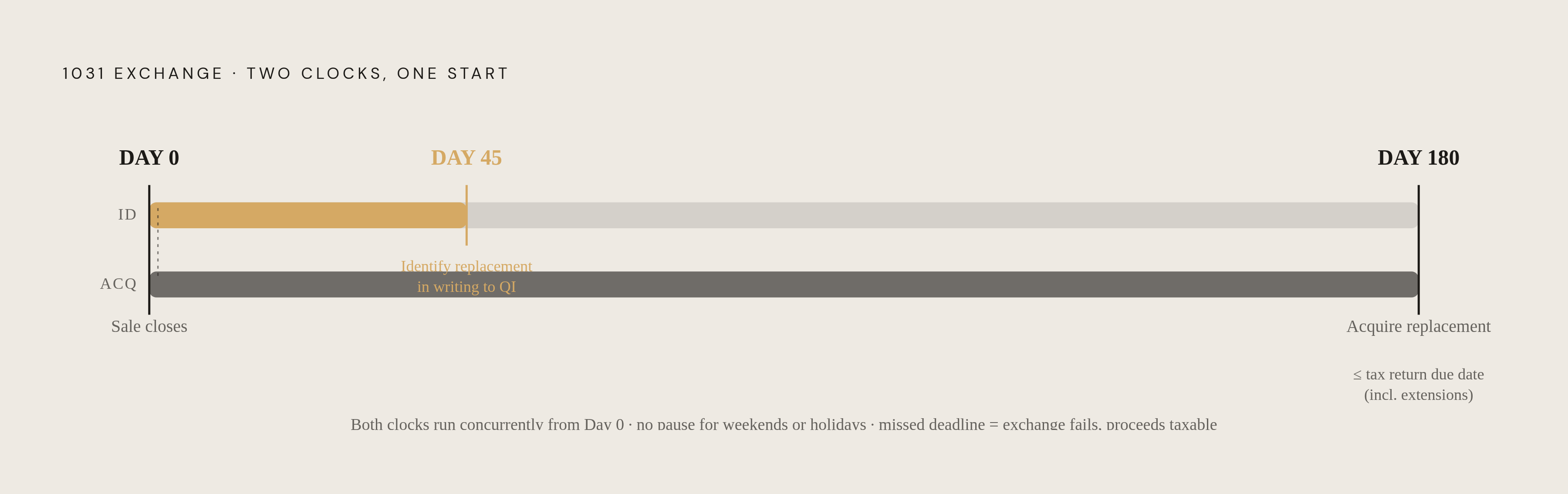
Two deadlines run from the moment the relinquished property sale closes, and both apply to every exchange without exception. CBIZ's July 2026 breakdown: by Day 45, the investor must submit a written, signed identification of replacement property to the QI, and by Day 180, acquisition of that replacement property must be complete. These two clocks run at the same time, not sequentially, and they run through weekends and holidays with no pause. The IRS does not grant extensions for financing delays, a seller who backs out, or title problems that arise late in the process, though it does grant relief for federally declared natural disasters under Revenue Procedure 2018-58. The 180-day window cannot exceed the investor's tax-return due date for the year of the sale, including extensions, a constraint that catches investors who sell late in the tax year. JTC's exchange timeline guide from May 2026 makes the point without much sympathy: if either deadline lands on a weekend or a holiday, the IRS does not move it, and as the guide puts it, the IRS doesn't care if it falls on Christmas.
Reg. §1.1031(k)-1(c)(4) offers investors a choice of identification methods, of which they may use exactly one. The option used in the overwhelming majority of exchanges is the Three-Property Rule, which allows the investor to identify up to three properties of any value, giving maximum flexibility without the all-or-nothing exposure that comes with alternative identification methods.
Full deferral is not automatic simply because a replacement property gets purchased. It requires reinvesting all of the net proceeds, replacing or exceeding the debt that existed on the relinquished property, and taking title in the same taxpayer's name. Any shortfall in any of those three areas creates what the tax code calls boot, and boot is taxable. Boot shows up in ways that catch investors off guard: buying a replacement property for less than the relinquished property sold for creates cash boot; ending up with lower net debt on the replacement property than existed on the relinquished one creates mortgage relief boot unless it's offset with additional cash; and paying non-exchange costs, such as loan fees, an owner's title insurance policy, or pre-closing property taxes, directly out of the QI-held proceeds reduces the dollars available for reinvestment and can create boot on its own.
A 1031 exchange defers tax, it doesn't erase it. Capital gains tax, depreciation recapture, net investment income tax, and any applicable state taxes all remain attached to the replacement property's adjusted basis, following the capital forward until the investor eventually sells outside of another exchange, or dies. That second outcome is where the exchange becomes genuinely powerful as a planning tool rather than just a deferral mechanism. A stepped-up basis at death can eliminate the deferred tax obligation altogether, which makes the 1031 exchange one of the more effective vehicles available for investors focused on transferring wealth across generations.
The overlap case: using a refinance before or after an exchange
An investor can use both tools in sequence, but the IRS scrutinizes a cash-out refinance executed on the relinquished property immediately before an exchange, and the safety of that move depends on whether the refinance can be shown to have an independent economic purpose.
Courts have upheld a pre-exchange refinance on the relinquished property when it was clearly not integrated with the sale transaction and was supported by a legitimate business reason that had nothing to do with pulling equity out ahead of the exchange, a standard generally described as requiring "independent economic" purpose. If the refinance instead looks like part of the same overall plan as the exchange, executed close in time with no separate rationale behind it, the IRS may treat the cash the investor pulled out as boot, or worse, as constructive receipt of the sale proceeds themselves, which would jeopardize the deferral entirely.
A refinance on the replacement property after the exchange has closed sits on much safer ground. Once the exchange is complete and the replacement property has been acquired, refinancing it to pull out equity has no bearing on the exchange that already happened. This is, in practice, the sequence many investors actually use: complete the exchange first to defer tax on the full gain, and only then refinance the replacement property to access liquidity without creating a new taxable event. None of this substitutes for advice specific to an investor's own transaction, and anyone considering this sequence should work through the timing and structure with tax counsel before acting on it.
What each tool solves and the investor situations where the choice becomes clear
The choice between a cash-out refinance and a 1031 exchange isn't a matter of ranking one instrument above the other in the abstract, since the right choice is determined not by which tool is "better" but by what the investor is actually trying to accomplish, and in many cases the goal itself reveals that only one of the tools is even available.
An investor who wants liquidity but intends to keep a specific appreciated asset has only one real option, since a 1031 exchange requires a sale and full reinvestment of proceeds, which rules it out entirely for this purpose. The same is true for an investor who wants to use the proceeds for something outside of real estate, whether that's paying off personal debt, buying a primary residence, covering personal expenses, or investing in something unrelated to property. A cash-out refinance is the correct tool here, because a 1031 exchange locks every dollar into replacement real estate and creates taxable boot on anything that isn't reinvested.
The picture flips for an investor who wants to reposition out of an asset entirely, whether that means switching property type, moving to a new geography, changing the tenant profile, reducing management intensity, or simply scaling up or down, all without triggering tax on the gain that has accumulated. A refinance cannot touch this goal because it doesn't involve a sale at all, and a 1031 exchange is the only path available. The exchange is also the clear choice for an investor facing a large capital gain and a significant depreciation recapture bill that would meaningfully cut into the funds available for reinvestment; preserving the full pre-tax proceeds so they keep compounding inside the replacement property typically outweighs exchange complexity and QI cost. For an investor trying to consolidate a scattered portfolio into fewer, higher-quality holdings, a 1031 exchange again does the work a refinance cannot, since multiple relinquished properties can be structured into a single replacement, or a single property can be exchanged into several.
An investor moving toward passive ownership without wanting to trigger a tax event has a specific structure available inside the exchange itself: a Delaware Statutory Trust, identified in the 2026 Angel Investors Network guide as a viable replacement-property option for accredited investors who need passive management or who cannot source a direct property fast enough to meet the identification window. And for investors thinking generationally, a 1031 exchange held until death allows heirs to receive a stepped-up basis and potentially sell with little or no tax consequence at all, an opportunity a cash-out refinance leaves completely untouched, since it never changes who owns the asset or what basis attaches to it.
Not every situation sorts cleanly into one category. An investor who needs some liquidity now while also wanting to reposition the underlying asset is facing a mixed goal, and in that case the combined strategy described earlier, completing the exchange first and refinancing the replacement property afterward, is worth modeling directly with a tax advisor before committing to either path. This overlap, using a refinance before or after an exchange, is the scenario most sophisticated investors actually face, and the IRS scrutiny attached to it is precisely what makes sequencing matter.
Where the 45-day identification window breaks down
Every deadline inside a 1031 exchange matters, but the 45-day identification window is the one that most often catches investors off guard, and starting to prepare for it before the relinquished property even closes can prevent an unplanned tax bill. JTC's exchange timeline guide from May 2026 recommends beginning the search for replacement property before the sale of the relinquished property closes at all; having candidates already identified by Day 0 removes most of the pressure that builds once the 45-day clock starts running.
Identification becomes irrevocable the moment Day 45 passes, and written, signed identification must be submitted to the QI by midnight of that day, since verbal discussions and vague descriptions are insufficient under IRS rules. Changes can be made freely up until Day 45, but once the deadline passes, the investor is locked into the identified properties, and if none can be acquired, exchange funds sit until the close of the exchange period and are then returned as taxable boot. There is a way to sidestep the identification step altogether: closing on the replacement property before the identification deadline arrives means the property is deemed identified by contract, though keeping a clear paper trail for the CPA is still good practice even when this shortcut applies.
The form of the identification matters as much as the timing. Most investors end up using the Three-Property Rule, identifying up to three properties of any value, because it offers the most flexibility with the least exposure compared to the alternative identification methods, which carry an all-or-nothing acquisition requirement.
None of the pressure inside this window is theoretical. Market competition, financing delays, and due diligence timelines all compress inside the 45-day window, so early preparation is a structural requirement of the process itself.
The Risk in Qualified Intermediary Selection
Once an investor decides to pursue a 1031 exchange, the next decision, who holds the proceeds during the exchange period, carries more weight than it might first appear. Because QIs are largely unregulated at the federal level and QI insolvency has cost investors millions, choosing the right intermediary is not an administrative detail; it is one of the most consequential decisions in the exchange process.
No federal agency oversees QIs directly. Nevada is the only state that requires a QI to be licensed, and in every other state, the full responsibility for vetting a firm before committing exchange funds to it falls on the investor. The 2026 Angel Investors Network guide points to cases where QI insolvency cost investors millions after proceeds were held in commingled accounts, a risk that proper fund segregation avoids entirely.
Evaluating a QI comes down to a small number of concrete key criteria. Exchange proceeds should be held in segregated, FDIC-insured qualified trust or escrow accounts, and investors should ask directly how the funds are held, because many QIs keep proceeds in a single commingled account that is insured only up to the standard per-depositor FDIC limit, an amount that falls far short of the proceeds generated by a typical real estate sale. Fidelity insurance coverage, proof of how long the firm has operated, and a clear written explanation of how funds are segregated from the QI's own operating accounts all belong on the list of questions an investor asks before signing an agreement and wiring a single dollar of exchange proceeds anywhere.
Sources
- 1031 Exchange Timeline: Deadlines, Rules & Expert Answers
- 1031 Exchange Guide 2026: Rules, Timelines, DST Options
- 1031 Exchange Explained: Rules, Timeline, and Guide for Property Owners
- 1031 Exchange Deadlines: 45-Day and 180-Day Rules Explained
- 1031 Exchange Timing Rules Explained: Deadlines, Extensions and the 180-Day Rule