DST Investment Fees and Load Structures Investors Should Know
Hidden DST fees can easily consume 15 percent of your initial investment before returns begin.
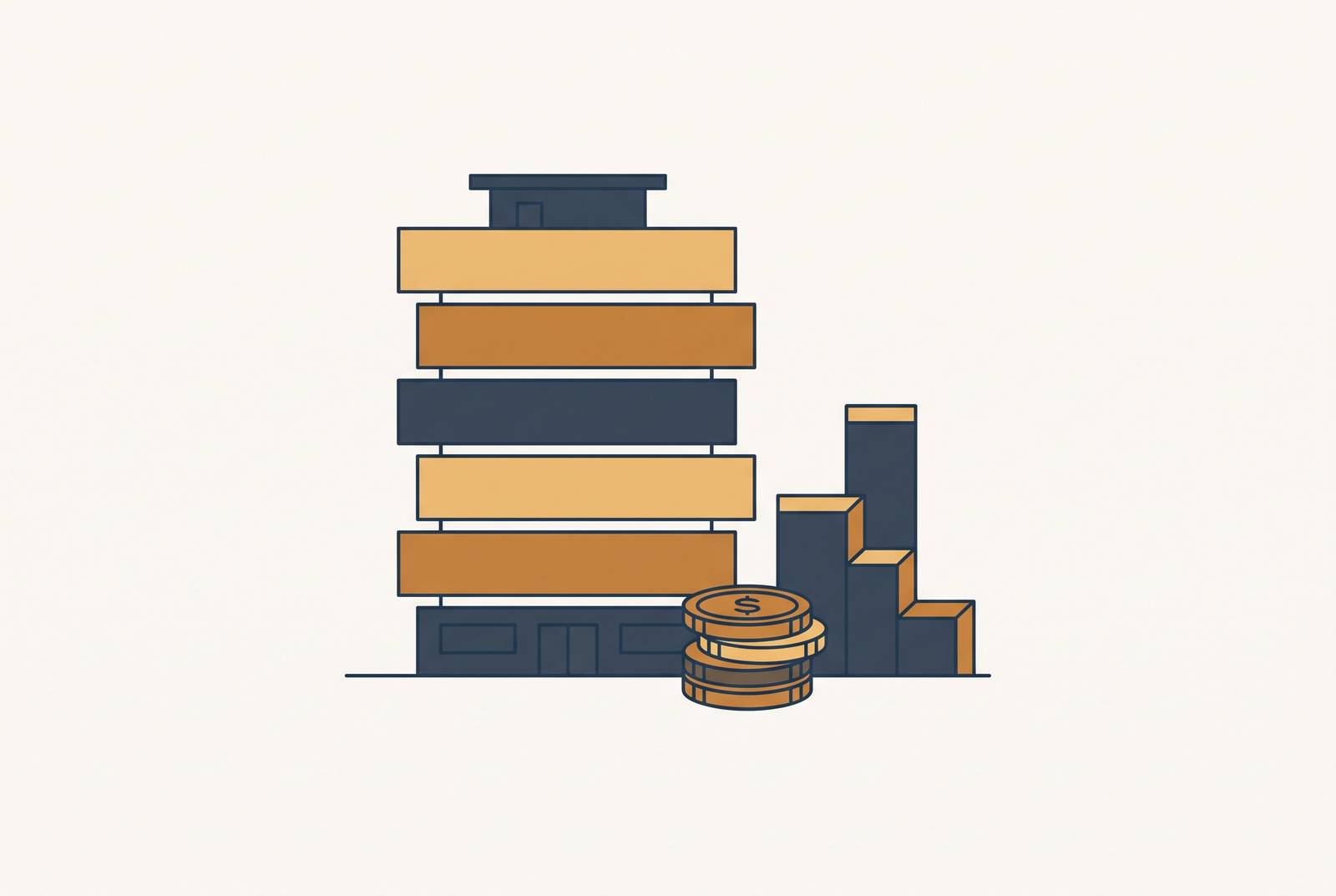
DST fees do not appear as a single line item; each layer is embedded in the structure itself and must be found in the offering documents. Anyone rolling 1031 exchange proceeds into a Delaware Statutory Trust needs to understand each layer before signing, because the fee stack is embedded in the structure itself, not bolted on as an afterthought https://origininvestments.com/3-factors-advisors-must-consider-to-help-clients-avoid-dst-yield-traps/. DST Investment Fees and Load Structures Investors Should Know.
DST fee structures compared with most real estate investments
Investors do not buy the building. They buy a fractional beneficial interest in the trust that owns it, which is a meaningfully different legal position than holding a deed outright.
That distinction exists for a specific reason. IRS Revenue Ruling 2004-86 confirmed that a beneficial interest in a DST qualifies as like-kind property for purposes of a 1031 exchange, and that single ruling is what has channeled billions of dollars into these offerings every year since What Real Estate Investors Should Know Before Investing Into a DST / Wealthstone Group DST as 1031 Replacement Property: Fees, Restrictions, and Institution…. That has become a mainstream corner of the exchange world. It is a mainstream destination for exchange capital, and the scale of it is exactly why the fee structure deserves scrutiny.
The tradeoff for that 1031 eligibility is passivity, and it is not optional What Real Estate Investors Should Know Before Investing Into a DST / Wealthstone Group DST as 1031 Replacement Property: Fees, Restrictions, and Institution…. Seven IRS requirements govern how a DST can operate: no new debt and no refinancing of existing debt except in narrow emergency circumstances, no capital improvements beyond routine maintenance, and no ability for investors to direct property management decisions What Real Estate Investors Should Know Before Investing Into a DST / Wealthstone Group DST as 1031 Replacement Property: Fees, Restrictions, and Institution…. Investors are locked out of the operating decisions. That passivity is not a sponsor's preference or a marketing choice, it is the statutory price of admission for 1031 treatment What Real Estate Investors Should Know Before Investing Into a DST / Wealthstone Group DST as 1031 Replacement Property: Fees, Restrictions, and Institution….
That structural reality is exactly why the fees look different from anything else in real estate investing. A DST sits at the intersection of real estate ownership, securities regulation, and tax law simultaneously, and each of those domains requires its own infrastructure: licensed distribution channels, legal structuring, and ongoing compliance, each of which generates a cost category. Every one of those functions generates a cost category. So when comparing DST fees to a brokerage commission or a REIT expense ratio, the comparison breaks down fast, because DST fees are not a toll charged on top of the investment. They replace costs an investor would otherwise bear directly: sourcing a property, underwriting it, arranging financing, staying compliant, and eventually executing an exit. These costs exist.
The upfront load: contents, recipients, and day-one cost
The upfront load has three components. Selling commissions go to the broker-dealers and registered representatives who distribute the offering and run suitability review, and this exists because sponsors are generally barred from selling DST interests directly, since these are regulated securities. Organization and offering costs cover the legal, accounting, printing, marketing, and filing work of structuring the trust itself. Acquisition fees go to the sponsor for sourcing, underwriting, and closing on the underlying property, compensating the transactional legwork that put the deal together.
Offerings distributed through brokers and commission-based advisors run higher, sometimes topping 15 percent, and separate sourcing puts the commonly cited syndication fee range at 10 to 15 percent as well 4 Factors Investors Should Consider to Avoid a DST Yield Traps / Origin Investments ABC Money. The range matters because it is wide enough that two DST offerings with identical properties and identical projected yields can produce very different outcomes for the investor, purely based on load.
The day-one math is blunt. A 15 percent load on a $1 million investment means the effective deployed capital is $850,000, and the underlying property has to generate an 18 percent total return before the investor even gets back to even, a hole the investor starts in rather than a return target 4 Factors Investors Should Consider to Avoid a DST Yield Traps / Origin Investments ABC Money. That is not a return target. That is a hole the investor starts in. One illustrative example from the market: a property valued at $50 million, with $6 million in sponsor fees and $1 million in standard closing costs layered on top, requires a DST offering of $57 million to close, and the investor is down 12 percent before the trust owns a single square foot DST Sponsors 2026: Evaluation Guide & Property Types Compared.
Marketing materials rarely say any of this. They lead with yield, because yield is the number that sells, and the load is buried in the offering price rather than itemized as a deduction anyone can see at a glance. Finding the real number means going into the PPM and doing the arithmetic. Blackstone's 2025 DST platform through BREIT reported upfront loads in the 6 to 8 percent range, well under the 10 to 15 percent industry standard ABC Money What Real Estate Investors Should Know Before Investing Into a DST / Wealthstone Group. That does not mean every traditional sponsor's load is unjustified. But an institutional player demonstrating that lower loads are structurally achievable puts real pressure on the rest of the market to explain the gap ABC Money What Real Estate Investors Should Know Before Investing Into a DST / Wealthstone Group.
Ongoing fees during the hold period: asset management, property management, and other recurring charges
The load is only the entry cost. Once the trust owns the property, the sponsor or an affiliate typically charges an asset-management fee for overseeing the investment: monitoring performance, administering the master lease, handling investor reporting and distributions, running the trust's back office. That fee usually shows up as a percentage of assets, gross revenue, or equity, and the range across sources runs 0.5 to 2 percent annually, with property management fees separately running 3 to 6 percent of gross revenue DST Sponsors 2026: Evaluation Guide & Property Types Compared.
Beyond those two, other recurring charges can appear depending on the sponsor and the deal: fees for coordinating debt on the property, administrative charges tied to running the trust itself, and reserve contributions withheld from distributions to fund future capital needs. That last one deserves attention, because DSTs cannot make capital calls under IRS rules, so any reserve for a roof replacement or a major system repair has to be pre-funded out of investor distributions rather than raised later.
Reserves also open the door to a subtler problem. A sponsor can raise more equity than the deal strictly needs, park the excess in reserves, and use it to prop up distributions that look stronger than the property's actual income supports. Sponsors may raise more equity than needed to inflate reserves and supplement distributions, so a higher-than-expected yield can be partly a return of capital rather than property income, with potential tax consequences for 1031 exchangers, and details of this practice are often buried in offering document fine print.
The gap between advertised yield and net yield compounds over time. Average year-one cash flow across the DST market sat at 4.86 percent in 2025, and a DST marketed at a 6 percent gross yield can net closer to 4 percent once ongoing fees are subtracted out. Over a one-year hold that gap is a rounding error. Duration amplifies the cost, as a five-to-ten-year hold means even a modest annual fee creates a meaningful drag on total return, and ongoing fees deserve the same scrutiny as the upfront load.
Disposition fees and sponsor promotes: what investors pay when the property sells
The fee stack does not end when the hold period does. In most DST structures the sponsor collects compensation at three separate points: upfront, throughout the hold, and again at disposition. The exit is not a fee-free event just because the entry and the hold already carried a cost.
The disposition fee compensates the sponsor for executing the sale: managing the transaction, marketing the asset to buyers, and closing the deal, usually calculated as a percentage of the gross sale price. On top of that, many structures include a sponsor promote, a carried-interest arrangement where the sponsor participates in the upside once returns clear a specified preferred-return threshold. In theory that aligns sponsor and investor incentives around performance. In practice, it also means that if the deal performs well, a meaningful share of the exit-year economics flows to the sponsor rather than staying entirely with the investor.
For an investor planning to roll DST proceeds into a subsequent 1031 exchange, this layer carries specific weight What Real Estate Investors Should Know Before Investing Into a DST / Wealthstone Group DST as 1031 Replacement Property: Fees, Restrictions, and Institution…. Disposition fees and promote distributions reduce the net proceeds available for that next exchange, which compresses the exchangeable basis exactly at the moment the investor is trying to preserve as much capital as possible. Taken together, the upfront load, the ongoing management drag, and the disposition and promote charges are exactly what produces the 25 to 35 percent cumulative erosion figure that defines the full stack across a typical hold. Disposition fees are disclosed in the PPM but rarely emphasized in advisor conversations, and per S3, investors who focus only on yield and entry-load miss the exit economics entirely.
How the layers interact: modeling what fees cost across a typical hold period
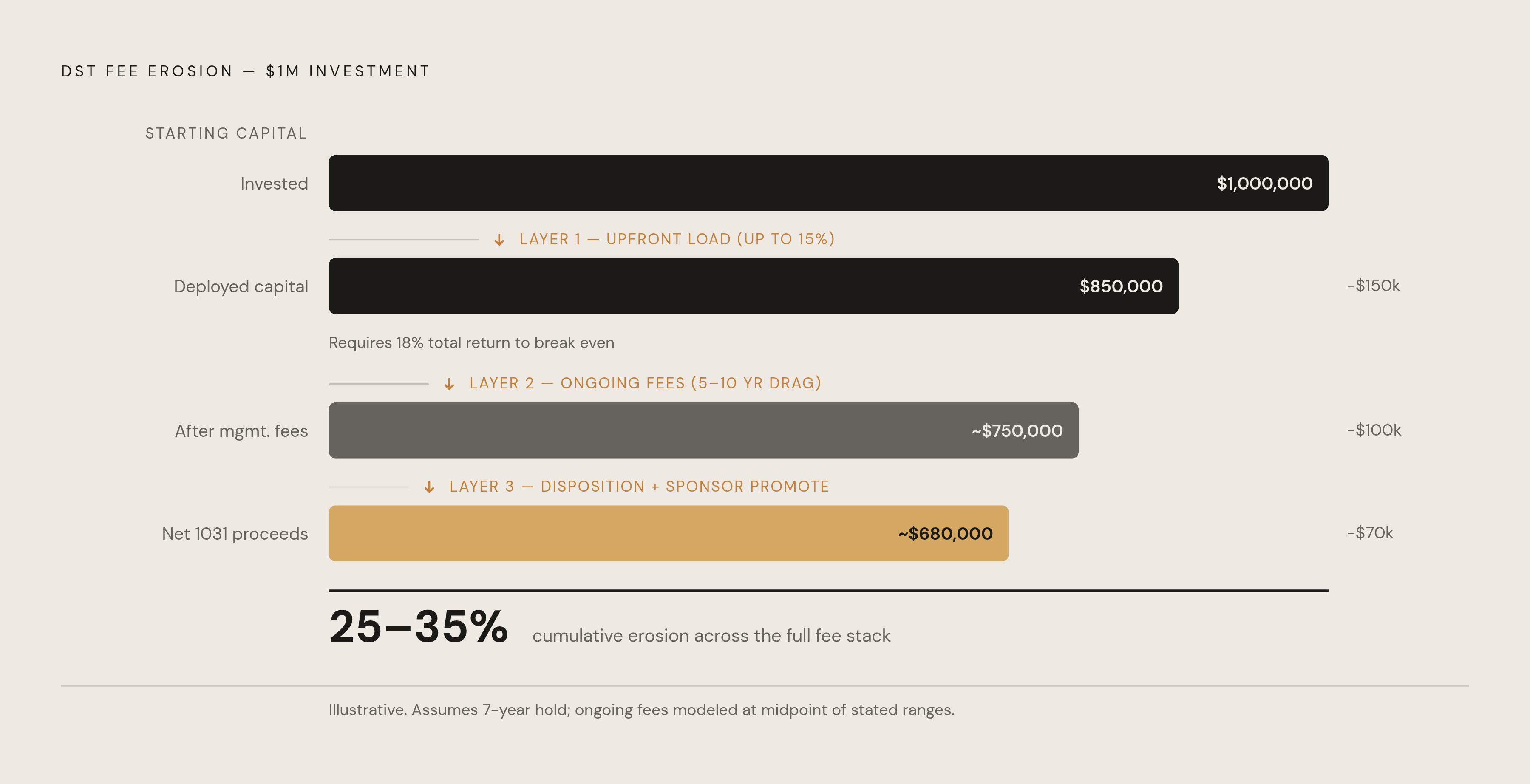
Running the numbers in sequence sharpens the picture. Start with a 15 percent upfront load: only 85 cents of every invested dollar reaches the property, and the investor needs an 18 percent total return just to break even. Layering in an annual management fee of 1 to 2 percent across a five-to-seven-year hold compounds the effective cost well past what a simple one-time load comparison would suggest. Adding disposition fees and a promote at sale shrinks the proceeds available to the investor at exit, or available to roll into the next exchange, further still.
Yield alone hides all of this. A $1 million investment earning a 6 percent yield over five years produces meaningful cash flow, but if the upfront load is 15 percent, the investor needs substantial appreciation just to recover the entry cost. But if that same deal carries a 15 percent upfront load, the investor needs substantial appreciation on top of that cash flow just to recover the entry cost, and a yield figure by itself never communicates that hurdle. The comparison gets even starker side by side: a DST with a 4.5 percent yield and 4 percent total upfront fees produces a positive first-year return of 5.3 percent, while a DST advertising a higher 5.0 percent yield but carrying 16 percent in upfront fees produces a first-year loss of 6.8 percent. The higher-yield product is the worse deal once fees enter the picture, by a wide margin.
For exchange proceeds specifically, the stakes are proportionally larger than they'd be for ordinary investment capital. An investor moving 1031 proceeds into a DST is typically deferring tax on a large accumulated gain, and the entire pre-tax amount is what's at work in the structure What Real Estate Investors Should Know Before Investing Into a DST / Wealthstone Group DST as 1031 Replacement Property: Fees, Restrictions, and Institution…. Fee erosion eats into capital that carries a deferred tax liability attached to it. No individual fee in the stack tells the whole story on its own. It's the interaction of all three layers that determines what an investor actually keeps.
Fee locations and PPM disclosures
Marketing materials and one-page summaries are built to lead with the distribution rate, because that is the number that closes deals. Fee loads sit embedded in the offering price rather than presented as a visible line-item deduction, and finding them takes deliberate effort.
The PPM is the document that actually settles the question. Every component of the upfront load, every ongoing fee, the disposition charge, and the promote structure are all disclosed there, but the disclosure only works if someone reads it closely rather than skimming for the yield figure. A handful of sections are worth going to directly: the use-of-proceeds section shows exactly how each invested dollar splits between real estate and fees, the compensation-to-sponsor section itemizes every payment the sponsor and its affiliates stand to receive, the distribution policy and reserves section reveals whether distributions are backed by property income or by reserve drawdowns, and the debt terms section lays out loan maturity, interest rate structure, and refinancing risk that affects exit value independent of the fee stack.
Beyond the document itself, sponsor track record is the check that catches what a PPM alone cannot. Distribution history relative to a sponsor's own initial projections, which sponsors can provide for prior offerings, is the clearest signal available of whether a deal performed the way it was pitched. A sponsor running many active DSTs but few completed dispositions has an execution record that is still unproven, whereas a sponsor with documented full-cycle dispositions has something verifiable to point to. Asking for disposition history, not just the current yield on an open offering, is the single most useful question available to a prospective investor. Specific sections to review in any PPM.
The sponsor concentration risk that fee analysis alone won't catch
Fee math misses one risk entirely, and it has nothing to do with percentages. Investors often hold interests across several DST properties and assume that spreads risk. If every one of those properties was originated by the same sponsor, the portfolio is concentrated at the organizational level even though it looks diversified at the asset level.
That concentration matters because sponsor-level problems, regulatory trouble, management turnover, a cluster of underperforming assets, can hit every DST an investor holds from that sponsor at the same time, regardless of how many separate properties are technically in the portfolio. Real diversification means exposure across multiple sponsors, not multiple buildings from a single one. Fee structures are sponsor-specific too: a favorable load from one sponsor says nothing about another sponsor's pricing, so an investor assembling a multi-sponsor portfolio has to evaluate each offering's fees on its own terms rather than assuming consistency.
Advisor access is the practical constraint here. An advisor with broad DST market access can build a portfolio across sponsors; an advisor tied to a single sponsor's platform cannot offer that protection no matter how good the individual deal looks. And because DST interests are illiquid, there is no practical way to exit mid-hold if sponsor-level problems occur later, so this risk compounds silently across the full five-to-ten-year term.
Evaluating DST fees in the context of a 1031 exchange: what the timeline pressure changes
None of this happens in a vacuum. That speed is a genuine advantage. Fee discipline also tends to erode here, because an investor racing a 45-day clock gives a load structure far less scrutiny than the same investor would in an unhurried decision.
The math makes that lapse expensive. A 15 percent load on $1 million of exchange proceeds is $150,000 gone before the property does anything, and a poorly structured or failed exchange can cost even more once the deferred tax liability comes due. Speed of identification and quality of fee structure are two separate questions, and treating fast identification as a substitute for fee review is how investors end up in the wrong deal. Multifamily properties make up 42 percent of available DST inventory, the largest single sector, and under time pressure investors often default to whatever asset class has the most available supply rather than the most fee-efficient offering.
There's a related cost that sits just outside the DST fee stack but still eats into the same pool of capital. The qualified intermediary holds exchange proceeds during the identification period, and the interest earned on those funds, whether it is shared with the investor or retained by the QI, is a separate but real cost layer on top of DST fees. A no-fee QI model that shares interest earned on held funds with the investor removes that added cost entirely: an investor is not paying QI fees on top of DST load fees, and is earning interest during the identification window rather than losing it to the intermediary holding the funds. The 45-day identification window creates real pressure, as investors must identify replacement property within 45 days of closing the relinquished property sale, and DSTs are often chosen partly because they can be identified quickly.
Questions to ask a DST sponsor before committing exchange proceeds
On the upfront load, a 15% load on a $1 million investment means the investor's effective deployed capital is $850,000, and the property must generate an 18% total return before the investor breaks even 4 Factors Investors Should Consider to Avoid a DST Yield Traps / Origin Investments ABC Money. Ask for the use-of-proceeds breakdown in the PPM so it's clear how much of each dollar reaches the real estate itself. Ask how the sponsor's load compares to the 7 to 12 percent range that's typical across the market, and if it runs higher, ask what specifically justifies the premium.
On ongoing fees, ask what the annual asset-management fee is and what base it's calculated against, assets, gross revenue, or equity, since those produce very different dollar amounts. Ask directly whether any current distributions are being supplemented by reserve drawdowns rather than property income, and ask where that would be disclosed if it were happening.
On exit economics, ask what disposition fee applies at sale and whether it's calculated on gross sale price or net proceeds. Asking what the promote structure looks like reveals what preferred-return threshold triggers the sponsor's participation in upside.
On track record, ask how many DSTs the sponsor has taken through a full disposition cycle, and ask for documented investor returns on those completed deals rather than projected returns on active ones. And on the qualified intermediary side of the same transaction, confirm who is actually holding the exchange funds, whether those funds are held in a segregated account, and what happens to any interest those funds earn while sitting with the intermediary.
Sources
- What Real Estate Investors Should Know Before Investing Into a DST
- 4 Factors Investors Should Consider to Avoid a DST Yield ...
- DST Sponsors 2026: Evaluation Guide & Property Types Compared
- How Much Should You Pay for a DST? Examining DST Fee Structures | ABC Money
- DST as 1031 Replacement Property: Fees, Restrictions, and Institutional Economics — Apers