Using DSTs to Solve the 45-Day Identification Deadline
DSTs let investors meet the strict 45-day identification deadline.
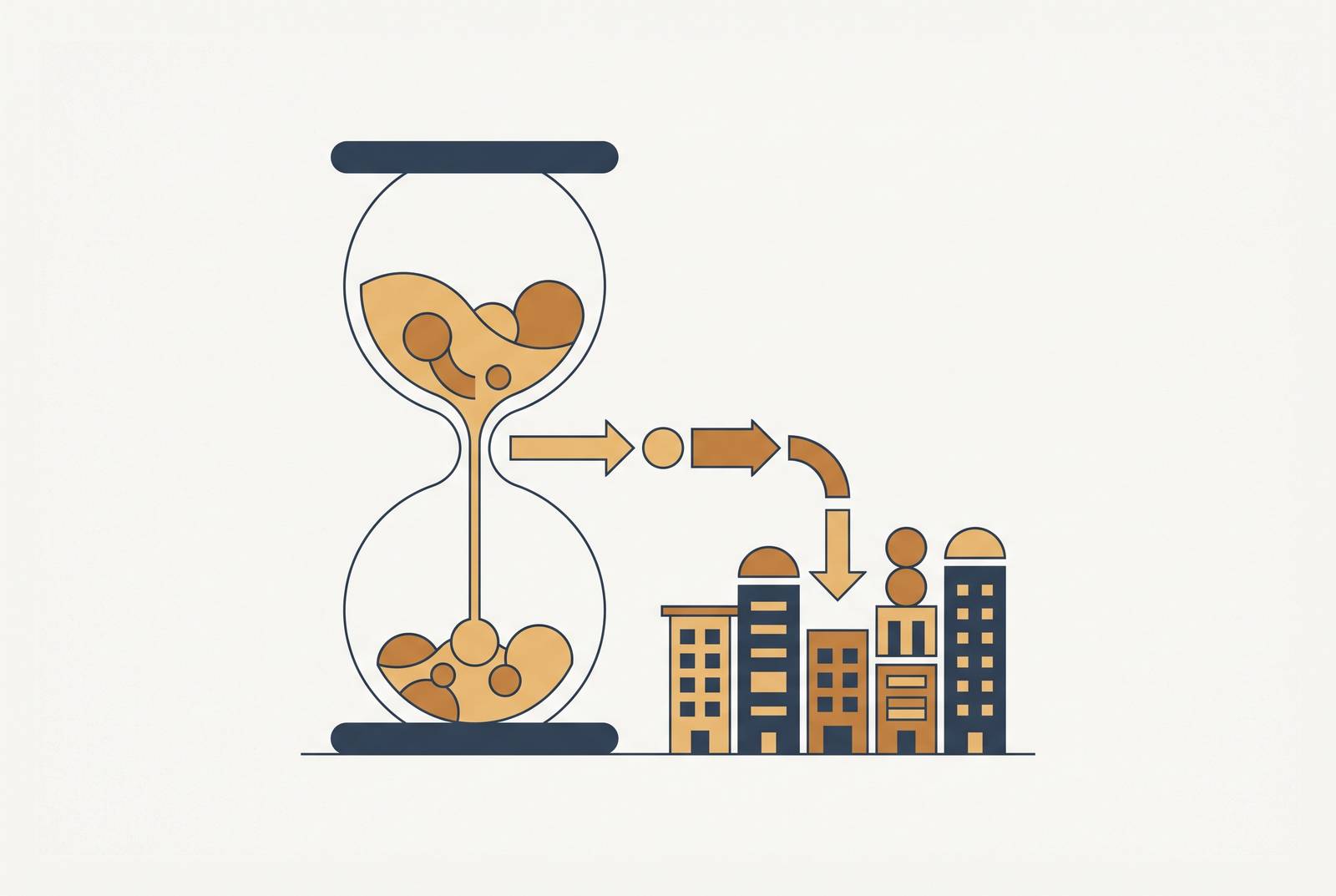
Most of the anxiety around a 1031 exchange gets pointed at the 180-day closing window, but that target is misplaced 1031 Exchange Guide 2026: Rules, Timelines, DST Options. When an exchange dies, it usually dies inside the 45-day identification deadline 1031 Exchange Guide 2026: Rules, Timelines, DST Options. That deadline runs on calendar days with no relief mechanism built into the ordinary course of a transaction. Weekends don't pause it, holidays don't pause it, and neither does a lender dragging its feet or a seller backing out at the last minute. Day 45 is day 45.
The financial consequence of missing it isn't proportional, and there's no partial credit. Blow past the deadline and the entire gain the exchanger was deferring comes due in that tax year: federal capital gains at 15 to 20%, depreciation recapture at 25%, whatever the state charges, and the 3.8% net investment income tax stacked on top The Ultimate 1031 Exchange Guide (2026).
The Three Property Rule lets an exchanger name up to three properties regardless of their combined value. The 200% Rule allows any number of properties, provided their combined fair market value stays at or under 200% of the relinquished property's fair market value 1031 Exchange Guide 2026: Rules, Timelines, DST Options. A third option, the 95% Exception, permits naming any number of properties at any value, but only if the exchanger actually closes on 95% of what got identified 1031 Exchange Guide 2026: Rules, Timelines, DST Options. That bar is high enough that it's rarely used in practice 1031 Exchange Guide 2026: Rules, Timelines, DST Options. Exceed the Three Property or 200% limits without satisfying the 95% exception, and the IRS treats the exchange as if no property was identified at all, a total failure 1031 Exchange Guide 2026: Rules, Timelines, DST Options.
A second, quieter deadline sits inside the first one. The 180-day window can't run past the exchanger's tax-return due date for the year of sale, including extensions 1031 Exchange Guide 2026: Rules, Timelines, DST Options The Ultimate 1031 Exchange Guide (2026). An investor who sells late in the fourth quarter and skips filing for an extension can lose real days off the back end of the exchange without ever noticing. Under guidance IPX1031 updated in December 2025, exchanges begun between October 17, 2025 and December 31, 2025 must close by April 15, 2026, absent an extension 1031 Exchange Guide 2026: Rules, Timelines, DST Options The Ultimate 1031 Exchange Guide (2026). None of this is paperwork trivia. It's the actual mechanism by which exchanges fail, and understanding it changes how an investor should think about replacement property from the moment the relinquished property goes under contract. The only recognized exception is a federally declared disaster, under which the IRS may grant extensions of up to 120 days under Revenue Procedure 2018-58.
Why the IRS treats DSTs as qualifying replacement property
A Delaware Statutory Trust is a legal entity formed under Delaware's trust statute, 12 Del. C. § 3801 and following, built to hold a single real estate asset, usually something institutional in scale, such as a multifamily complex, an industrial park, or a commercial office building. Investors don't buy the property directly. They buy a beneficial interest in the trust that owns it, becoming fractional co-owners of the underlying asset without taking on the management burden that comes with direct ownership.
IRS Revenue Ruling 2004-86 confirmed that a properly structured DST is classified as a grantor investment trust for federal tax purposes, with each investor's beneficial interest treated as a direct undivided fractional interest in the underlying real property, qualifying for like-kind exchange treatment under §1031. That classification is the reason a DST interest is eligible for exchange treatment at all. Without the ruling, a DST interest looks like a security rather than real estate, which would disqualify it from exchange treatment entirely. The ruling is the foundation the entire industry stands on.
Because a DST interest is legally a security even while it's treated as real property for exchange purposes, it comes wrapped in securities regulation. Offerings go out under Regulation D and stay restricted to accredited investors, a rule the SEC imposes because these interests are illiquid, privately placed, and not something a retail investor should stumble into without financial cushioning. Accredited status generally means a net worth over $1 million excluding the primary residence, and the minimum investment often starts around $100,000, lower than most direct property acquisitions Anchor 1031 Complete 1031 Exchange Guide. Sponsors keep an inventory of pre-assembled offerings, fully documented and ready to go. An investor isn't negotiating a deal from scratch; the investor is choosing from what already exists. DSTs are not a workaround or a gray-market maneuver. They're an IRS-sanctioned structure with a clear statutory and ruling basis, and that basis is what lets them function as a legitimate deadline-management tool.
DSTs and the 45-Day Problem
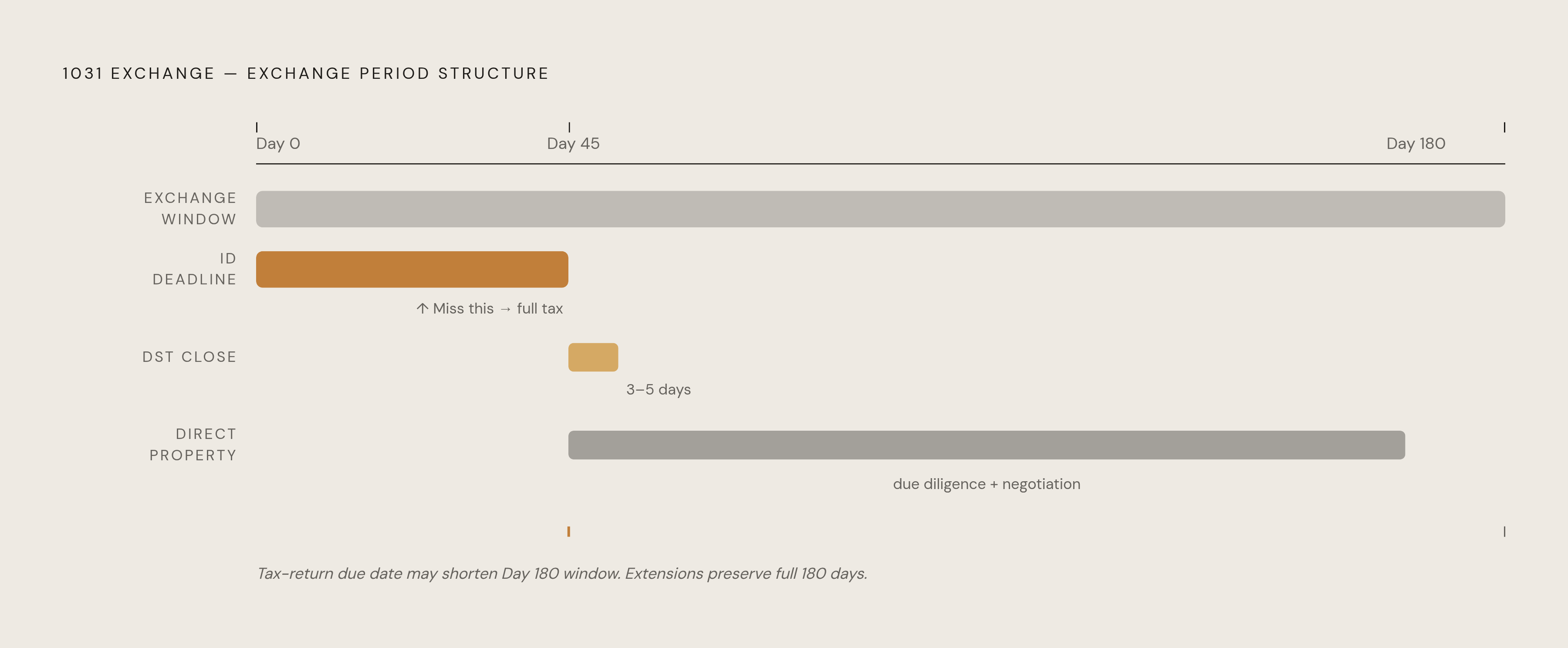
Speed is the whole argument. Once the relinquished property sells, a DST interest can typically close within 3 to 5 business days, Bonaventure's guide to DST 1031 exchanges notes, a timeline direct acquisitions simply cannot match Bonaventure DST 1031 Exchange Guide. Direct property drags an exchanger through negotiation, due diligence, financing contingencies, title work, inspection periods, and whatever timeline conflicts the seller happens to be carrying, and none of those steps pauses the IRS clock while it works itself out 1031 Exchange Guide 2026: Rules, Timelines, DST Options. The 45-day window doesn't care that the seller's attorney is on vacation or that the lender's underwriter needs another week.
A dual-track identification strategy takes direct advantage of mechanics already built into the identification rules. An exchanger can name a target direct property and, in the same 45-day window, name one or more DST offerings as backup. If the direct deal closes on schedule, the DST identification simply goes unused. If the direct property falls through, the identified DST becomes the fallback, provided it was named in the written identification notice before day 45 1031 Exchange Guide 2026: Rules, Timelines, DST Options. The rule allows up to three identified properties, of any type.
Executing this correctly comes down to paperwork discipline. The identification notice for a DST needs an unambiguous, distinguishable legal name for the trust entity, and naming the underlying property address too is standard practice, consistent with the specificity the regulations demand under Treas. Reg. §1.1031(k)-1(c), even though the IRS hasn't issued guidance specific to DST identification language. The notice has to be signed by the exchanger and delivered to the Qualified Intermediary, not to an attorney or a broker, since both count as the exchanger's own agents and are disqualified from receiving it 1031 Exchange Guide 2026: Rules, Timelines, DST Options. IPX1031's stated best practice is to get the notice to the QI before the close of business on the day before the deadline, not at midnight on day 45 itself, so there's time to confirm it actually arrived 1031 Exchange Guide 2026: Rules, Timelines, DST Options.
The scale of capital moving through DSTs suggests this isn't a niche fallback anymore. DST sponsors raised roughly $8.41 billion in equity in 2025, up 49% from $5.66 billion in 2024, anchor1031.com reports Anchor 1031 DST Hub. That growth tracks a broader shift in how investors use the structure: less a passive-income sleeve now, more a genuine mechanism for keeping exchanges alive when the direct-property route stalls Anchor 1031 DST Hub.
Trade-offs of choosing a DST over direct ownership
The same Revenue Ruling that opened the door to DST eligibility also locked the structure into a narrow set of operating restrictions the industry calls, somewhat informally, the "seven deadly sins". That's not a footnote. It shapes everything about how a DST can and can't be run.
Control is the first thing to go. The quality, solvency, and asset management of the DST sponsor directly affects the investor's outcome, and investors have no recourse to redirect the asset. Investors who've built a strategy around cost segregation studies should note a specific constraint here too: depreciation recapture cannot be deferred after a cost segregation study has already been completed in a DST exchange, which closes off a planning tool some direct-ownership investors lean on heavily.
Sponsor risk drives the outcome directly, and there's no lever an investor can pull to redirect the asset if the sponsor underperforms. None of this makes a DST a lesser product. It makes it a different one. A DST solves a deadline problem; it's not a substitute for direct ownership among investors who want operational control or the ability to force a sale on their own timeline. The right moment to reach for one is specific: a failing timeline, no suitable direct property in hand, and a genuine need for a qualifying replacement asset before day 45 or day 180 runs out 1031 Exchange Guide 2026: Rules, Timelines, DST Options. It isn't the default answer for every exchanger in every situation. DST interests are illiquid, typical holding periods run 5 to 10 years according to anchor1031.com, and there's no established secondary market, the Anchor 1031 Complete 1031 Exchange Guide states.
Serial exchanges and estate planning extending the DST's value beyond the immediate deadline
The DST doesn't have to be the end of the road. When the sponsor eventually sells the underlying property, the investor holding a beneficial interest can roll the proceeds into another exchange, either a new DST or direct property, and keep the deferral running. Chained together across multiple cycles, serial exchanging lets the original tax gain keep deferring indefinitely. The decision to use a DST to save a failing exchange can end up compounding in value well past the immediate crisis it solved.
Estate planning is where the structure's long-term value gets most concrete. At death, heirs receive a step-up in basis to the property's fair market value, which wipes out the capital gains tax that had been deferred across however many exchange cycles came before. It becomes a durable estate-planning instrument.
None of this is without political risk. Section 1031 has drawn repeated reform proposals over the years, and the most recent significant one, in the administration's FY 2025 Green Book, floated capping 1031 gain deferral at $500,000 per taxpayer, or $1 million for joint filers, per year Anchor 1031 Complete 1031 Exchange Guide. Anchor1031.com reports that as of early 2026 nothing has been enacted, but anyone building a strategy around multiple future exchange cycles, rather than a single transaction, should track this risk Anchor 1031 Complete 1031 Exchange Guide. Still, the core logic holds regardless of legislative noise: choosing a DST to survive a failing 45-day window isn't a consolation prize. It keeps the investor inside the 1031 system altogether, which is the only way serial deferral, estate planning, and the step-up at death ever become available in the first place 1031 Exchange Guide 2026: Rules, Timelines, DST Options.
Verifying QI selection, fund security, and DST readiness before the clock starts
None of the DST strategy works if the Qualified Intermediary handling the exchange isn't set up correctly before the sale even closes 1031 Exchange Guide 2026: Rules, Timelines, DST Options. The exchange agreement has to be signed before the relinquished property sells, not after, and if exchange funds ever touch the investor's own hands, even briefly, the exchange ends on the spot. That timing detail trips up more exchanges than it should.
QIs occupy a genuinely strange regulatory position: no federal license is required to become one, no federal body oversees how the funds are held, and no FDIC protection is guaranteed by default. According to baker1031.com, that gap is exactly where the industry's history of fraud comes from. It isn't hypothetical. The FTC reported 23 separate instances of investor losses in 2012 alone, totaling an estimated $250 million, tied to QI fraud and negligence, 1031specialists.com states, and a wave of QI insolvencies in 2007 and 2008 cost other investors their exchange proceeds outright, angelinvestorsnetwork.com reports Baker 1031 Qualified Intermediary Safety.
A short list needs confirming before signing an exchange agreement with any QI 1031 Exchange Guide 2026: Rules, Timelines, DST Options. Funds should sit in segregated, FDIC-insured accounts, never mixed in with the QI's own operating capital. The QI should carry fidelity bond coverage and Errors & Omissions insurance, with 1031specialists.com suggesting a floor of at least $1 million in fidelity bond coverage as a baseline Anchor 1031 Complete 1031 Exchange Guide. Membership in the Federation of Exchange Accommodators works as a credentialing signal in an industry with no federal licensing requirement to fall back on, so it's worth checking too. Fee transparency matters just as much: an exchanger should know what's being charged and what happens to the interest earned on funds while they sit with the QI during the exchange period 1031 Exchange Guide 2026: Rules, Timelines, DST Options.
Some QIs have built their entire model around closing these gaps directly. Exchanges can open in as little as a few minutes, including same-day and at the closing table, and each file gets handled by a single senior Exchange Officer with 10+ years of experience, with support available seven days a week until midnight ET Anchor 1031 Complete 1031 Exchange Guide. That kind of structure exists specifically for investors who need both speed and transparency while racing a tight identification window.
Confirm accredited investor status first, since DSTs are available only to accredited investors under Regulation D. Start researching sponsors and available offerings well before the clock starts, not on day 40 when the panic sets in. The identification notice needs to state the DST entity's legal name and the underlying property address, signed and delivered to the QI before midnight on day 45 1031 Exchange Guide 2026: Rules, Timelines, DST Options. Confirm, specifically, that the QI has the infrastructure to receive a written identification notice and log it with a confirmation of receipt, since not every QI can confirm delivery in real time. Speed of exchange opening matters for DST-backed strategies too: the ability to open an exchange same-day or at the closing table keeps the clock from ticking while paperwork sits delayed. And plan whether to pursue a dual-track strategy, direct property primary with a DST backup, or a DST-only identification, making sure the chosen approach fits within the Three Property or 200% Rule, per the 1031 Exchange Guide: Rules, Timelines, DST Options 1031 Exchange Guide 2026: Rules, Timelines, DST Options.