LLC Ownership of Exchange Properties and Estate Planning Alignment
Structuring your LLC for 1031 exchanges requires alignment with tax rules and estate planning goals.
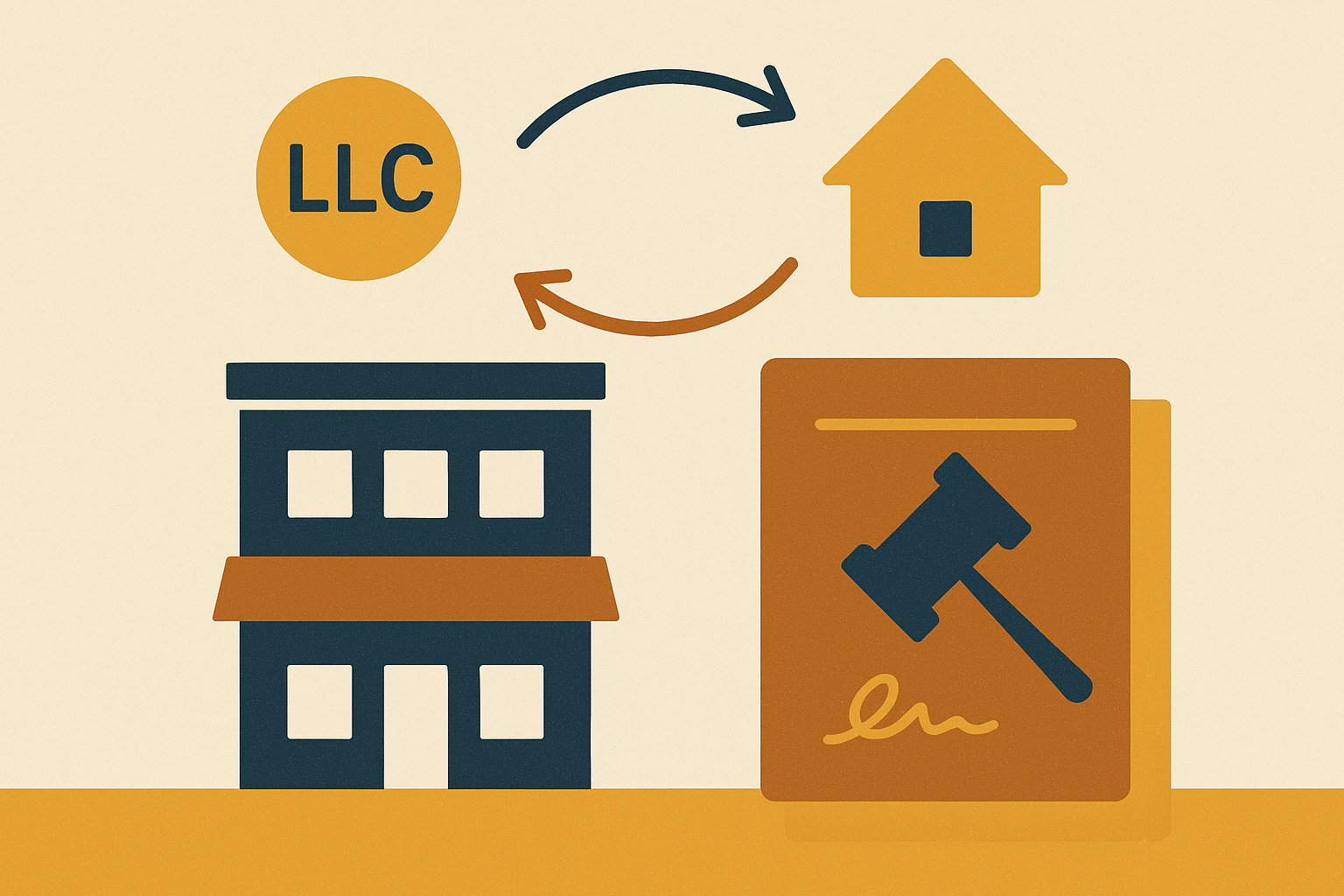
Most investors who hold rental property inside an LLC did not set up that structure with a future 1031 exchange in mind. They set it up for liability protection, for keeping one property's problems from touching another, for the basic organizational sense an LLC brings to a growing portfolio. By the time a sale and exchange come into view, the entity is already in place, and the question is no longer whether to use an LLC but whether that LLC, as structured, can actually complete the exchange the owner wants to complete, and whether the ownership decisions made years earlier will support or undercut an estate plan the owner is only now starting to think through seriously.
LLC ownership of investment property and the opportunity and compliance risk it creates inside a 1031 exchange
The IRS applies what practitioners call the same-taxpayer rule: whoever sells the relinquished property must be the one who acquires the replacement property. There is no exception to this, and no workaround that skips it. An LLC does not change that rule, but it changes how the rule plays out in practice, because an LLC can be taxed in several different ways and each one puts the entity in a different position relative to the exchange. LLCs exchange property constantly, alongside corporations and trusts, so the real issue was never whether an LLC qualifies. The entity's structure shapes the path through the exchange and the risks that come with it. Investors who treat the LLC's structure and their estate plan as two separate conversations, unconnected to the mechanics of the exchange itself, tend to find out too late that a decision made for one purpose quietly undermined the other. Avoiding that outcome means understanding what kind of LLC is holding the property before it goes under contract.
The same-taxpayer rule for single-member versus multi-member LLCs
Everything about how an LLC exchange unfolds traces back to one classification question: how does the IRS see this LLC as a taxpayer? Single-member and multi-member LLCs sit on opposite sides of that question, and the gap between them determines how much flexibility an owner has once a sale is in motion.
A single-member LLC is, by default, a disregarded entity. The IRS treats the LLC as indistinguishable from its owner for tax purposes. It looks through the entity and treats the individual owner as the party who sold the property and the party who must acquire the replacement. That transparency gives single-member LLCs real flexibility. An owner can sell through one single-member LLC and buy the replacement through a different single-member LLC, or take title in their own name, provided the same individual stands behind every transaction. The reverse works too: someone who held the relinquished property personally can form a new single-member LLC solely to take title to the replacement property, and the same-taxpayer rule is still satisfied, because the IRS was always looking at the person, not the paperwork. There is one exception worth knowing. If a single-member LLC elects to be taxed as a corporation, it becomes its own taxpayer rather than a disregarded entity, and at that point the owner can no longer move between entities mid-exchange as though the LLC weren't there. Outside of that election, a single-member LLC is generally the cleanest available vehicle for combining 1031 flexibility with the liability protection an LLC is meant to provide.
Multi-member LLCs work on different terms. Most are taxed as partnerships, which makes the LLC itself the taxpayer, not the individual members who hold interests in it. That means the exchange has to happen at the entity level: if the LLC sells the property, the LLC has to be the one that reinvests. A member cannot pull out their fractional share of the proceeds and go a separate direction while the rest of the group exchanges, at least not without creating taxable boot for the member who exits that way. The practical consequence is that single-member LLC owners face a relatively simple compliance path, while multi-member LLC owners have to get every member pointed in the same direction before a buyer ever signs a contract.
Multi-member LLC partner disagreement on reinvestment, the drop-and-swap and its risks
Member disagreement is the most common friction point in multi-member LLC exchanges, and it is predictable: one partner wants to defer taxes and keep building the portfolio, another wants cash now. Because the entity carries a single tax outcome for everyone in it, a partnership structure gives a dissenting member real leverage to block the group's exchange or force a taxable distribution nobody else wanted.
The standard fix is known as the drop-and-swap. Before the sale closes, the LLC distributes the property out to its members, and each member becomes a tenant-in-common holding an undivided fractional interest directly, rather than holding an interest in the LLC that owns the property. From that point forward, each member decides independently. Those who want to defer taxes hire their own qualified intermediary and pursue replacement property on their own schedule. Those who want liquidity simply sell their share and pay the tax.
The risk sits in the timing. If the drop happens right before the sale, tax authorities can argue the tenants-in-common never actually held the property for investment purposes in their own right, which would disqualify the exchange for anyone trying to use it. Courts have looked at drop-and-swap transactions that appear to be filed at the last minute, treating them with more skepticism than ones where the ownership change had time to settle in before a sale was arranged. The structure holds up best when the planning comes well ahead of the sale. Members who have held tenant-in-common interests for a meaningful stretch of time before the property goes on the market are in a materially stronger position than members who converted structure the week before closing.
There is a mirror-image option for situations where a sale is already imminent and there isn't time to drop ownership cleanly beforehand: the swap-and-drop. Here the LLC runs the exchange at the entity level first, holds the replacement property for a period of time, and only afterward reorganizes into a tenant-in-common or similar co-ownership structure to let members go their separate ways. Reversing the sequence this way can be the more defensible choice when the clock is already running on a pending sale.
Neither approach is automatically correct. Which one fits depends on how much lead time exists before the sale and how settled the members already are in their intentions. What both share is that tax authorities look past the legal mechanics to the underlying intent, and the sequence and timing of each step carry as much weight as the steps themselves. Members facing this kind of disagreement should work through the choice with a tax advisor and an attorney before any property goes under contract, not after.
Changing LLC ownership after an exchange, to add a spouse, bring in heirs, or restructure, and the retroactive risk to the exchange
The same-taxpayer rule does not expire at closing. Title to the replacement property has to be held under the same tax identification number as the relinquished property, and any change to that introduces the same-taxpayer question all over again, even months after the exchange is technically complete.
A handful of common, well-intentioned moves can trigger this. Adding a spouse to the title, even when a lender requires it as a condition of financing, changes the ownership from one tax ID to two, and because the relinquished property was sold by a single owner, that shift can partially unravel the exchange. Distributing ownership interests to heirs or converting the LLC into a tenant-in-common structure too soon after closing raises the same concern. So does buying out one member of a multi-member LLC while the exchange is still fresh. In each case, the IRS can view the post-closing change as evidence that the original exchange was never really about holding the property for investment, the basis on which the deferral was granted.
There is no fixed number of days or months written into the tax code that defines a safe waiting period. What tax advisors generally recommend is holding the replacement property in its original ownership form until the exchange is, in the common phrase, "old and cold," typically understood as several years. When a lender forces a title change sooner than that, such as requiring a spouse be added for the loan to close, the investor should get documentation that ties the change to the financing requirement rather than to any tax motive, and should loop in their tax advisor and estate planner before making the change, not after. Converting an LLC into a tenant-in-common structure is entirely permissible on its own terms. What makes it work or fail is timing: well before the exchange, or well after it, never while the exchange is still recent.
None of this means an investor has to choose between a clean exchange and a sound estate plan. It means the sequencing matters. The right vehicle and the right moment for bringing a spouse or heirs into ownership are the subject of the sections that follow.
Revocable living trusts layered with LLC ownership without disrupting the exchange
A revocable living trust solves the timing problem described above because, from the IRS's perspective, it barely exists. For federal tax purposes, a revocable trust is a disregarded entity. The grantor is treated as the owner of whatever the trust holds. A trust therefore uses the same tax identification number as the individual who created it. Tenants-in-common interests, similar co-ownership structures, and revocable trusts all share this same quality: none of them introduce a new taxpayer into the picture. An investor can sell property held individually and acquire the replacement inside a revocable trust, or sell from the trust and acquire individually, and the same-taxpayer rule stays satisfied throughout, because the IRS was always looking at the same person.
This makes the revocable trust the cleanest available tool for solving the succession problem that a raw LLC interest leaves unresolved. Property titled in a revocable trust passes to heirs without going through probate. Florida's state bar, in its consumer guidance on trusts, notes that assets held in trust avoid probate and that the trustee has immediate authority to manage trust assets at the grantor's death, with no court appointment necessary. That transfer also happens privately, outside the public record that probate proceedings typically create.
Combining the two structures gives an investor both benefits at once. The LLC holds the property itself, providing the liability protection and the organizational separation that drew the investor to an LLC. The revocable trust, in turn, owns the membership interest in the LLC, and it is the trust document, not a probate court, that directs where that membership interest goes at death. Nothing about this arrangement creates a new taxpayer or disrupts exchange eligibility, because the trust is invisible to the IRS the whole way through. Some states also extend privacy protections around LLC ownership disclosure, and layering a trust on top can keep beneficial ownership out of public filings entirely, though the specifics vary by state.
A revocable trust offers no protection from the grantor's own creditors during their lifetime, because the grantor retains full control and can revoke the trust at will. Asset protection beyond the liability shield an LLC already provides calls for an irrevocable trust, a separate and considerably more complex tool that falls outside what this piece covers.
The step-up in basis at death as the definitive outcome of a hold-to-death exchange strategy
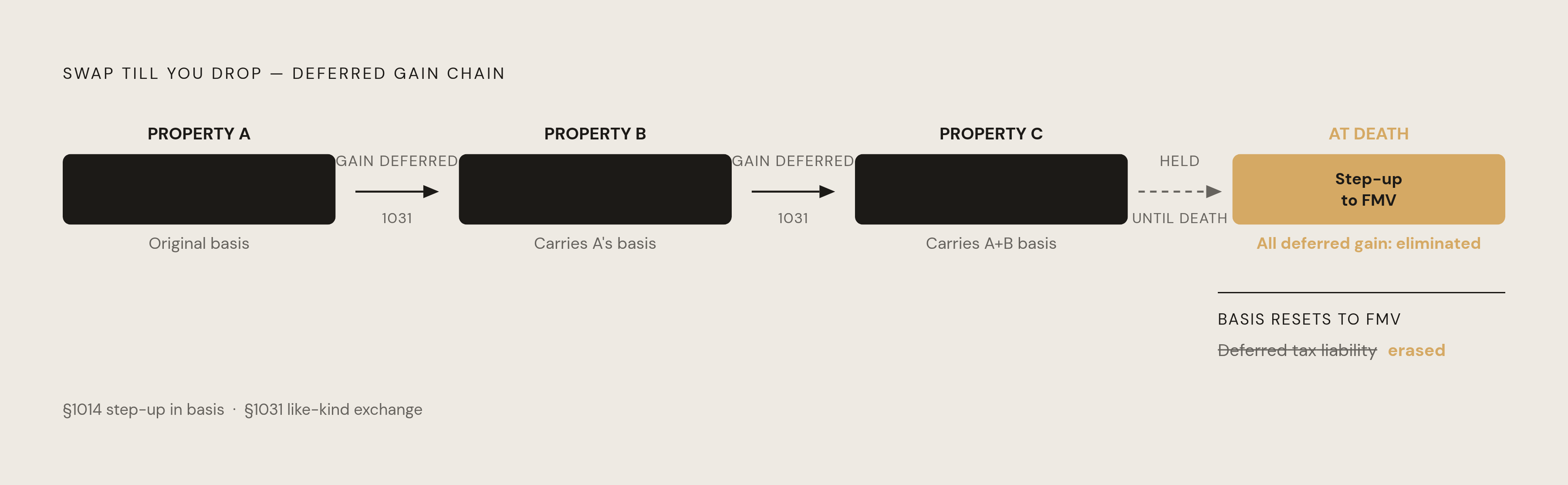
Everything described above, the entity choice, the member alignment, the careful timing around title changes, the trust layered on top of the LLC, builds toward a single outcome at death: the step-up in basis. At death, the cost basis of the property resets to its fair market value at that moment, which can eliminate the capital gains and depreciation recapture that built up across the owner's entire holding period. Tax that had only ever been deferred, exchange after exchange, is erased. Heirs who decide to sell the inherited property shortly afterward may owe little or no capital gains tax, depending on their individual circumstances and the tax law in effect at the time.
The strategy often called "swap till you drop" relies on this logic. An investor sells Property A and exchanges into Property B, later exchanges B into C, and holds C until death. Each exchange along the way defers the accumulated gain rather than taxing it, and the step-up at death removes that deferred liability permanently rather than simply passing it to the next transaction.
An LLC held through a revocable trust fits this endpoint without friction. The trust directs the LLC's membership interest to heirs without a probate proceeding. The heirs receive a stepped-up basis in the real estate the LLC holds. The deferred tax liability that followed the property through every prior exchange, built up over years of appreciation and depreciation, simply disappears at that moment. Whether that final outcome is available when it matters most depends on the structure an investor chooses at acquisition and the discipline exercised at every exchange and every title change along the way.
Sources
- Can llc do 1031 exchange? - Deferred
- Tax Consequences of Using a Single-Member LLC as a 1031 Exchange Accommodator
- 1031 Exchange LLC Structuring - 1031 Exchange - Wolterman Law Office
- Real Estate Partnerships and Section 1031 Exchanges
- Can You 1031 Exchange Out of an LLC That Owns Real Estate? Not Directly — But There Are Workarounds
- Trust as 1031 Exchanger: Revocable, Land & Other Trusts
- What happens to 1031 exchange when owner dies? - Deferred
- LIKE KIND EXCHANGES