Exchanging Out of Active Management Into Net Lease Properties
Tired landlords can defer taxes by trading rental stress for net lease stability under Section 1031.

A 1031 exchange is the mechanism that lets a landlord sell a management-heavy rental and move into net lease real estate without handing a large share of the gain to the IRS on the way out. The investors driving this shift built wealth through hands-on ownership, and they are tired in a specific, cumulative way: years of tenant turnover, maintenance calls, property management oversight, rent collection, and vacancy risk add up to a portfolio that produces income but also produces stress. The question shifts from returns to terms: can the property be sold and the proceeds redeployed without a large chunk going to taxes? That question points straight at Section 1031 of the Internal Revenue Code, and for investors who had put off repositioning because of talk of 1031 reform, the rule now stands on firmer ground, giving them a clearer runway to act. Net lease properties, particularly triple-net (NNN) structures, are the destination this investor profile tends to land on, because they offer exchange-eligible real estate exposure with a fraction of the day-to-day workload.
What a 1031 exchange does to the gain, and why the QI's role is structural
A 1031 exchange doesn't erase the capital gains tax on a sale. It carries the gain forward into the replacement property by reducing that property's tax basis, so the tax bill stays alive and comes due only at a future sale that isn't itself structured as an exchange. Picture a rental bought for $350,000, sold years later for $800,000, with $100,000 of depreciation claimed along the way, often inflated early by a cost segregation study. None of that gain disappears in a 1031 exchange. It moves into the new property's basis and waits there.
Depreciation recapture moves with it, and it doesn't follow the regular capital gains rate. Unrecaptured Section 1250 gain on real property is capped at 25%, a separate rate structure that matters directly to anyone exchanging out of a rental that has been depreciated heavily over a long hold. Because the carried-over basis reduces the depreciable basis of the replacement property, depreciation on the new NNN asset doesn't start over from zero. It blends the carried-forward basis with any new capital put in, and that blend shapes the after-tax cash flow the investor actually collects once the exchange closes.
None of this works without a Qualified Intermediary, whose job is load-bearing, not paperwork. The IRS applies a doctrine called constructive receipt, and it reads broadly: if an investor has the ability to direct or access exchange funds, even money sitting with an attorney, an escrow agent, or an entity the investor controls, the IRS can treat that as receipt of the money, which collapses the deferral. That's why the exchange agreement has to be signed before the relinquished property ever closes, not after. A Qualified Intermediary holds the sale proceeds in a segregated account, prepares the exchange documents, and wires funds directly to the closing on the replacement property. The investor's hands never touch the cash at any point in the process. The exchange runs as a fixed six-step sequence, and skipping any one of those steps, or bringing in the intermediary after the first closing instead of before it, ends the deferral.
Where the 180-day exchange window shrinks
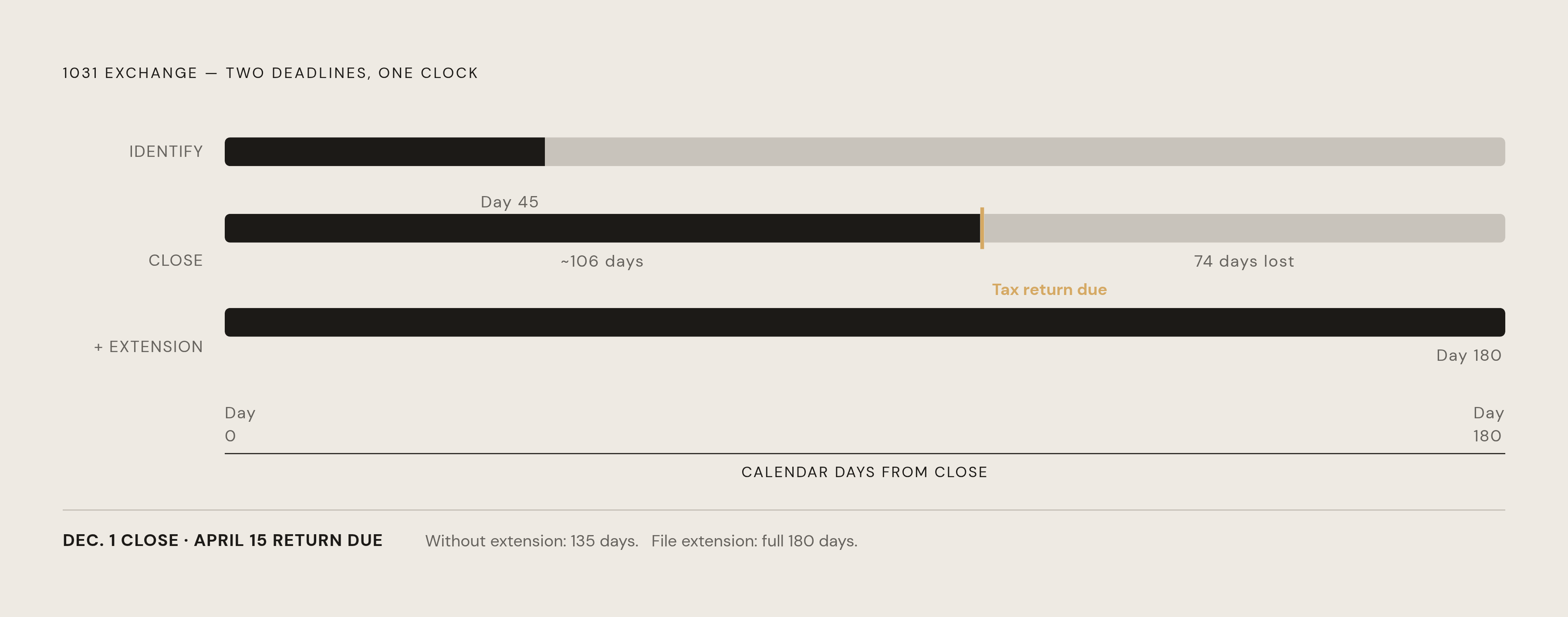
Every 1031 exchange runs against two clocks, and both start ticking the day the relinquished property closes. The IRS does not grant extensions for a slow market, a financing delay, or a personal emergency, though federally declared disasters can trigger relief. Investors get 45 days to identify replacement property in writing, and the full exchange, from the first closing to the purchase of the replacement, must finish within 180 calendar days of the relinquished property's transfer date, or by the investor's tax return due date including extensions, whichever comes first. Weekends and holidays count against both deadlines just like business days do. Treasury Regulation 1.1031(k)-1(b)(2)(i) sets the 45-day identification period to end at midnight on day 45, and a phone call or a verbal heads-up to a broker means nothing under that rule. Identification has to reach the Qualified Intermediary in writing.
The part of this that catches investors off guard involves the interaction between the 180-day period and the tax filing deadline. The exchange period ends when the calendar deadline or the tax return due date, including extensions, arrives first. An investor who closes a sale in early December and plans to file taxes on the normal schedule the following spring may end up with far fewer than 180 days to finish the exchange, because the return due date arrives first. Filing a valid extension restores the full 180-day period, but sellers who close late in the year and don't know to file that extension routinely lose weeks of search time without realizing it until the window has already started closing.
Investors get three ways to identify replacement property, but most use only one of them: the three-property rule, which allows identification of up to three properties with no limit on their combined value. Whichever rule applies, identification only counts if it describes the property without ambiguity, by legal description, street address, or a name that distinguishes it from any other property. "A retail building in Phoenix" does not meet that bar and would invalidate the identification. This timing pressure sets up the central challenge of moving from an active rental into a net lease property: sourcing and underwriting a single NNN asset inside a window that may already be shorter than it looks.
Why "like-kind" is broader than most active landlords assume
The single biggest misconception blocking landlords from considering net lease real estate is the belief that a 1031 exchange requires swapping one property type for a near-identical one. Any U.S. real property held for investment or business use is like-kind to any other such property, and the type of asset, its improvement level, and its asset class play no role in determining eligibility. A raw land parcel in Montana is like-kind to a multifamily apartment building in Atlanta. An industrial warehouse is like-kind to a retail strip center. The rule cares about how the property is held and used, not what it looks like.
That breadth is what makes the active-to-passive move possible in a single step. A hands-on residential landlord can exchange directly out of a single-family rental or a small multifamily property and into a single-tenant NNN commercial building, with no intermediate exchange and no workaround required. What falls outside the rule matters just as much as what qualifies inside it. Section 1031 now applies exclusively to real property: equipment, vehicles, and partnership interests no longer qualify after a past tax law change narrowed the rule's scope. Primary residences don't qualify, vacation homes used mainly for personal enjoyment carry tight restrictions, and dealer property, meaning real estate held primarily for sale as inventory rather than investment, is excluded. The test that actually governs eligibility is one of purpose, not time. Section 1031 asks what the property was held for, documented investment intent, rather than how long it was held before the exchange.
Net lease properties as the natural landing point for passive repositioning
A triple-net lease shifts the three largest variable costs of ownership, property taxes, insurance, and maintenance, onto the tenant. That single structural feature turns what used to be an active management burden into a income stream that arrives on a fixed schedule. Instead of tracking repair calls and vacancy cycles, the landlord mainly has to watch the tenant's credit quality and the length of the lease. For an investor leaving a management-heavy residential or small commercial portfolio, that's a real change in how time gets spent owning real estate, not a cosmetic one. Net lease assets also tend to carry long initial lease terms, so they cut down on near-term rollover risk compared to the shorter tenancies typical of residential rentals.
This fits an investor who is equity-rich, focused on steady income rather than growth, and willing to accept a lower cap rate in return for giving up operational complexity. Due diligence on a single-tenant NNN property concentrates on a short list: tenant credit, lease term, rent escalations, cap rate, financing structure, and the residual value of the real estate once the lease ends. That's a narrower diligence surface than a multi-unit residential property demands, where income, condition, and tenant mix all have to be underwritten unit by unit. Inside a compressed 45-day identification window, that narrower surface helps, since you have less to evaluate before a written identification has to go to the Qualified Intermediary.
There's also an estate planning dimension that reinforces the case for holding net lease property long-term. If investors keep exchanging throughout their lives, they carry the deferred gain forward each time without ever triggering the tax, so deferral compounds across multiple transactions. When the investor dies, heirs typically get a stepped-up basis under IRC Section 1014, which can wipe out the accumulated deferred gain. A NNN property held for the long run can serve as both an income vehicle during life and a basis reset for heirs after it, two goals met by the same asset.
The debt-matching requirement: where most NNN exchanges stumble
To defer the full gain, the replacement property has to match or exceed both the purchase price and the debt of the property sold, with all net equity reinvested, or the investor has to add cash to cover any shortfall in debt. Falling short on either value or debt creates what the tax code calls boot, and boot is taxable in the year of the exchange even when the rest of the transaction otherwise qualifies for deferral. Boot covers any value received outside the exchange itself.
The most commonly overlooked trigger of boot in an active-to-passive exchange is mortgage relief. If the property being sold carried a substantial mortgage and the NNN replacement is bought with less debt, the IRS treats that difference in debt as boot received, and it's fully taxable regardless of intent. Boot can also come from exchange expenses paid out of funds held by the Qualified Intermediary if those expenses don't count as qualified exchange costs under the rules.
Net lease assets complicate this matching in two directions at once. High-credit, single-tenant NNN properties, especially those backed by strong corporate tenants, often trade at compressed cap rates in a market crowded with institutional buyers, and the all-in purchase price on one of these can run well above the value of the property being sold, forcing the investor to bring more capital or arrange more financing than expected. At the same time, some NNN sellers resist offering seller financing, and lenders evaluating NNN acquisitions look primarily at the tenant's credit rather than the borrower's operating history, which is a different underwriting conversation than the one residential investment loans involve. An investor leaving a leveraged residential portfolio for an all-cash NNN purchase will owe tax on mortgage-relief boot equal to the debt gap, a cost that needs to be modeled before the exchange is ever committed to, not discovered afterward.
The way to avoid this is to model purchase price, equity, and debt together before the 45-day identification deadline arrives, not after a property has already been identified and the clock is running out. If you line up a lender who understands NNN acquisition financing before the relinquished property even closes, you get a concrete debt target to aim for while you search for replacement property, instead of finding out the financing doesn't match once it's too late to adjust.
DSTs as a backup when direct NNN sourcing fails
Delaware Statutory Trusts exist as a practical fallback for accredited investors, and in some offerings sophisticated non-accredited investors, when they can't source a qualifying direct NNN property inside the 45-day identification window. A DST holds real estate inside a trust structure, and investors buy beneficial interests in that trust rather than taking title to the property directly. Certain DST interests can qualify as replacement property in a 1031 exchange when the trust and the exchange are both structured to meet IRS requirements.
Owning a DST interest means trading direct control of the property for a passive beneficial interest in the trust. The investor gives up direct control over leasing, financing, and sale decisions, handing that authority to the trust's sponsor and manager in exchange for a passive position in institutional-grade real estate that might otherwise be out of reach for an individual buyer. For an investor racing a 45-day clock with no direct property yet identified, a DST offers a way to complete the exchange on time and preserve the tax deferral, at the cost of the control a direct purchase would have kept in the investor's own hands. Weighed against the debt-matching and sourcing difficulties that come with direct NNN acquisitions, a DST is not a lesser option so much as a different one, suited to the investor who values certainty of execution within the deadline over control of the underlying asset.
Sources
- 1031 Exchange Explained: Rules, Timeline, and Guide for Property Owners
- 1031 Exchange Rules 2026: Every Deadline and Deal ...
- 1031 Exchange Deadlines: 45-Day and 180-Day Rules Explained
- Like-Kind Exchange: 2026 IRC Section 1031 Definition, Rules, and Real Estate Examples
- DST Properties: 2026 Guide to 1031 Exchange Options