What Your Qualified Intermediary Must Prove Before You Wire Exchange Proceeds
Missing even one of four conditions turns your 1031 exchange into a taxable sale.

If you skip that proof and miss even one condition, a deferred exchange becomes a fully taxable sale in the year the property closed. This piece walks through what each condition requires, how to verify it before the wire goes out, and what a comparison of intermediaries should actually weigh, from contract assignment to fund segregation to who keeps the interest on your money while it sits in escrow.
Why the QI safe harbor exists
A failed exchange has one consequence: the tax bill arrives immediately, in the year of sale, with no deferral left to soften it. The exchange depends on Treasury Regulation 1.1031(k)-1(g)(4), a safe harbor that lets the QI, not the taxpayer, stand in as the party who legally acquires and transfers both the relinquished property and the replacement property. The structure traces back to an early appellate case that first established that a sale and a later purchase could be treated as one continuous exchange rather than two separate taxable events, and lawmakers later narrowed the rules further by limiting Section 1031 to real property.
What the safe harbor protects against is simple to state and unforgiving in practice: if the investor takes actual or constructive receipt of the sale proceeds at any point, the IRS treats the transaction as a completed, taxable sale. Treasury Regulation 1.1031(k)-1(g)(4) lays out exactly four conditions a QI must meet to anchor that safe harbor, and missing even one triggers gain recognition, generally in the year of sale, though special installment-reporting rules can apply if the QI becomes insolvent. The investor carries the burden of confirming each condition before wiring funds, because the IRS will not excuse a failure on the grounds that the intermediary looked legitimate or came recommended.
What the four safe-harbor conditions require, read literally
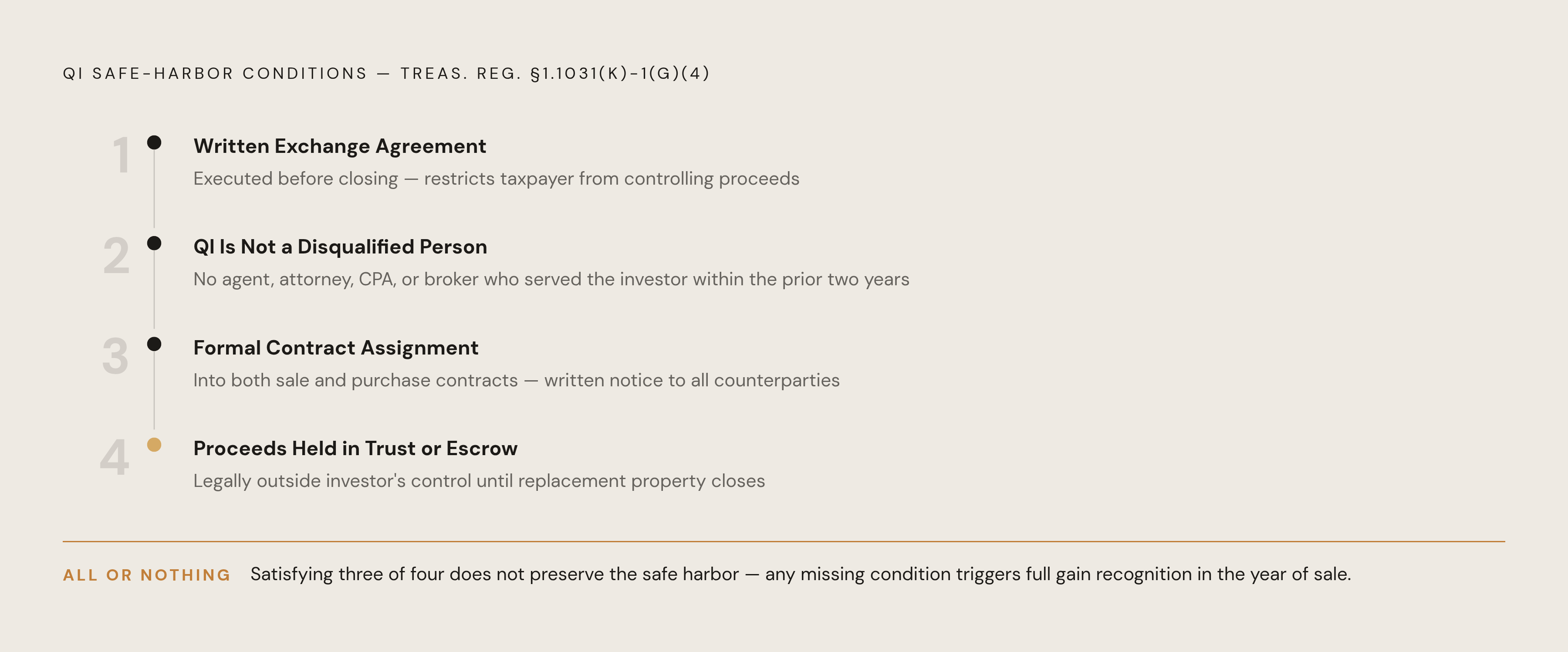
The regulation sets four distinct requirements, and each one has to be met independently. If you satisfy three out of four, the safe harbor does not hold; the exchange simply fails on the fourth.
The second condition requires that the QI not be a "disqualified person." A QI who handled an earlier, already-completed exchange for the same investor is not disqualified by that prior relationship alone.
The third condition requires that the QI formally acquire and transfer both properties through contract assignment, so it has to be written into both the relinquished-property sale contract and the replacement-property purchase contract as the legal party doing the acquiring and transferring, not simply an escrow holder processing paperwork. 1.1031(k)-1(g)(4)(iv), where the relinquished property deeds straight from the taxpayer to the buyer and the replacement property deeds straight from the seller to the taxpayer, as long as the QI's contract assignment is properly in place behind the scenes.
Each of these four conditions demands affirmative, written proof, not an investor's assumption that a professional-looking intermediary has the paperwork handled. The sections that follow take each one in turn.
Verifying the written exchange agreement before closing
Condition 1 is the first thing an investor needs to nail down, and it's the one where timing leaves no room for correction after the fact.
The agreement itself has to name the QI as the party holding the proceeds and has to explicitly restrict the taxpayer from receiving, pledging, borrowing against, or otherwise controlling those funds while the exchange is open. None of that should be left to assumption or verbal reassurance.
Execution matters as much as content. A draft agreement that was emailed over but never countersigned does not satisfy the condition, no matter how close the closing date. Some QI platforms today can open and fully document an exchange in as little as five minutes, including same-day openings and signings completed at the closing table itself, which makes the pre-closing timing requirement genuinely achievable even on a compressed schedule. Once the closing wire leaves escrow without a valid agreement already in place, you have no legal remedy to fix it after the fact.
Proving the QI is not a disqualified person
Condition 2 catches most investors off guard, because the people they'd naturally turn to first, their own attorney, their CPA, their real estate broker, are exactly the people the regulation excludes. The advisor can be excellent at their job and still be legally barred from this particular role.
The two-year lookback runs from the date of the first relinquished-property transfer, not from the date the exchange agreement gets signed. A CPA or broker who stopped actively working for the investor 23 months earlier is still disqualified under the regulation, a detail that trips up investors who assume a cooling-off period of "about two years" gives them more flexibility than it actually does.
Complicating the picture further, there's no federal license or standardized certification required to operate as a QI. The one national designation specific to this work is a trade association's certified exchange specialist credential. It isn't a government certification, but it does indicate that the officer handling the file has met a recognized professional standard in the field.
Before wiring anything, an investor should get a written representation from the QI stating that no employee, officer, or owner of the firm has acted in any of the disqualifying capacities for that specific taxpayer within the prior two years. That representation needs to cover the firm's principals as well as whoever is handling the file day to day. A firm whose managing partner previously advised the investor on the underlying sale is disqualified even if a completely different employee is the one managing the exchange.
Confirming contract assignment, the procedural step most investors never check
Condition 3 is the least visible of the four, largely because the QI handles it behind the scenes and investors rarely ask to see the paperwork. For the QI to legally "acquire and transfer" both properties, as the safe harbor demands, it has to be formally assigned into both the relinquished-property sale contract and the replacement-property purchase contract, and every counterparty involved has to receive written notice that the assignment happened.
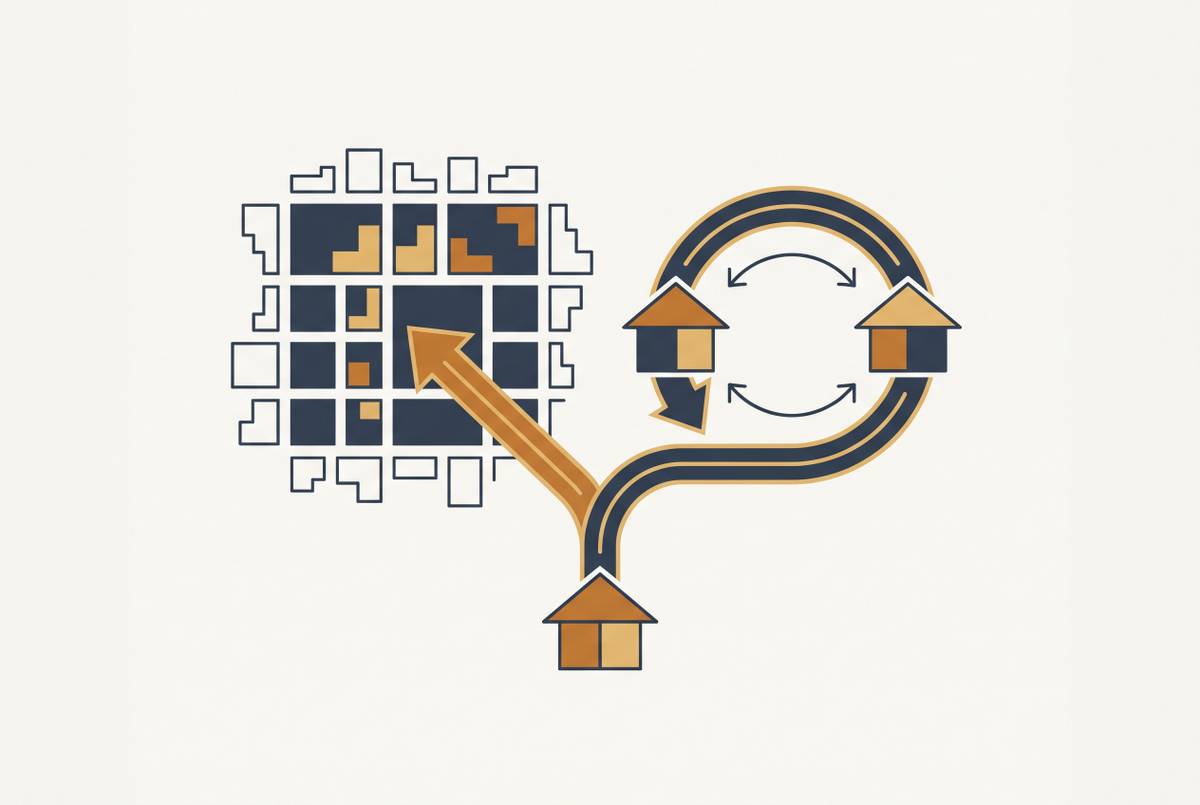
Direct deeding, where the deed passes straight from the original seller to the ultimate buyer, or from the replacement-property seller directly to the exchanger, is permitted under the regulations and widely used because it simplifies the chain of title. But the deeding shortcut produces a real risk only if the QI's contract assignment is not actually in place behind it, since direct deeding depends entirely on that assignment having already been completed. Before you sign anything, ask the QI to confirm in writing how it will execute the agreement and manage the closing timeline, and check whether it can reliably deliver a fully executed copy days ahead of closing.
What fund-holding arrangements prevent constructive receipt
Condition 4 requires more than the investor's good intentions about leaving the money alone. You need an account structure that keeps control legally and mechanically out of your hands until the replacement property closes.
The trust or escrow account holding the proceeds needs to require the QI's signature before any transfer of funds can happen. If several clients' funds sit pooled together in a commingled account, you're at risk of loss when the QI runs into financial trouble, because no clean line separates one client's money from another's.
If neither you nor the QI can move funds without the other's sign-off, that dual-signature requirement gives you the strongest structural protection you can get.
FDIC coverage needs separate confirmation, not an assumption based on the bank's name. Ask the QI in writing how coverage is structured across the full balance of the exchange funds, not just whether the bank carries FDIC insurance in general. This is where the gap between QIs becomes concrete and measurable. Technology-driven intermediaries like Deferred.com build this segregation into the platform itself, enforcing it automatically, and hold exchange funds in segregated, FDIC-insured commercial bank accounts with coverage structured up to $175 million per client, logging every transfer in real time and publishing the coverage details openly.
QI bankruptcy and fraud risk in fund-protection documentation
A QI can satisfy all four safe-harbor conditions on paper and still fail the investor if it becomes insolvent or defrauds its clients. When intermediaries have declared bankruptcy or otherwise failed to meet their contractual obligations, taxpayers have missed the strict deadlines that govern a deferred or reverse exchange, and that disqualifies the transaction from Section 1031 treatment. The gain becomes taxable in the current year, and any resulting loss gets handled under separate sections of the tax code, a cold consolation for an investor who also lost access to the underlying funds.
Credible QIs carry specific financial safeguards, so you should demand written confirmation of each before you wire anything. SOC 1 Type 2 audit reports confirm that a firm's internal financial controls have been tested independently over time, not just described in a marketing brochure.
Technology adds a layer of protection that paper policies alone can't match. If a platform logs every fund transfer, enforces segregation of duties programmatically rather than relying on a single employee's judgment, and flags unusual activity automatically, it cuts down on both the manual errors and the deliberate misconduct that have caused QI failures in the past. Deferred's approach, segregated FDIC-insured accounts with coverage up to $175 million, software that enforces segregation of duties and records every transfer, and a strict no-commingling policy between client funds and the firm's own operating funds, reflects the kind of benchmark investors should hold any QI to when reviewing its fund-protection documentation.
The interest income question every investor should ask before the wire goes out
Exchange funds can sit with a QI for up to 180 days, and that balance earns interest the entire time. The investor has every right to know, in writing, before the wire goes out, who collects that interest and at what rate.
Most traditional intermediaries keep all or most of the interest earned on exchange funds as a revenue source, on top of whatever exchange fee they charge separately. Before wiring funds, ask directly whether the QI retains the interest earned on your balance or credits it back to you, what rate applies and whether that rate is published openly or only available on request, and whether interest gets paid out at all if the exchange is later cancelled. Deferred.com has built its pricing model around sharing that interest with the client rather than retaining it, which is worth citing here not as a sales pitch but as a concrete example of what a written, transparent answer to this question actually looks like in practice, since other structures exist across the industry and the investor's job is to get a clear answer before committing funds, whichever answer that turns out to be.
The service-model elements that determine whether the four conditions stay satisfied through closing
Satisfying the four conditions at the moment the wire goes out is necessary, but it isn't sufficient on its own. The conditions have to hold for the entire exchange period, and a QI whose day-to-day operations introduce gaps or handoff errors can let the safe harbor collapse well after the money has already moved.
If a dedicated team stays familiar with a specific file, its deadlines, and its documentation, you get real protection that a rotating call-center model can't match, where continuity gets lost every time the file changes hands. That matters because the 45-day identification deadline and the 180-day closing deadline carry no exceptions for administrative error or ordinary scheduling problems; Revenue Procedure 2018-58 recognizes only a federally declared disaster as grounds for one. A staff unfamiliar with a file's specifics is a structural risk to both deadlines, not a minor inconvenience.
Availability matters just as much, because these deadlines run in calendar days, including weekends and holidays, not business days. A QI reachable only during standard weekday business hours leaves the investor without coverage for most of the calendar period the exchange actually spans. So ask directly whether support extends into evenings, weekends, and holidays, and find out who you can reach if a closing document needs attention outside normal hours.
Independence in how the QI's staff gets compensated is a less obvious factor but a real one. If a QI has commissioned salespeople, or financial incentives tied to exchange volume, it may carry subtle conflicts of interest, and that can affect how aggressively it defends your safe harbor versus closing the file quickly. The underlying principle holds regardless of which QI an investor chooses: the right intermediary is one whose operational model makes compliance durable across the full 180 days, not one that simply looks compliant at the moment the wire is sent.
A practical pre-wire verification checklist for each of the four conditions
Every item below should be confirmed in writing, not taken on a phone call and not inferred from a website description, before any wire instruction goes out.
Beyond the four conditions themselves, a thorough investor should also get written confirmation of the fidelity bond carrier, coverage amount, and whether it covers this specific exchange balance; written confirmation that E&O and cyber insurance are currently in force; a written statement of the interest policy, including the rate, who receives it, and whether it's paid out if the exchange is cancelled; and written identification of the specific senior officer responsible for the file from opening through closing. The safe harbor under Treasury Regulation 1.1031(k)-1(g)(4) is a legal structure that has to be proven, in writing, before the wire goes out. It is not a default condition that comes with the territory simply because a firm calls itself a Qualified Intermediary.