Opportunity Zone vs 1031 Exchange for Appreciated Real Estate
Compare the reinvestment rules, timelines, and tax outcomes of each strategy.
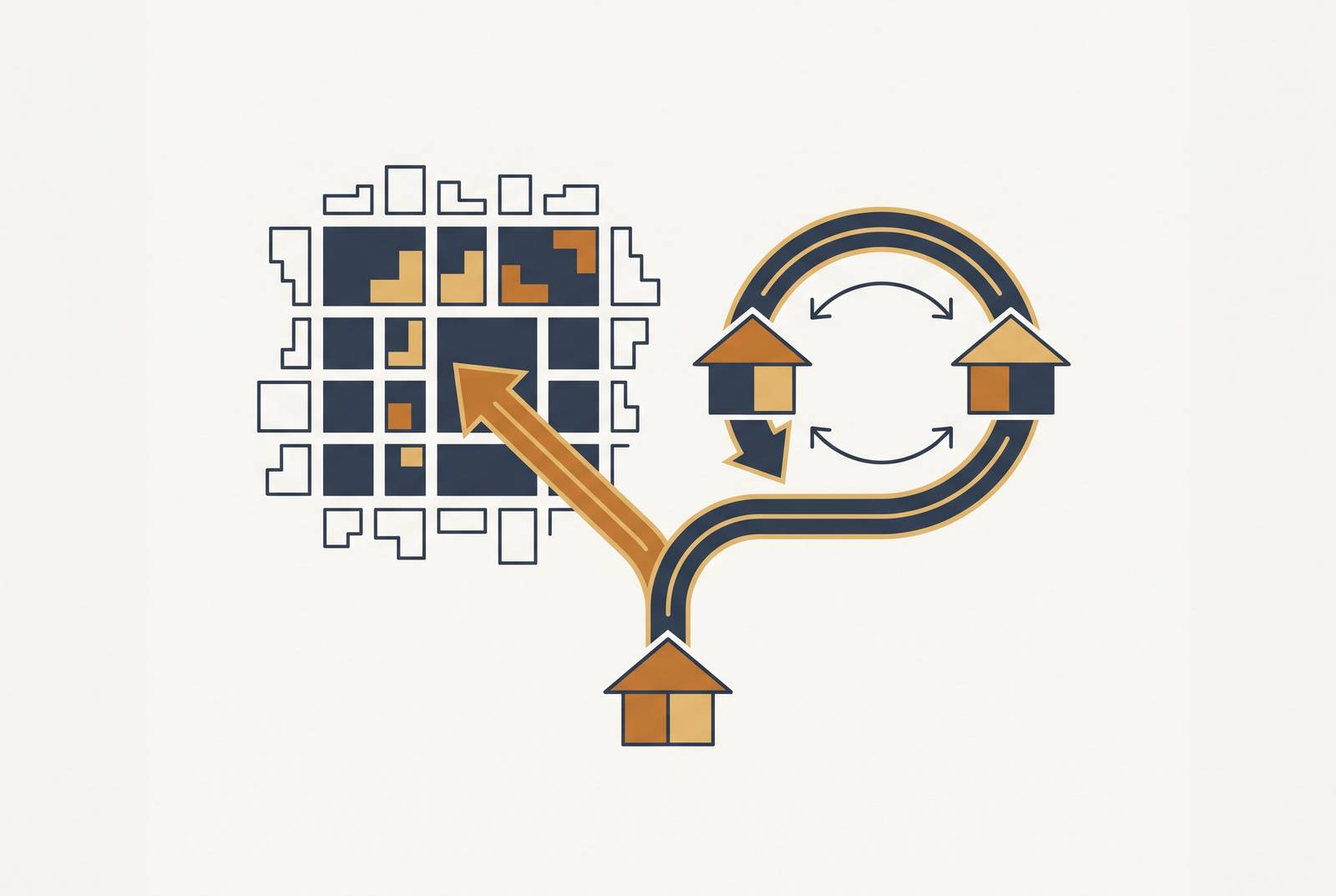
A 1031 exchange and an Opportunity Zone investment both let a real estate seller put off a capital gains tax bill, but they do it through different mechanics, different timelines, and different reinvestment rules. The right choice depends on what kind of gain an investor has, how long they're willing to stay committed, and how much of their original capital they need to keep free.
No specific providers are recommended here, and no external sources back any picks, because choosing a Qualified Intermediary or Opportunity Zone fund manager turns on the investor's specific gain composition, timeline, and risk tolerance rather than on a ranked list. What the two structures offer is materially different: a 1031 exchange requires all net proceeds to move into replacement real property within 180 days and defers both the capital gain and depreciation recapture, while an Opportunity Zone investment requires only the gain itself to enter a Qualified Opportunity Fund within 180 days, leaves the original basis in the investor's hands, and can absorb gains from any asset class, not just real estate. For investors with long-held rental property, the comparison isn't symmetrical: a 1031 exchange defers depreciation recapture alongside the capital gain, while an OZ investment generally leaves recapture taxable immediately, which means the effective share of the tax bill each structure actually defers can differ substantially depending on how much accumulated depreciation is in the picture. The four structural differences that drive every decision, what must be reinvested, which asset classes qualify, how the tax benefit ends, and what the investor owns afterward, are covered in detail below.
What a 1031 exchange does with appreciated real estate
A 1031 exchange defers capital gains tax. It doesn't erase the liability. Under IRC Section 1031, an investor who sells investment real estate and reinvests the proceeds into qualifying replacement property defers federal capital gains tax, depreciation recapture, and the 3.8% net investment income tax. The deferred gain doesn't vanish: it rolls into the replacement property's cost basis and resurfaces if and when the investor ever sells outside of another exchange.
Two deadlines start the moment the relinquished property closes, and both run at the same time. Neither deadline moves. The 180-day window also can't run past the investor's tax-return due date for the year of sale, including any extensions actually filed. An investor who sells in the fourth quarter and doesn't file an extension can find the window cut shorter than 180 days simply because the tax return comes due first.
The 45-day identification period sits inside the 180-day closing period rather than adding to it, so the two clocks are really one clock with two checkpoints. What the investor can name during that window is governed by one of three identification rules. The 200% Rule allows any number of properties as long as their combined fair market value doesn't exceed 200% of the sale price of the relinquished property. The 95% Rule removes the value cap entirely but requires the investor to actually close on at least 95% of everything identified, a requirement strict enough that few investors choose it.
Every dollar of exchange proceeds has to pass through a Qualified Intermediary, and the investor can never take possession of those funds, even briefly. Since the Tax Cuts and Jobs Act, only real property qualifies for 1031 treatment: personal property, equipment, and other asset classes were removed from eligibility. Proposed caps on 1031 exchanges were considered and rejected, so the deferral remains available at full strength under current law. The mechanics get reported to the IRS on Form 8824, and the deferred gain and the depreciation history both carry forward into the new property's basis.
Opportunity Zone investment mechanics for a real estate seller
An Opportunity Zone investment starts from a different premise than a 1031 exchange. Only the capital gain itself needs to be reinvested, not the full sale proceeds, and the tax benefit on offer includes the possibility of excluding future appreciation from tax. An investor has 180 days from the date a capital gain is realized to put that gain, and only that gain, into a Qualified Opportunity Fund (QOF). There's no 45-day identification requirement sitting inside that window the way there is with a 1031. The full 180 days are available for locating and committing to a fund.
Because only the gain moves into the QOF, the investor's original basis stays in their hands. A 1031 exchange has no equivalent flexibility, since it requires all proceeds, basis included, to move into the replacement property.
Under what's commonly called OZ 2.0, the mechanics work as follows. Gains placed into a QOF are deferred for up to five years from the investment date, or sooner if an inclusion event occurs first. For gains realized in 2026, investors need to place capital into a QOF on or after January 1, 2027, within the 180-day window tied to when the gain was recognized. That date matters for anyone sitting on a 2026 gain right now: the window to act under these terms opens at the start of 2027, and the clock on the 180 days is already running from the point the gain was realized.
The larger prize sits further out. If the QOF investment is held for at least ten years, every dollar of appreciation generated by that investment, growth above and beyond the original gain contributed, is excluded from federal tax. And an Opportunity Zone investment isn't limited to real estate gains the way a 1031 exchange is. Gains from stocks, cryptocurrency, the sale of a business, or any other appreciated asset all qualify for QOF investment, which makes OZ a far broader tool for an investor whose gains aren't confined to property.
What are the key differences between a 1031 exchange and an Opportunity Zone investment for appreciated real estate?
A 1031 exchange and an Opportunity Zone investment solve different problems for different situations, and the choice between them comes down to four structural differences.
The first concerns what has to be reinvested. A 1031 exchange requires all net proceeds to move into the replacement property; pulling any cash out along the way creates taxable boot. An Opportunity Zone investment only requires the gain portion, leaving the original basis in the investor's hands to use elsewhere. For an investor who needs liquidity from the sale, or whose basis represents capital they need for something else entirely, that difference alone can decide the question before anything else gets weighed.
The second concerns which assets even qualify. A 1031 exchange, since the TCJA, applies only to real property. An Opportunity Zone investment accepts any capital gain. An investor selling a mix of real estate, stock, and a business interest can route all of those gains into one QOF, where a 1031 would only ever touch the real estate piece of that picture.
The third concerns how the tax benefit ends. A 1031 exchange can be repeated indefinitely, and at death, heirs receive a stepped-up basis under IRC Section 1014 that wipes out the deferred gain. An OZ investment works on a fixed clock instead: the deferred gain on the original investment comes due at the end of the deferral period, a rolling five years from the investment date under OZ 2.0, and the tax-free treatment only applies to the appreciation the QOF investment generates after a ten-year hold.
The fourth concerns what the investor actually owns once the reinvestment is done. A 1031 exchange keeps the investor in direct ownership of real estate, carrying the same market risk, tenant risk, and interest-rate risk as owning any other investment property. An Opportunity Zone investment adds a different kind of risk on top: the fund manager's track record, the execution timeline of whatever project the QOF is built around, and illiquidity that can run well past the ten-year mark before an investor sees a return of capital.
The asymmetry most investors miss: depreciation recapture and the OZ gap
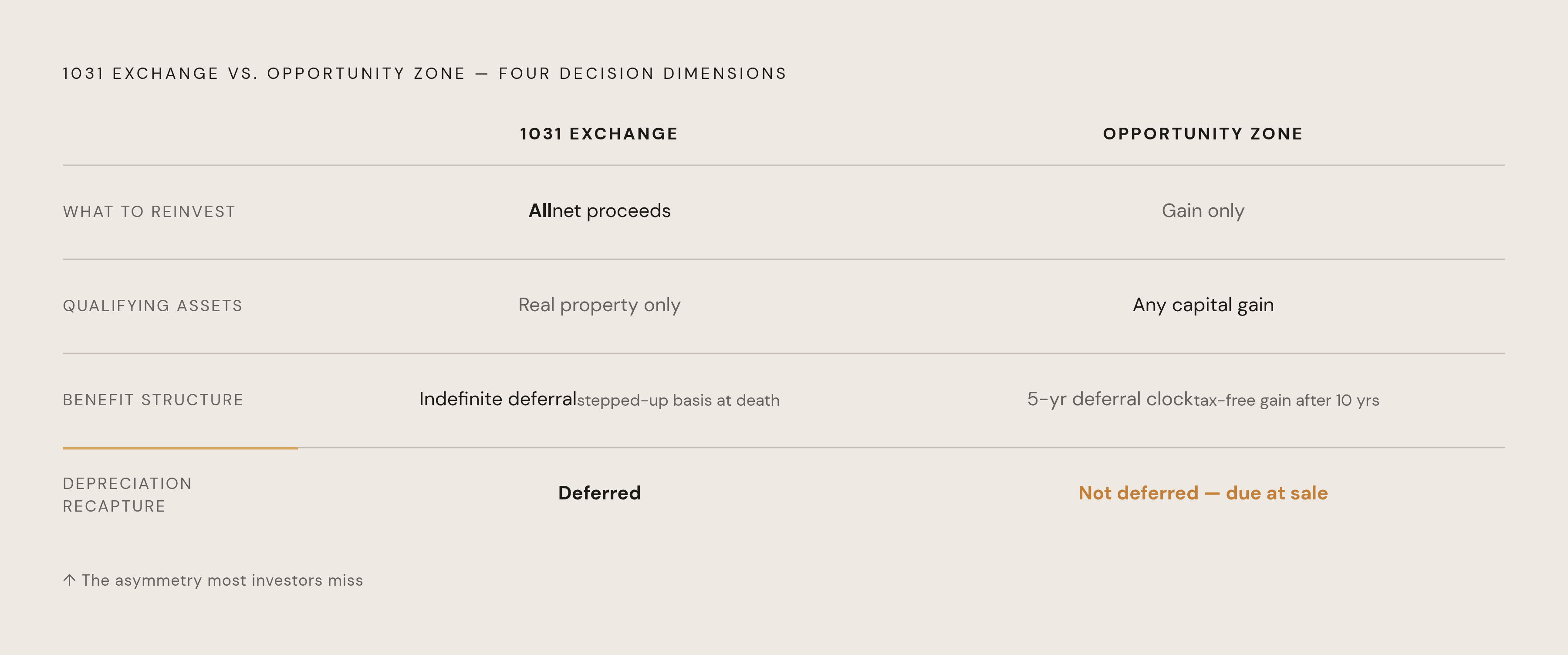
Owners of long-held rental property, the group most likely to be weighing these two strategies against each other, run into a gap that an Opportunity Zone investment simply doesn't close. Depreciation recapture from a prior real estate sale is generally taxable right away when the proceeds go into a QOF. It doesn't qualify for OZ deferral. A 1031 exchange, by contrast, defers depreciation recapture along with the capital gain, rolling both into the replacement property's basis.
For an investor who has held a rental property for a long stretch of years, accumulated depreciation can account for a substantial share of the total tax bill sitting at the point of sale, and that's exactly the share an Opportunity Zone investment leaves exposed. None of this means an OZ investment is a bad option for someone in this position. It means the comparison between "deferred gain under OZ" and "deferred gain under 1031" isn't measuring the same thing for a long-held property: a 1031 exchange defers a larger share of the actual tax liability once recapture is in the picture. Investors unfamiliar with how depreciation recapture is calculated on their specific property should work through the number with a tax professional before assuming either structure covers it the same way.
When the OZ structure or the 1031 wins
Neither structure is the default right answer. Each fits a different set of facts about the investor's gain, timeline, and goals, and the four differences above map fairly cleanly onto specific situations.
An Opportunity Zone investment tends to be the stronger fit when the gain itself is diversified, coming from equities, a business sale, or a mix of assets rather than real estate alone, since a single QOF can absorb all of it in a way a 1031 exchange never could. The fit gets stronger still when depreciation recapture is a small piece of the total tax picture relative to the size of the capital gain, since the OZ gap on recapture barely registers in that case. And for anyone sitting on a 2026 gain, the OZ path only works if capital gets committed to a QOF before January 1, 2027, so timing itself becomes part of the decision.
A 1031 exchange tends to win out when an investor wants deferral with no fixed end date and plans to keep building a real estate portfolio over time, using the swap till you drop approach toward an eventual stepped-up basis at death. It's also the better fit when all of the sale proceeds, not just the gain, need to move into the next property, particularly for an investor trying to maintain or increase leverage along the way. An investor who wants to stay in direct property ownership, rather than hand decisions over to a fund manager, also fits the 1031 path more naturally. And where the sale is closing imminently and speed is the binding constraint, a Qualified Intermediary can open a 1031 exchange the same day or right at the closing table, while a QOF investment still requires finding and vetting a fund first.
These two tools aren't mutually exclusive, and sophisticated investors often run them side by side. An investor can execute a 1031 exchange on the real estate sale itself while separately investing other capital gains, from equities or a business sale, into an Opportunity Zone fund. Treating the choice as either/or misses that the two strategies were built to solve different problems, and a seller sitting on more than one kind of gain may not need to choose.
Why the Qualified Intermediary choice matters
Once an investor decides a 1031 exchange fits, the exchange only works if the Qualified Intermediary handling it does its job correctly, and the QI industry carries no federal license or standardized certification requirement. Any entity can hold itself out as a QI. The work of vetting one falls entirely on the investor.
Fund security is the first thing to check. The exchange agreement should state in writing that funds will sit in a separate, segregated account. A fidelity bond protects against intentional wrongdoing by a QI's employees or principals, so it's worth asking directly for the bond amount and the carrier behind it. Errors and omissions insurance covers something different: ordinary negligence, the kind where a clerical mistake causes an exchange to fail outright, and a QI needs that coverage in place to make an investor whole if its own error is what causes the loss.
Speed matters just as much as security, since the QI has to be in place before the relinquished property closes. The strict identification and closing deadlines, 45 days to identify and 180 days to close, running in parallel rather than back to back, leave no room for a slow setup process. An investor whose sale is closing within days needs a QI capable of opening same-day. Deferred.com, for instance, can open an exchange in as little as five minutes, including same-day openings handled right at the closing table, and it gives investors and their advisors real-time tracking of both the 45-day and 180-day windows so nobody loses track of the clock.
A QI's service model matters too, since a QI paying attention at that level tends to catch problems before they turn into a blown deadline. Not every QI's fee structure and service model line up the same way, and that gap is where the next part of the decision lives.
The traditional QI fee model's hidden cost to investors
Most investors measure the cost of a QI by looking at the exchange fee alone, and that's the smaller number. The bigger cost, and the one far fewer investors notice, is the interest earned on exchange funds while they sit with the QI for up to 180 days. Many traditional QIs hold that money in an interest-bearing account and keep the interest for themselves as undisclosed revenue on top of the stated fee.
Because every dollar of proceeds has to pass through a QI without the investor ever touching it, the choice of which QI to use is a structural decision, not a minor administrative one. A QI that publishes its interest rates upfront, holds funds in a segregated account with FDIC insurance, and assigns a single senior officer to a file instead of rotating the investor through different staff changes both the investor's peace of mind and the actual economics of the exchange. Deferred.com, as one example in this category, shares the interest earned on exchange funds with the investor, using that shared interest to cover its own fee. On a large exchange, where funds can sit for months at a time, the interest at stake is a significant amount, and whether a QI keeps it or shares it is as consequential a decision as whether to use a 1031 exchange.