After-Tax Equity Yield as the Correct Metric for Disposition Timing
After-tax equity yield reveals the true reinvestable capital left once all taxes settle.

Watching an investment property close for a strong sale price produces a specific kind of satisfaction: a number on a settlement statement that feels like a scorecard for years of ownership. That number, whether it's the gross sale price or the net proceeds left after commissions and closing costs, is the wrong figure to optimize, because it measures the size of a transaction rather than the performance of an investment decision. The question that matters at disposition isn't how much the seller received but how much capital you still have to compound forward, once every friction is paid, including the tax bill the sale itself creates. A sale that nets a large sum but triggers a tax liability consuming a substantial share of that sum does not leave the investor with the full sale price to redeploy. The portion consumed by tax does not get discounted; it disappears from the compounding base permanently, unless the investor holds the asset until death and benefits from a stepped-up basis.
After-tax equity yield is the correct metric for disposition timing: it is the annualized return on the equity that survives taxation and remains available for reinvestment, and it is the only number that captures both what an investor keeps and how hard that remainder works going forward. Gross sale price is the wrong figure to optimize because it measures the size of a transaction rather than the performance of an investment decision. Net proceeds fail for the same reason, since they still leave the embedded tax liability unaccounted for, and a dollar consumed by tax does not get discounted, it disappears from the compounding base permanently, failing to earn a return in every subsequent year. A high gross price or a large net proceeds figure tells an investor nothing about the equity base that actually enters the next investment once federal long-term capital gains tax, depreciation recapture, state capital gains tax, and the Net Investment Income Tax are stacked and paid.
The disposition decision is a capital allocation decision, and you can't make that call unless you know how much capital you actually control after every cost, taxes included. If you treat a sale as a liquidity event rather than an allocation decision, you miss how far liquidity and investable capital diverge once a tax liability sits embedded in the proceeds. An investor who sells and pays tax has made an allocation that cannot be undone: a portion of their equity has gone to the government, and the future compounding that portion would have produced is gone with it. Understanding this distinction, between the cash a seller receives and the capital a seller actually retains for reinvestment, is essential groundwork for any investor evaluating disposition timing. A technology-powered Qualified Intermediary like Deferred.com, which specializes in like-kind exchanges, is built around exactly this insight: helping investors quantify and preserve the capital actually available for reinvestment after tax, rather than conflating the sale price with the capital base.
What is after-tax equity yield and why is it the correct metric for disposition timing?
The correction for this miscalculation is a single metric: after-tax equity yield, the annualized return on the equity that survives taxation and remains available for reinvestment. It is the only number that captures both what an investor keeps and how hard that remainder works going forward. Three inputs determine it: the equity that clears the tax event, the income or appreciation that equity produces in the next investment, and the time horizon over which it compounds. A gross yield quoted on a replacement property means little on its own, because it says nothing about the equity base to which it will apply. A high cap rate on a depleted equity base can underperform a moderate cap rate on a preserved one, and an investor who only compares cap rates across deals is comparing the wrong variable.
After-tax equity yield requires holding two things in view at once: the size of the equity base that survives disposition, and the productivity of that base once redeployed. This dual focus is what distinguishes it from the single-number thinking that gross proceeds encourages. It also reframes the tax cost of a sale as an ongoing yield drag rather than a one-time expense. A dollar amount paid in tax feels like a sunk cost, something absorbed once and then forgotten, but the equity that tax consumes would otherwise have compounded at whatever rate the replacement investment earns, for every year the investor continued to hold it. That reframing isn't a rhetorical flourish; it reflects the actual mathematics of compounding, since forgone equity doesn't just vanish once, it keeps failing to earn a return in every subsequent year. The basis mechanics of a 1031 exchange confirm the underlying structure: when an exchange is done correctly, the deferred gain reduces the basis of the replacement property, so the investor's full equity base enters the next investment rather than being partially liquidated to pay tax.
The tax layers that erode equity at a taxable disposition
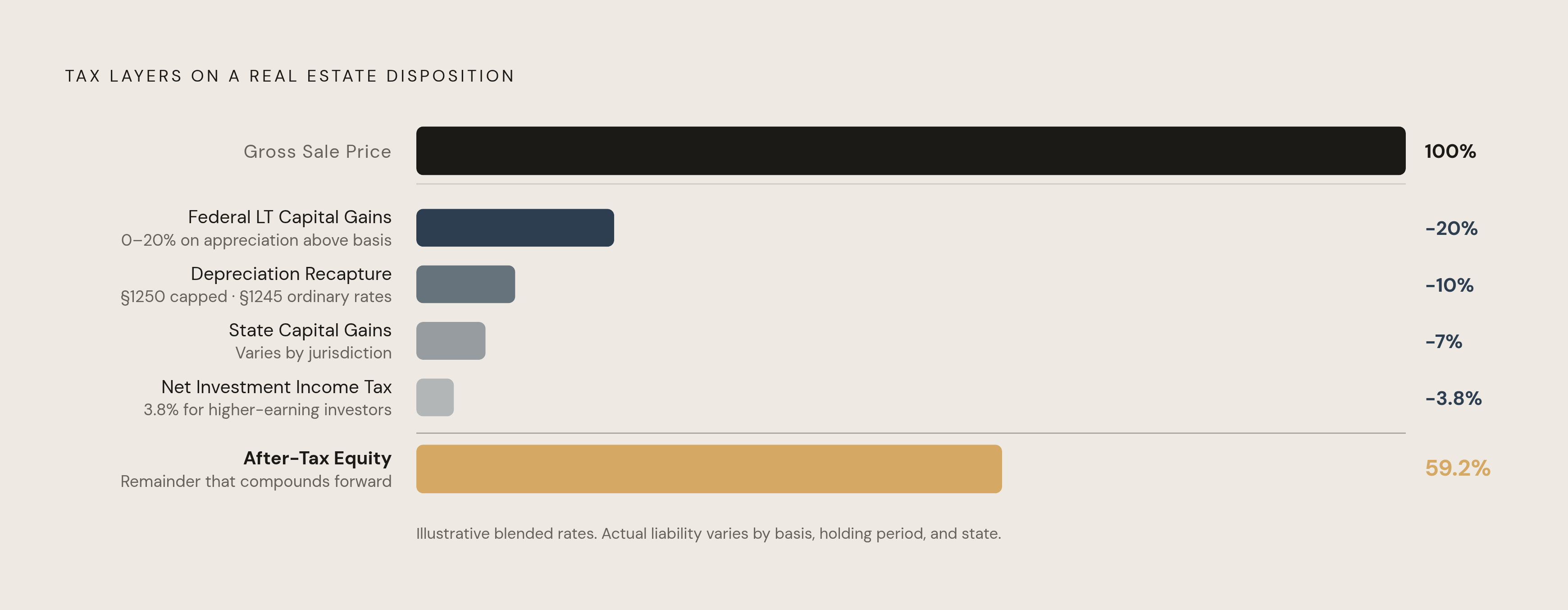
A taxable disposition of investment real estate doesn't trigger one tax. It triggers several, stacked on top of one another, and together they remove a far larger share of the investor's equity than most sellers anticipate before closing. Federal long-term capital gains tax applies to the appreciation above the adjusted basis, which is the first and most familiar layer. Depreciation recapture sits on top of that: it is taxed at a special rate up to the applicable ceiling, with Section 1250 real property subject to a recapture cap and Section 1245 personal property taxed at ordinary income rates, and this liability applies to all depreciation the investor previously took, whether or not the investor felt they meaningfully benefited from it along the way. State-level capital gains tax adds a third layer on top of the federal liability; it varies by jurisdiction, and you get no offset against what the federal government already claims. If you earn at a higher level, the Net Investment Income Tax can apply to passive real estate income as a fourth layer. Stacked together, these layers can push the effective tax rate on a fully depreciated, long-held property well above what the headline long-term capital gains rate alone would suggest.
The problem compounds with time, because the longer an investor holds and depreciates a property, the lower the adjusted basis falls, and the wider the gap between sale price and taxable basis grows. If you bought years ago, took depreciation consistently, and watched the property appreciate meaningfully, you sit in exactly the position where this stacked tax burden bites hardest. That population, long-held, fully depreciated, strongly appreciated properties, is where the gap between a taxable sale's after-tax equity yield and an exchange's after-tax equity yield opens widest. A cost segregation study that accelerated depreciation early in the hold period makes this worse rather than better: the faster depreciation was taken, the lower the current basis sits, and the larger the recapture liability becomes at sale.
How a 1031 exchange preserves the full equity base
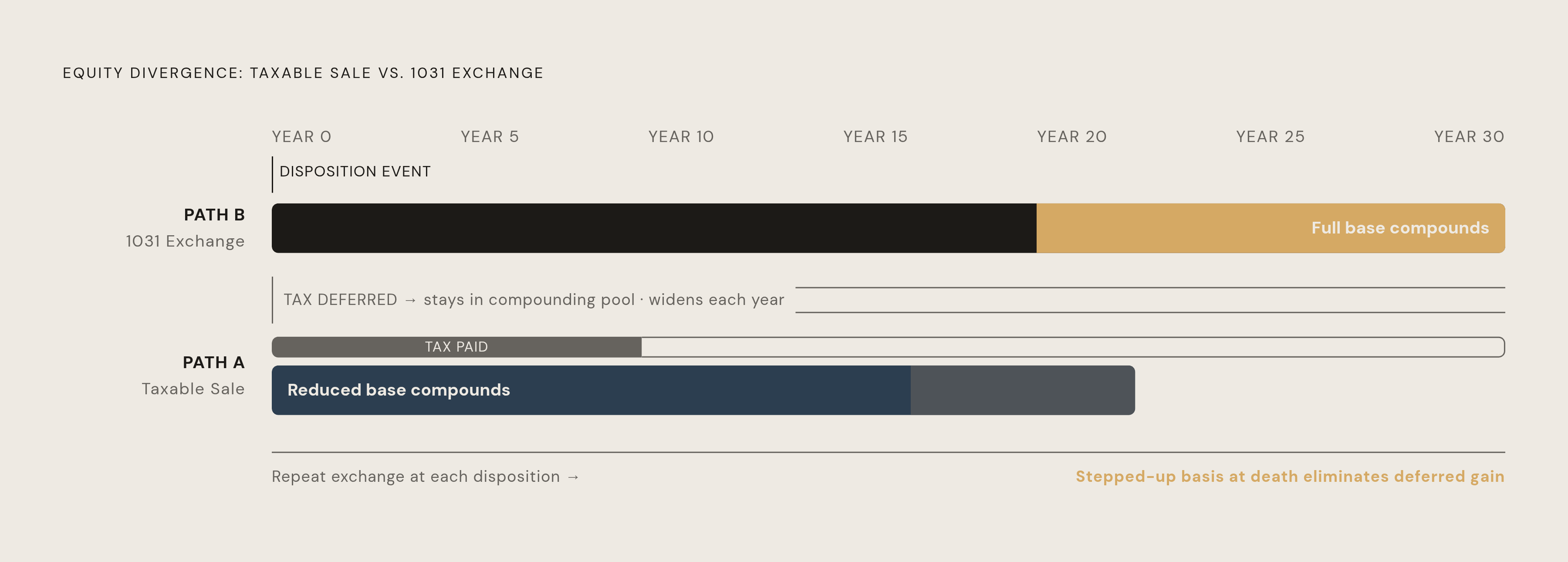
A properly structured 1031 exchange avoids partial liquidation of your equity to satisfy a tax bill, so the entire base keeps working in the replacement property instead. Because of that, an exchange produces a higher after-tax equity yield than a taxable sale executed in the same market environment, when the quality of the replacement investment stays constant. The mechanism is basis replacement: the gain that would otherwise be recognized at sale carries forward into the replacement property through a reduced adjusted basis, so the tax liability is deferred rather than eliminated, but it does not consume capital today. An investor who exchanges enters the replacement investment with a materially larger equity base than an investor who sold and paid tax, and the size of that difference is exactly equal to the tax that was deferred.
That differential equity base compounds at whatever rate the replacement property earns, so the longer the holding period and the stronger the return, the larger the compounding advantage becomes over time. Deferral is also repeatable: an investor can exchange again at the next disposition, and the one after that, continuing to compound on the full equity base rather than resetting to a smaller, post-tax residual at every transaction. There is a permanent exit from the deferral cycle built into the tax code: stepped-up basis at death allows heirs to receive the property at fair market value as of the date of death, potentially eliminating the accumulated deferred gain entirely for investors who hold through their estate rather than selling during their lifetime.
Don't run the comparison as exchange versus no tax. It's exchange-forward compounding on a larger base versus pay-tax-now compounding on a smaller one. The deferred liability travels into the replacement property embedded in the reduced basis, so an exchange changes when and whether the gain is recognized rather than making it disappear. Investors who think of an exchange purely as a way to avoid tax tend to undervalue it, while investors who model it as a way to preserve the compounding base see its full mathematical force. Depreciation on the replacement property blends the carried-forward basis with any new capital you invest, and that affects your after-tax cash flow going forward, so model it carefully before closing. The basis mechanics involved illuminate why the metric matters in practice: when an exchange is structured correctly through a qualified intermediary, the deferred gain reduces the basis of the replacement property, letting the investor's full equity base enter the next investment rather than being partially liquidated to pay tax, a concrete demonstration of how after-tax equity yield moves from a theoretical concept to an actionable one.
The exchange rules that determine whether equity preservation happens
The equity preservation a 1031 exchange promises is not automatic. It depends on satisfying a set of strict, non-negotiable IRS requirements, and failing any single one of them converts the exchange into a taxable sale, eliminating the after-tax equity yield advantage the whole strategy was built to capture. The first requirement concerns who holds the money: the IRS treats constructive receipt broadly, so if an investor can access, direct, or control the sale proceeds at any point in the process, the exchange fails. A qualified intermediary must hold the funds under an exchange agreement executed before the sale closes. The choice of intermediary is therefore a decision with real financial consequences rather than a procedural formality. Two deadlines then begin running concurrently from the moment the relinquished property transfers. The investor has 45 calendar days to identify replacement property in writing, and that identification must include a specific street address or legal description, since a vague description such as "a property in Austin" does not satisfy the requirement. The investor then has 180 calendar days total to close on the replacement property. Both clocks run simultaneously rather than sequentially, weekends and federal holidays count toward both deadlines, and the IRS grants no discretionary extensions for ordinary circumstances; limited extensions are available only for federally declared disasters under Revenue Procedure 2018-58.
Full tax deferral also depends on meeting three financial conditions together; if you fall short on any one of them, the tax code calls the result boot, a taxable gain that partially erodes the equity preservation the exchange was meant to deliver. Take the gross sale price, subtract exchange expenses such as commissions and intermediary fees to get the relinquished property's net sale price, and the replacement property's purchase price must equal or exceed that figure. The equity reinvested must equal or exceed the equity that came out of the relinquished property, and the debt carried onto the replacement property must equal or exceed the debt that was retired, unless you offset any shortfall with additional cash. A separate requirement, the same taxpayer rule, mandates that the entity or individual who sells the relinquished property must be the same entity or individual who buys the replacement property. Common failure patterns: a property sold inside an LLC but the replacement purchased personally, or one spouse selling a jointly owned property while both spouses appear on the replacement purchase. The property itself must also satisfy a like-kind requirement, meaning both the relinquished and replacement assets must be real property held for investment or productive use in a trade or business, which excludes personal property, primary residences, and fix-and-flip inventory, though the definition is broad enough within real estate that a single-family rental can exchange into a commercial property, vacant land, or a multifamily building.
Boot needs separate attention, because it is the precise mechanism by which partial compliance produces partial equity erosion, and you need to model it in advance in every after-tax equity yield calculation. Cash left over in the exchange after closing and a reduction in debt relief both constitute boot, and purchasing a replacement property of lower value than the relinquished property typically produces one or both. Interest earned on exchange funds while they sit with the qualified intermediary is also taxable as ordinary income regardless of whether the investor reinvests it, and if that interest causes total exchange proceeds to exceed the replacement property's purchase price, the excess is treated as boot as well, a detail that needs to be modeled before closing rather than discovered afterward. The stacked nature of these liabilities is why a no-fee exchange intermediary that publishes transparent interest rates on held funds, and returns that interest directly to the client, carries real mathematical weight: every dollar preserved through deferral and every basis point earned on funds held during the exchange window compounds forward into the replacement investment, amplifying the after-tax equity yield over time.
How the disposition timing decision changes with after-tax equity yield
Once after-tax equity yield replaces gross return as the decision criterion, a taxable sale has to clear a much higher bar to justify itself, and in most cap rate environments, an exchange that deploys the same equity into a comparably performing asset wins the comparison. If you sell and pay tax, you have to find a replacement investment that earns a high enough return on the smaller, post-tax equity base to match what an exchanging investor earns on the full, preserved base. So the tax-paying investor's next deal has to work harder just to arrive at the same terminal wealth position. The gap isn't marginal: it widens as the deferred tax liability grows larger, as the preserved equity base grows larger, and as more compounding years remain in the investment horizon. A taxable sale can still be the right decision in specific circumstances, for an investor genuinely exiting real estate altogether, one holding losses that offset the gain, or one facing a replacement market with no suitable assets available, but the exchange alternative has to be priced correctly for that determination to be an honest one. If you compare gross cap rates on prospective replacement properties without adjusting for the equity base underneath them, you aren't running the comparison that matters: after-tax equity yield on the full exchange equity base against after-tax return on the reduced post-sale equity base.
The same metric disciplines decisions made during the identification period itself. A replacement property that looks inferior on a gross return basis can turn out to be superior on after-tax equity yield once the size of the equity base being preserved is accounted for. This resolves a behavioral trap visible in practice: some investors let an exchange fail rather than settle for a replacement property they consider suboptimal, without weighing the fact that the tax cost of letting the exchange fail reduces the equity available for every investment that follows. A compressed timeline makes it harder to evaluate long-term suitability carefully, so you should start the replacement property search before the relinquished property closes rather than waiting until the 45-day clock has already started. If you can't locate a suitable direct replacement inside that window, Delaware Statutory Trusts offer a fractional interest in real estate that qualifies as like-kind replacement property, so you still have a workable option even under time pressure. Measuring the sell-versus-exchange decision against after-tax equity yield rather than gross proceeds reframes the question: not which number looks larger at closing, but which path leaves the largest base of capital compounding forward.