Installment Sale vs 1031 Exchange for Seller-Financed Deals
Seller financing forces a choice between deferral by timing or by reinvestment.

A seller-financed deal puts two separate tax tools on the table at once, an installment sale under IRC §453 and a 1031 exchange under IRC §1031, and most investors assume they can pick features from each without consequence, but they cannot. The two tools run on different logic: one defers gain by spreading payments over time, the other defers gain by reinvesting proceeds into replacement property, and combining them carelessly can produce a tax bill larger than either tool alone would have caused.
Seller financing forces a structural choice between two tax tools
Picture the deal as it actually arrives: a buyer wants the property, but a bank won't underwrite the purchase on terms either side can live with, so the seller offers to carry part of the price as a note. The exchange clock, if there's an exchange in play, is already running. At that moment, before anyone signs anything, the seller is standing at a fork that most people don't realize they've reached.
An installment sale defers gain through timing. The investor sells, reports a portion of each payment as taxable gain as it arrives over the years, and never has to find or close on another property. A 1031 exchange defers gain through reinvestment. The investor sells, moves the proceeds into a like-kind replacement property through a Qualified Intermediary, and owes no current tax on the gain as long as the exchange rules are followed to the letter. These are two different legal mechanisms, each with different clocks, different paperwork, and different failure modes.
Seller financing is what forces the issue, because a note from the buyer behaves very differently depending on which side of the transaction it sits on and which of the two tools governs the deal. If you carry it correctly, seller financing can make an exchange work when conventional financing has fallen through. But if carried without planning, it can turn an exchange into a taxable event the investor never intended. The structure has to be set before closing. There is no fixing it afterward.
How an installment sale works under IRC §453
The installment method taxes each payment received using a fraction: gross profit divided by contract price. That ratio, the gross profit ratio, is applied to each principal payment as it comes in, and that portion is the taxable gain for the year. The remainder of each payment is treated as a tax-free return of the investor's basis. Interest on the note is a separate item entirely, reported as ordinary income in the year received, and it never gets the benefit of capital gains rates no matter how the principal is handled.
The total tax bill does not shrink. An installment sale changes the timing of when tax is owed, and the benefit to the investor comes from the time value of deferring a large liability across several years while that deferred cash keeps working elsewhere.
The sharpest limitation sits in IRC §453(i). Any depreciation recapture classified as §1245 income must be recognized in full in the year of sale, no matter how small the actual cash received at closing turns out to be. This hits hardest for investors who ran cost segregation studies and claimed bonus depreciation on personal property components of a building, like appliances, carpeting, or specialized equipment, since all of that recapture comes due in year one even if the buyer only put a small amount down. Investors who stuck to straight-line §1250 depreciation on a residential rental face no §1245 recapture at all, and in that case the entire gain, both the unrecaptured §1250 portion and the long-term capital gain, can be spread across the installment years as payments arrive. Before choosing this path, an investor needs a clear picture of accumulated depreciation and what recapture category it falls into, because that number determines how much tax comes due immediately regardless of how the sale is financed.
The installment sale's real appeal is its simplicity. There's no replacement property to find, no 45-day identification deadline, no 180-day closing window. For an investor who wants out of real estate entirely, or who wants to redirect capital into something other than another property, that simplicity carries real weight.
How a 1031 exchange works
Under IRC §1031, no gain or loss is recognized on the exchange of property held for productive use in a trade or business or for investment, so long as the investor receives like-kind replacement property in return. Deferral here comes from reinvestment, not from spreading out payments the way an installment sale does.
The exchange runs on two clocks that start ticking on the same day the relinquished property transfers. The first is the identification period: the investor must identify replacement properties in writing within a short window after that transfer. The second is the exchange period: the investor must actually receive the replacement property within a limited number of days of the same transfer date, or by the due date of the tax return including extensions, whichever comes first. The 45-day identification window sits inside the 180-day total. Investors who sell late in the calendar year and then file their return early without requesting an extension can unintentionally shorten that 180-day period and disqualify an exchange that would otherwise have been valid. Filing an extension protects the full window.
The rule that governs the whole structure is constructive receipt, and it allows no exceptions: the investor must never touch the sale proceeds. All funds have to flow directly to a Qualified Intermediary, and any actual or constructive receipt of money, even briefly, breaks the exchange. This rule is what makes seller-financed notes so dangerous inside an exchange.
A 1031 exchange can defer §1245 depreciation recapture along with capital gains, as long as the replacement property has enough §1245 property to offset what was claimed on the relinquished property. This is a capability installment sales simply don't have, and it becomes the deciding factor for investors who ran cost segregation and are sitting on a large recapture exposure. The exchange defers tax. Gain carried forward into the replacement property, plus any further appreciation, becomes taxable when that property is eventually sold outside another exchange, though heirs who inherit the property receive a stepped-up basis at death, which can erase the deferred gain permanently. Section 1031 remains fully in force for 2026, and the tax law passed in July 2025 left it unchanged.
The boot trap: what happens when a seller carries a note inside a 1031 exchange
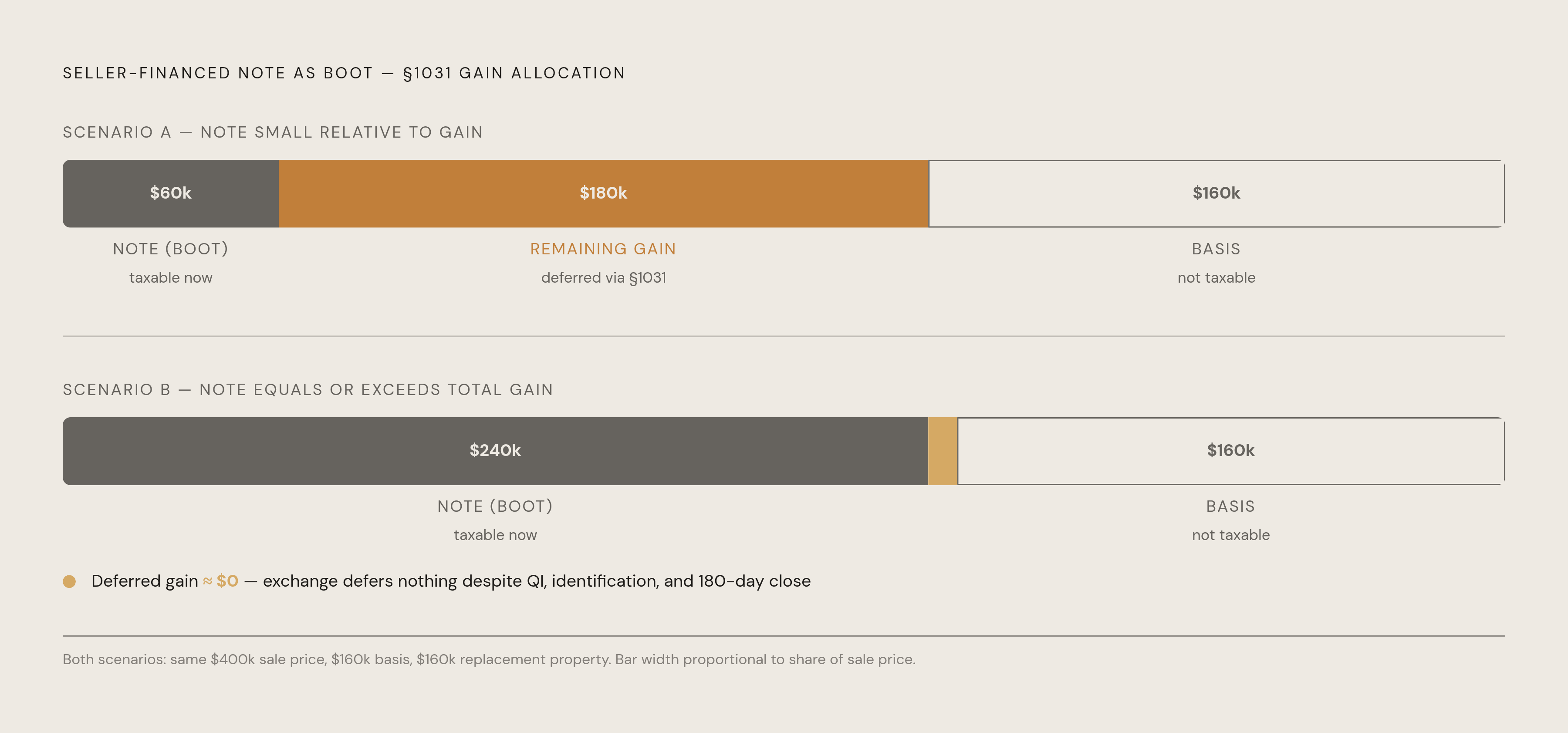
This is where the two tools stop being compatible and start working against each other. An investor who sells the relinquished property and accepts a promissory note from the buyer has, in the eyes of the IRS, received boot. A note is classified as "other property," commonly called boot, and it triggers taxable gain immediately to the extent of the note's face value. The investor expected the exchange to shelter the gain, but the note sits outside the exchange's protection.
The mechanics of this collision matter more than the label. Gain goes to the note first, and only what remains beyond the note's face value can be deferred under Section 1031. That means the exchange benefits the investor only if the total realized gain exceeds the face value of the seller-financed note. If the note is large relative to the gain, the exchange may defer little or nothing, even though the investor still went through the entire process of hiring a Qualified Intermediary, identifying replacement property, and closing within 180 days.
This is the trap that catches experienced investors as often as first-timers. An investor expecting a partial exchange to shelter most of the gain can find that the note absorbs the entire taxable portion, leaving the exchange with nothing left to defer and the appearance of a tax-deferred transaction that deferred almost nothing. The IRS treats a note from the buyer as "other property" whether the investor receives it actually or constructively, and that classification holds even if the investor goes on to acquire a legitimate replacement property through the exchange. Intent doesn't cure the structure.
The scenario is not a rare edge case. It arises whenever a buyer can't secure conventional financing and the seller agrees to carry paper instead, and tightening lending conditions have made that arrangement more common, not less. Compounding the difficulty, IRS guidance on combining §1031 and installment sale rules is limited, so investors working through this territory are operating without a clear rulebook and carrying more planning risk than a straightforward exchange would involve.
The choice of structure has to happen before closing. Waiting until the funds are already in hand to decide between a 1031 and an installment sale can produce a transaction that qualifies cleanly as neither, leaving the investor with a bigger immediate tax bill than either tool would have caused on its own. A dedicated exchange officer who handles a file from intake through closing, rather than a model built around sales handoffs, is positioned to catch this kind of structural risk during planning, before it becomes irreversible.
Structural workarounds when seller financing on the relinquished property cannot be avoided
When you can't sidestep seller financing on the relinquished property, you can turn to several structural approaches to manage or eliminate boot. Each comes with a real trade-off, and none is automatically the right answer.
The note can be paid off in cash before closing. If the investor has the liquidity, the note is excluded from the exchange entirely, and its tax basis becomes equal to its face amount rather than the carried-over basis from the relinquished property. This simplifies the math considerably, but it only works for investors who have that cash available in the first place, which many don't.
The note can be directed to the Qualified Intermediary and sold before the replacement property closes. The note is made payable to, or assigned to, the QI, who then sells it to a third party, a bank, a private investor, or a pension fund, and the proceeds flow into the exchange account to help fund the replacement property purchase. Because notes typically sell at a discount to face value, the investor generally has to make up that difference in cash to avoid boot exposure on the discounted portion.
The note can become part of the replacement property purchase itself. The QI holds the note and transfers it to the seller of the replacement property as part of the acquisition price, leaving that seller holding a third-party note. This produces the same tax outcome as a cash exchange, but it depends on finding a replacement property seller willing to accept a note from someone they've never met, which in practice is hard to arrange.
An investor can elect out of installment sale treatment under §453(d), accelerating full gain recognition into the year of sale. This can make sense for an investor planning to put all proceeds into a clean exchange and who wants to avoid the complexity of running both sets of rules simultaneously.
Finally, if the buyer's note is short-term and will be paid off in full before the exchange closes, the cash from that payoff can flow into the exchange and resolve the boot exposure. This option depends entirely on confidence that the buyer can refinance quickly, which is not something the seller controls.
If none of these paths is workable, an installment sale may simply be the better fit. The investor exits without needing a replacement property and manages the tax consequence through payment timing. Because this choice is irreversible once closing happens, investors need to move decisively the moment the right structure becomes clear. Technology-driven platforms such as Deferred.com can open an exchange quickly, even at the closing table itself, which gives an investor the flexibility to lock in a 1031 the moment suitable replacement property is identified in a seller-financed scenario, rather than defaulting to an installment sale by default of time running out.
Seller financing on the replacement property side, which is the cleaner structure
The asymmetry here is one many investors overlook: when the investor is the buyer of the replacement property, and it's the seller of that replacement property who carries the note, the structure is far simpler and generally creates no boot exposure for the investor running the exchange.
In this version of the deal, the investor combines exchange proceeds with the seller-carried note to acquire a replacement property of equal or greater value. The note helps satisfy the requirement that the replacement property be of equal or greater value and that debt be replaced, leaving the tax treatment on the investor's side of the transaction uncomplicated.
Seller financing on the replacement property side can bridge a valuation gap, add negotiating flexibility, and smooth a closing, which matters particularly for commercial real estate, multifamily assets, or specialized properties where conventional lending terms vary widely from one lender to the next. A note carried by the replacement property seller can also come with flexible terms, interest-only payments, a longer amortization schedule, or a balloon structure, that improve cash flow during a stabilization period or set up a later refinance under better terms.
The investor still has to confirm that total replacement property value meets or exceeds the relinquished property value, and that net equity is fully reinvested, to avoid boot from under-replacement. But the note itself, on this side of the deal, is not the threat it is on the other side.
Choosing between the two tools
The right tool is the one that matches what the investor plans to do with their capital after the sale closes, and how much depreciation recapture exposure sits on the relinquished property.
A 1031 exchange fits an investor who wants to stay in real estate and has already identified, or is confident they can identify, suitable replacement property within the 45-day window. It fits an investor pursuing a hold-until-death strategy, since a chain of exchanges carried through to death, combined with the stepped-up basis heirs receive, is the only path to permanently eliminating deferred gain. Heirs who inherit property sold under an installment sale don't get that benefit. They continue recognizing gain on whatever payments remain outstanding. The exchange also fits best when the buyer can pay all cash or secure conventional financing, since seller financing on the relinquished property isn't required at all in that scenario, and the boot trap never enters the picture.
An installment sale fits an investor who wants out of real estate, who is comfortable managing recapture exposure in the year of sale, and who values simplicity over the reinvestment requirements and strict deadlines that come with an exchange. The constructive-receipt rule that governs 1031 exchanges is unforgiving: the investor can never touch the sale proceeds, and every dollar must flow directly to a Qualified Intermediary, since any actual or constructive receipt of funds breaks the exchange. A no-fee intermediary such as Deferred.com holds funds in segregated, FDIC-insured accounts and publishes its interest rates openly, so that capital stays secure and working throughout the exchange period, and investors don't have to guess at the fee structures the rest of the industry negotiates.
Neither tool is more sophisticated than the other. Each answers a different question about what the investor wants their money doing next, and the seller financing in the deal decides which answer is actually available.