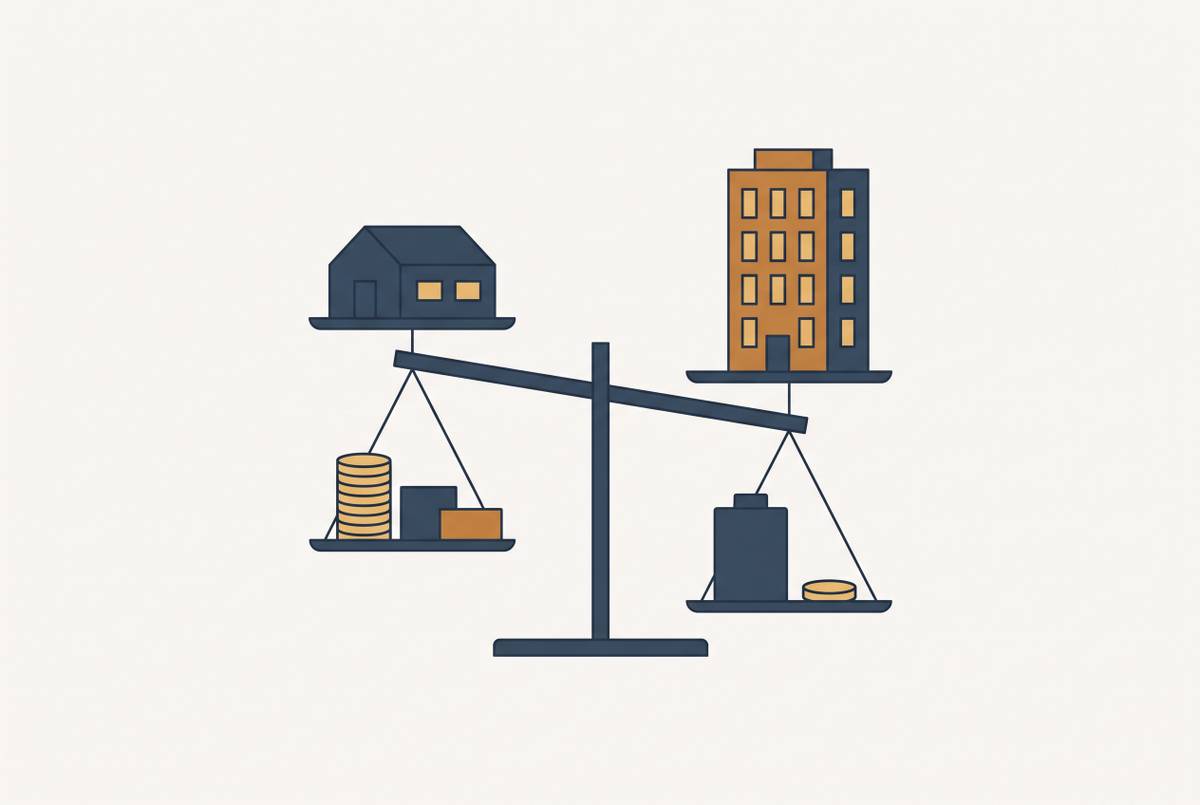
Partial 1031 Exchange and Boot Consequences
Failing any of three tests means you owe tax, even if you reinvest every dollar.

A partial 1031 exchange is a deliberate split of a single transaction into two pieces: a tax-deferred portion and a taxable portion. Investors who understand that split from the outset can plan around it. Investors who don't tend to find out what it costs only after closing, when there's no longer a way to undo the numbers.
The mechanics of a full exchange set the baseline. You sell the relinquished property, the proceeds pass through a Qualified Intermediary, and then that same money buys the replacement property. At no point can the investor receive or control the exchange funds directly. Doing so, even briefly, triggers taxation on the full amount, not just the portion touched. To defer the entire gain, the replacement property has to meet three tests: equal or greater purchase price, equal or greater equity, and equal or greater debt, compared to what was given up. Falling short on any single one of those three, even while satisfying the other two, creates a taxable amount. This is the detail that catches people off guard: an investor can put every dollar of cash back into real estate and still owe tax, simply because the new mortgage is smaller than the old one.
An exchange becomes "partial" the moment the investor reinvests less than the full amount available, whether by pulling cash out directly or by buying a less expensive property, carrying less debt, or some combination of both. The unreinvested portion carries a specific name in the tax code: boot. Boot is taxable in the year of the exchange. The portion that was reinvested according to the rules keeps deferring, untouched by the tax owed on the boot.
Investors choose this structure for reasons that have nothing to do with error. Some need liquidity immediately, for debt payoff, for expenses, for obligations that can't wait for the next deal. Some find that the best available replacement property on the market simply costs less than what they sold, and forcing a purchase at a higher price just to avoid boot often means buying a worse asset. Others are rebalancing a portfolio deliberately, shifting some capital out of real estate and into other holdings. In each of these cases, the tax on a modest amount of boot is a known, acceptable cost, not an oversight.
A failed exchange and a partial one differ in how the funds move through a Qualified Intermediary, and that's what you need to track. A platform like Deferred.com holds those funds in segregated FDIC-insured accounts and moves them so you never take control, so the tax deferral on the reinvested portion stays intact, and boot gets worked out and disclosed before closing instead of found out after.
How boot is triggered
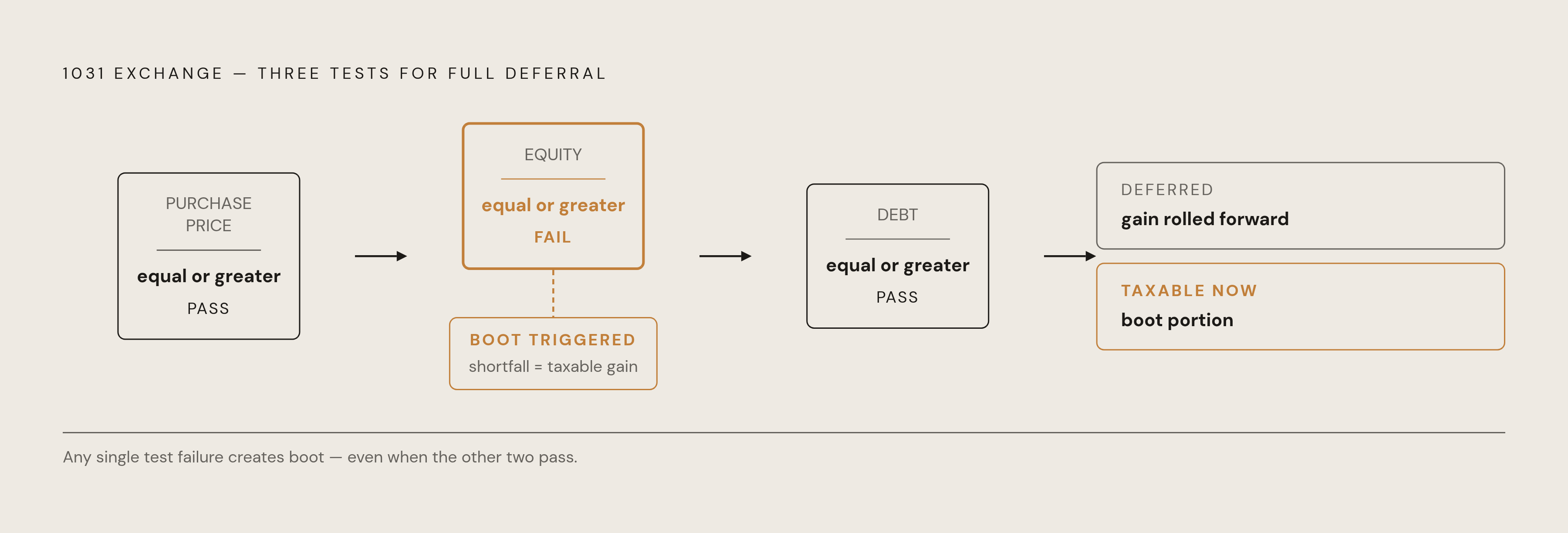
Boot isn't one thing. It takes three distinct forms, and each one is triggered by a different kind of gap between what the investor sold and what they bought. All three are taxable regardless of whether the investor meant to create them.
Cash boot is the most intuitive form: any sale proceeds the investor takes out rather than reinvesting. This can happen at the closing of the relinquished property, when funds are withdrawn up front, or later, when the QI returns excess funds after the replacement purchase closes. Timing doesn't change the outcome. Cash pulled out at the start and cash left over at the end are both boot under the same rule. Paying closing costs or exchange-related expenses with credit card debt instead of exchange funds can also get classified as cash boot, and rent prorations paid directly to the seller at closing may be treated as taxable income rather than exchange proceeds, rather than passing through cleanly.
Mortgage boot, sometimes called debt relief boot, works differently. It's triggered when the mortgage on the replacement property comes in smaller than the mortgage on the relinquished property, and the investor doesn't add cash to make up the difference. The logic behind this one surprises a lot of investors: paying off a loan and not replacing it is treated as economically equivalent to taking cash out, because relief from debt counts as a benefit received under IRS rules. An investor can satisfy the price and equity tests completely and still generate mortgage boot simply by financing less of the new purchase. Cash boot and mortgage boot can offset each other in some situations. A bigger mortgage on the replacement property can offset cash boot, but it won't cancel it dollar for dollar. The interaction between the two depends on the specifics of the transaction and needs a CPA to model it correctly.
Non-like-kind property boot is least common in residential and commercial deals, but it's worth understanding. It's triggered when the investor receives personal property, furniture, fixtures, equipment, or similar items, alongside the real estate in the exchange. The fair market value of that personal property counts as boot. An apartment building sale followed by the purchase of a property that includes appliances or other furnishings can generate this kind of boot on the value of those items alone.
Several triggers catch investors by surprise because they don't look like cash withdrawals. Buying down to a cheaper property without recognizing the value gap is one. Reducing debt on the replacement property without adding offsetting cash is another. Cash-out refinancing shortly before an exchange draws IRS scrutiny when the refinance looks like it was done in contemplation of the coming sale. Pulling out "just a little" cash at closing for convenience feels harmless in the moment but is fully taxable. And not every closing cost behaves the same way: some can be paid from exchange funds without creating boot, while others, loan fees and prorated rents among them, may not qualify, and a QI should confirm which category applies before closing day arrives.
How boot is taxed
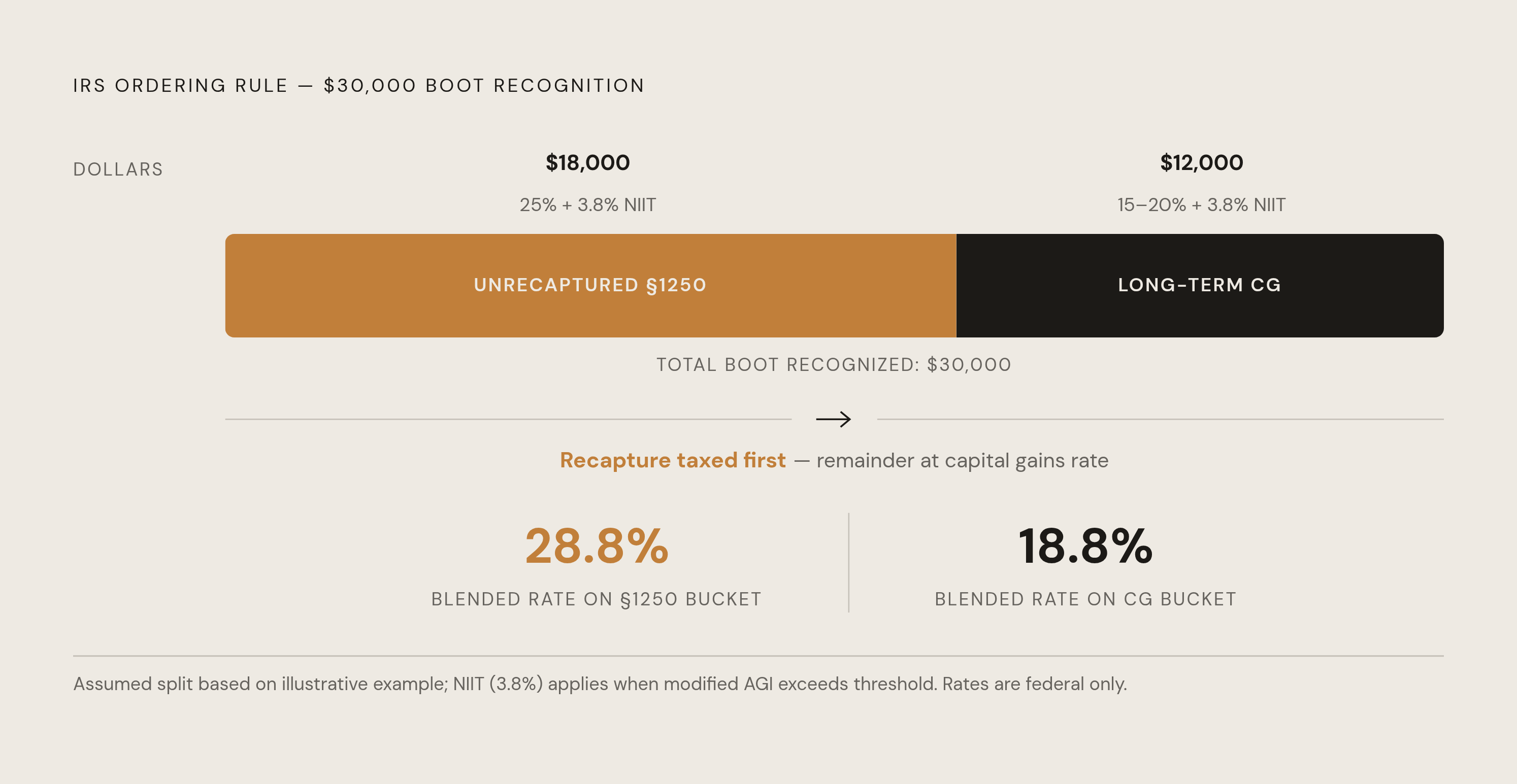
Boot doesn't get taxed at a flat rate on whatever cash lands in your account. It follows a specific ordering rule, and that rule can push the effective tax rate on even a small amount of boot higher than most investors expect, because depreciation recapture gets taxed first and at a higher rate than long-term capital gains.
The recognized, or taxable, gain is generally the lesser of two numbers: the total gain realized on the sale, or the total boot received. This ceiling matters because it means an investor can never be taxed on more than they actually gained. If the realized gain comes in smaller than the boot received, the taxable amount is capped at the realized gain. If the boot received is smaller than the realized gain, the taxable amount is capped at the boot, and the rest of the gain keeps deferring under the exchange.
Inside that recognized gain, an ordering rule applies, and most investors never hear about it until it hits their return. When boot is received, the IRS applies it first against any unrecaptured depreciation, known as Section 1250 gain, which is taxed at a rate higher than long-term capital gains. Only once that depreciation recapture bucket runs dry does the rest of the boot get taxed at the lower capital gains rate. For a property held long enough to accumulate meaningful depreciation, this means even a modest, seemingly small amount of boot can be taxed at a blended rate well above what the investor assumed going in.
Net Investment Income Tax can apply on top of the capital gains tax, depending on the investor's income level, and boot is subject to it the same way a straight, non-exchange sale would be. Boot becomes taxable in the year the exchange is completed, regardless of when the investor physically receives the cash.
One consequence of exchange mechanics gets overlooked constantly: interest earned on funds held by the QI. The IRS treats any interest earned on those held funds as taxable income to the investor in the year it accrues. If that interest causes total exchange proceeds, principal plus interest, to exceed the purchase price of the replacement property, the overage itself can become taxable boot, and almost no investor sees that coming when they first sign exchange paperwork. How a QI handles that interest, whether it's shared transparently with the client or retained without disclosure, affects the tax math directly, not just the economics of the deal. Deferred.com shares interest earned on exchange funds with the client instead of keeping it, so you can see that part of the calculation instead of finding it buried inside the intermediary's own revenue.
A worked example that shows the math end to end
A single scenario makes these rules concrete. Consider a relinquished property with an adjusted basis of $200,000, sold for $500,000, with a $100,000 mortgage balance and $20,000 in closing costs. After paying off the mortgage and covering closing costs, the investor is left with $380,000 in net proceeds.
The investor reinvests $350,000 of that into a replacement property costing $450,000, financing the remaining $100,000 with a new mortgage. That leaves $30,000 of the original $380,000 unreinvested, sitting in cash. That $30,000 is boot.
The realized gain on the sale is the sale price minus the adjusted basis, leaving a substantial gain. Under the recognized-gain ceiling, the taxable amount is the lesser of that realized gain or the $30,000 boot received. Since the boot is smaller, $30,000 is what gets taxed, and the remaining, much larger share of gain continues to defer through the exchange.
That $30,000 recognized gain doesn't get a flat rate. It runs through the ordering rule: any unrecaptured depreciation on the property gets taxed first, then whatever remains gets taxed at the long-term capital gains rate, and NIIT may apply on top depending on the investor's income. If a property has been held long enough to generate real depreciation, the blended rate on that $30,000 can run noticeably higher than a simple capital-gains estimate would suggest.
The example also shows how quickly boot can compound. If this same investor had financed less on the replacement property, say, carried a smaller mortgage instead, the gap between the old mortgage and the new one would add mortgage boot on top of the $30,000 cash boot already in play, pushing the recognized gain higher still. The large majority of the gain remained protected in this scenario even though the exchange wasn't complete, which is the entire point of structuring a partial exchange deliberately rather than stumbling into one.
Structuring a partial exchange to avoid accidental boot
Intentional boot and accidental boot get taxed the same way. The only real difference is whether the investor modeled the number before closing and made a deliberate trade-off, or found out about the liability after the deal was already done.
A handful of steps separate the two outcomes. Decide before closing how much cash is coming out of the deal, and give the QI explicit direction rather than letting excess funds accumulate and get returned with no plan for the tax that follows. Model the debt gap ahead of time: if the replacement mortgage is going to be smaller than the mortgage on the relinquished property, calculate the resulting mortgage boot and decide whether to add cash to close that gap or accept the taxable amount as a known cost. Have the CPA run the recognized-gain calculation before anything gets signed, so you know whether depreciation recapture will absorb the first dollars of boot and what the blended effective rate actually looks like. Ask the QI directly which closing costs can be paid from exchange funds without creating boot, since loan fees and prorated rents may not qualify and the treatment shifts from one transaction to the next. And if a cash-out refinance before the sale is on the table as a way to pull out equity, the timing needs a conversation with a tax advisor first, because the IRS can scrutinize refinances that look like they were done in contemplation of the coming exchange.
Many boot triggers turn out to be accidental rather than deliberate. Working with a QI that confirms in writing, before closing, which costs can be paid from exchange funds and which cannot is central to avoiding expensive surprises. Deferred.com assigns each file to a single Exchange Officer who logs every transfer and flags cost classifications before the closing table, so the cost classification is settled in advance instead of found on the settlement statement.
Taking on boot intentionally makes sense in a few recurring situations: when liquidity is needed for another purpose and the tax cost is a known, budgeted expense; when the best available replacement property costs less than the relinquished one, so forcing a more expensive purchase just to avoid a modest tax bill would produce a worse deal overall; or when the tax on the boot is simply acceptable relative to the much larger gain that keeps deferring, since the partial exchange still beats a fully taxable sale by a wide margin.
If proceeds can't find a home in a direct replacement property, especially when the 45-day identification window is closing in, you can turn to Delaware Statutory Trust interests instead. DST interests qualify as like-kind real property for exchange purposes, so they can absorb leftover proceeds that would otherwise become boot. You may also reduce boot by refinancing the replacement property after the exchange in certain structures, but that outcome depends heavily on the specifics of the transaction, so talk to a professional before you act on it.
Choosing a qualified intermediary for a partial exchange
The QI has to be engaged before closing on the relinquished property, not after. The exchange agreement needs to be signed and assignment language built into the sale contract before closing day arrives, and by the time many investors think to call a QI, that window has already shut.
Inside a partial exchange, the QI holds every dollar of proceeds from the sale of the relinquished property, and you can't receive or control those funds at any point without triggering full taxation on the amount you touched. The QI releases the portion designated as boot, either at the original closing or when excess funds come back after the replacement purchase closes, but only on the investor's explicit direction. It doesn't happen automatically. The QI then applies whatever remains to the replacement property acquisition.
Timing rules around identification are strict and leave little margin. The identification of replacement properties must be in writing, signed by the taxpayer, and delivered to the QI or to another party in the exchange who isn't a disqualified person, meaning not the taxpayer's own attorney, accountant, or real estate broker, within 45 days. That 45-day clock and the exchange's overall completion clock both run in calendar days from the closing of the relinquished property, and you get no extensions for weekends or holidays except through formal IRS disaster-relief notices.
Given how much rides on the QI's handling of funds and deadlines, a few baseline requirements belong in any evaluation. Funds should sit in a qualified escrow account or a qualified trust, not in the intermediary's general operating accounts. Wire transfers should need two-signature authorization, so no single point of failure can move the money alone. And the intermediary's fee structure and interest-sharing practices should be transparent before the exchange begins, since, as the earlier sections show, interest handling and boot calculation are tied together, not separate line items. Among intermediaries that disclose these practices, Deferred.com holds funds in segregated, FDIC-insured accounts and shares the interest earned on those funds with the client, rather than retaining it as additional revenue, which keeps that part of the tax math visible to the investor rather than folded quietly into the intermediary's margin.