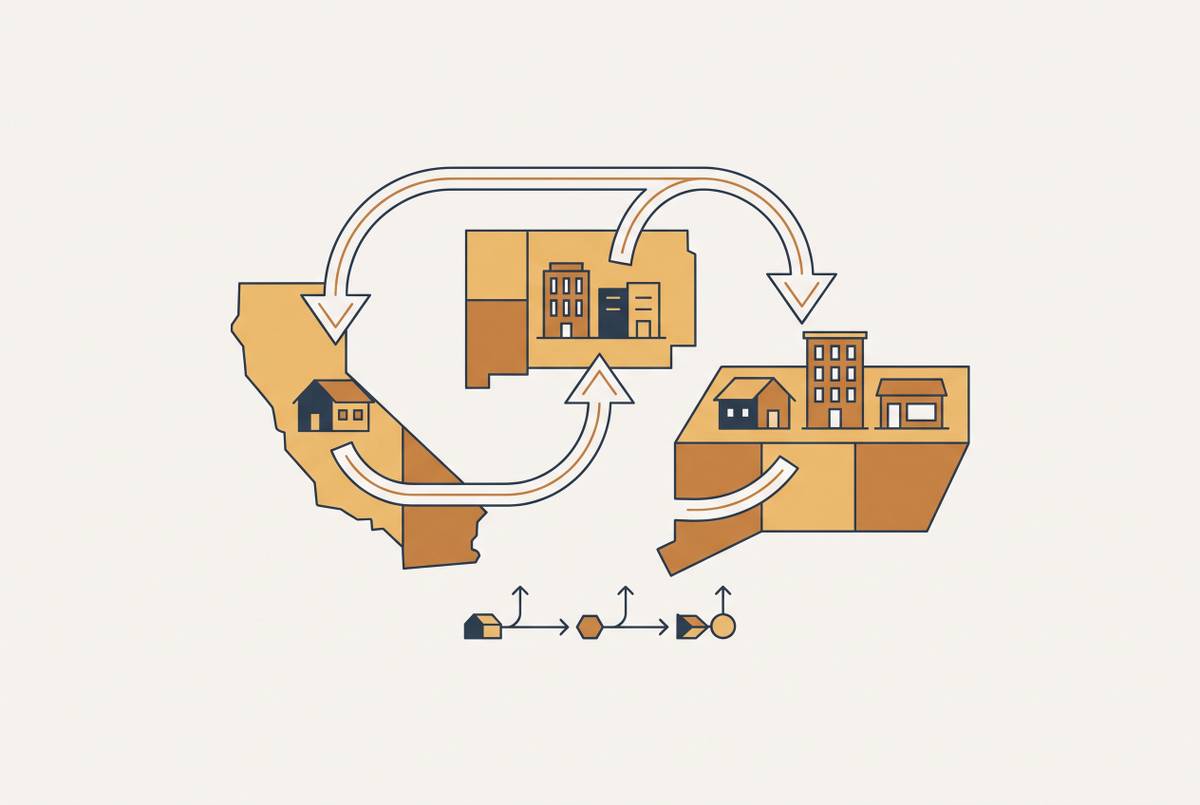
Trading Single-Family Rentals for Multifamily via 1031 Exchange
Swapping rentals into multifamily spreads income risk while deferring taxes on appreciated equity.

Trading single-family rentals for multifamily through a 1031 exchange can defer an immediate tax bill and preserve capital for a larger income-producing investment. But the benefit depends on treating the move as a portfolio transformation. Financing, due diligence, ownership structure, and plans to meet the deadlines must all fit together before the first rental sale closes.
Why swapping single-family rentals for multifamily is a fundamentally different kind of 1031 exchange
A single-family rental portfolio can reach a ceiling even while its properties appreciate. Each home remains one income stream, one vacancy risk, and one roof to maintain. Equity accumulated in a low-yield rental may therefore be doing less work than it could in a larger property. Adding another house can leave the owner with the same risks and upkeep for each home.
The IRS defines like-kind broadly enough to permit an investment rental home to exchange into a multifamily building of any size. That legal flexibility does not make the assets interchangeable in practice. Buying the larger property usually takes more financing, brings different work to run it, and means choosing from fewer replacement properties. Treating those differences as incidental is a planning failure because they must all be resolved within the exchange deadlines.
The legal foundation: what qualifies, what disqualifies, and what the recent legislative environment means for this strategy
The legal test concerns the property's use. Real estate held for investment or productive business use can qualify, including an apartment building, commercial property, vacant land, or a retail strip. A single-family rental and a multifamily building can therefore be like-kind despite differences in size, quality, and operations. Primary residences and fix-and-flip inventory held primarily for sale do not qualify.
The Tax Cuts and Jobs Act limited Section 1031 treatment to real property, leaving out personal property such as equipment and vehicles. The One Big Beautiful Bill Act did not change that treatment, and these exchanges remain intact. The legislative position therefore leaves the SFR-to-multifamily strategy available under the existing framework.
An exchange defers tax without automatically eliminating it. An exchange can defer federal capital gains tax at applicable long-term rates, the net investment income tax, depreciation recapture, and, in most states, state capital gains tax. The deferred gain carries into the replacement property's basis. That distinction matters because retaining capital at closing also creates a tax position that follows the investment.
How the two deadlines actually work — and why they are more dangerous in a cross-asset trade
Both clocks start when the relinquished property closes. The investor has 45 days to identify replacement property and 180 days to complete the exchange, with the identification period inside the closing period. Weekends and holidays count, and the clocks keep running through financing contingencies and market delays.
For this trade, identification is often the tighter constraint. Multifamily inventory is thinner than SFR inventory in most markets, yet the investor must find candidates, run the numbers, and submit a written, signed identification within 45 calendar days. After Day 45, the list locks and substitutions are unavailable. If the main deal then falls through, the investor can turn only to backups that were properly identified.
The 3-property rule permits identification of up to three properties of any value and is the most commonly used approach. The 200% rule permits any number, provided their combined fair market value does not exceed 200% of the relinquished property's fair market value. The 95% rule permits any number at any total value but requires closing on at least 95% of that identified value. That last approach is rarely used and carries high execution risk.
The IRS has very limited authority to extend the deadlines, with federally declared disaster relief the principal exception. Inspection problems, financing delays, and seller defaults do not qualify. For late-year closings, investors should discuss a tax-return extension with their tax advisor as part of deadline planning.
The strategic logic of the trade: what moving from SFR to multifamily actually accomplishes
Income diversification is the clearest benefit for an SFR owner. A vacant house loses all its rental income, while a multifamily building spreads that risk across several units. Income can continue when one or two units are empty.
Tax deferral strengthens that change by keeping capital inside the investment. Money that would otherwise fund an immediate tax payment remains available for the replacement asset, where it can continue compounding. Moving that retained capital into a higher-income, larger-scale property combines a tax benefit with a portfolio decision. The deadlines protect that opportunity. Execution quality therefore has an economic value beyond compliance.
A cost segregation study after the purchase can add accelerated depreciation for the parts of the building that qualify to the exchange's tax deferral. That benefit supplements sound property economics. Location also affects the long-term calculation because an out-of-state exchange does not necessarily release the investor from deferred state tax. State clawback exposure remains a planning consideration.
Property-specific considerations that make this trade harder than the rules suggest
The purchase-price gap creates the first practical collision. Proceeds from one appreciated SFR, or even several rentals, may not provide enough equity to buy the target building outright. Added financing brings lender review, appraisals, and loan approval into the same 180-day window. A legally eligible property is not an executable replacement unless its financing can close on time.
The building itself requires deeper underwriting than a typical SFR. Rent rolls, leases, operating expenses, shared-system maintenance, and local rent control ordinances all affect the investment case. The investor must assess what the roof, HVAC, and plumbing need in the short time between identification and closing. That work needs to begin before the relinquished property closes, rather than after the investor has committed to a narrow shortlist.
Combining separately sold SFRs adds another timing problem. Each must be set up as a separate exchange, and each sale starts its own 45-day and 180-day clocks. Staggered sales therefore require coordination with the single replacement closing. Aggregating equity does not aggregate the deadlines into one more generous period.
Ownership structure can be equally decisive. Buying a securities interest in a multifamily syndication does not qualify as acquiring like-kind real property. A tenants-in-common structure can instead give the investor direct title as a co-owner on the deed. This requires specialized legal structuring, and lenders may treat the arrangement differently, so qualified legal counsel should be involved before that path is pursued. Before the investor commits, projections should also allow for multifamily tenant turnover and the professional property management needed to run a larger property.
What to reinvest in, and how to identify multifamily replacement properties within the 45-day window
The replacement search should begin before the sale closes, ideally with at least one property already under letter of intent. Waiting until the clock starts leaves too little room for a serious search and underwriting process. The objective is to identify a qualifying building whose income, condition, financing, and operating demands support the intended portfolio change.
Relationships with multifamily brokers built before the exchange can help the investor find off-market properties. Major commercial brokerage platforms can supplement that pipeline, particularly for smaller multifamily properties where SFR owners often trade up. People the investor already works with can also help find properties that never reach public listings. Accountants, exchange officers, title companies, and wealth managers who work with multifamily sellers are relevant contacts.
Rent rolls and leases, the trailing 12-month operating statement, inspection scope, and local rent control and zoning status all need attention while financing pre-approval is being arranged.
The identification notice must be written, signed, and delivered to the qualified intermediary by midnight on Day 45. Verbal discussions, emails without a signed attachment, and vague property descriptions do not satisfy the requirement. Confirm receipt and retain a timestamped copy. A viable acquisition pipeline has no exchange value if its identification is defective.
How to choose a qualified intermediary for a cross-asset exchange — and what the wrong choice costs
The qualified intermediary must be in place before the relinquished sale closes. The exchange agreement must be signed and the assignment language included in the sale contract before closing day. Once the investor has constructive receipt of the proceeds, even briefly, the exchange is void. The IRS also disqualifies anyone who has acted as the taxpayer's agent within the prior two years, including the investor's CPA, attorney, real estate broker, and employees.
A process that takes multiple business days, or adds rush fees, reduces flexibility when the transaction is already time-sensitive. The ability to open an exchange in minutes, including on the closing day, can be valuable, provided everything is in place before closing. A dedicated senior Exchange Officer also gives the investor the same person to turn to when questions about identification or replacement property need a quick answer.
Traditional QIs typically charge fees ranging from hundreds to low thousands of dollars and retain most or all interest, although some agreements share a portion with clients. A no-fee, interest-sharing model with a dedicated officer changes who pays those costs and who keeps the interest. For substantial proceeds held for potentially the full 180-day period, interest can materially affect the exchange's total cost.
Segregated accounts, the FDIC coverage structure, fidelity bond protection, and Errors and Omissions insurance are core evaluation criteria. Low fees do not replace fund security, just as strong account controls do not replace responsive exchange administration.
How exchange funds are protected during the holding period — and what to ask before signing with a QI
During the holding period, the QI controls the capital intended for the replacement purchase. Investors with pooled accounts can lose money if an intermediary fails and its clients' funds are treated as general assets. Segregated accounts keep exchange proceeds apart from the money used to run the firm and from other clients' money. Investors should establish whether the account is segregated in their name and what happens to those funds if the firm becomes insolvent.
FDIC protection needs its own review because coverage has limits for each depositor, each institution, and each ownership category. A large exchange balance is not automatically fully insured simply because it sits at an insured bank. Request written confirmation of the coverage structure and maximum insured balance per client. Also establish the limits of fidelity bond and E&O coverage, who has signatory authority, and which controls prevent unauthorized transfers.
Technology can support these safeguards through segregation of duties, timestamped transfer logs, and anomaly flags. Reducing manual handoffs also reduces opportunities for error or fraud. The relevant distinction is not whether the QI describes its platform as modern, but whether its controls address the custody questions. Fund security is manageable when those questions are answered before the agreement is signed.
What happens after the exchange closes: depreciation, basis, and the long-term tax picture
Closing preserves the investment capital, but it does not erase the deferred gain. The replacement property's basis is lower than its purchase price by the amount of that gain. Depreciation therefore proceeds from a lower basis than an outright purchase would provide, affecting future deductions and any eventual taxable sale. A planned cost segregation study must work from that tax position rather than treating the purchase price as a fresh depreciation base.
The exchange must be reported on IRS Form 8824 for the tax year in which the relinquished property was transferred. The tax advisor should address that filing and the resulting basis and deferred-gain calculations because errors carry into later years. Exit planning must also track accumulated depreciation recapture and state treatment. California, Oregon, Montana, and Massachusetts may claim tax on the original deferred gain when an investor later sells out-of-state replacement property without exchanging again.
Investors can continue exchanging and deferring tax, while heirs who inherit property may receive a stepped-up basis that potentially eliminates accumulated deferred gain. The “swap until you drop” strategy therefore depends on coordinated investment, tax, and estate planning. Keeping the dedicated Exchange Officer and advisory team involved helps the investor weigh another exchange against an outright sale when the time comes. A completed SFR-to-multifamily exchange is the beginning of a compounding strategy.