Geographic Diversification via 1031 Exchange Across State Lines
Moved capital can reach stronger markets without triggering immediate tax.
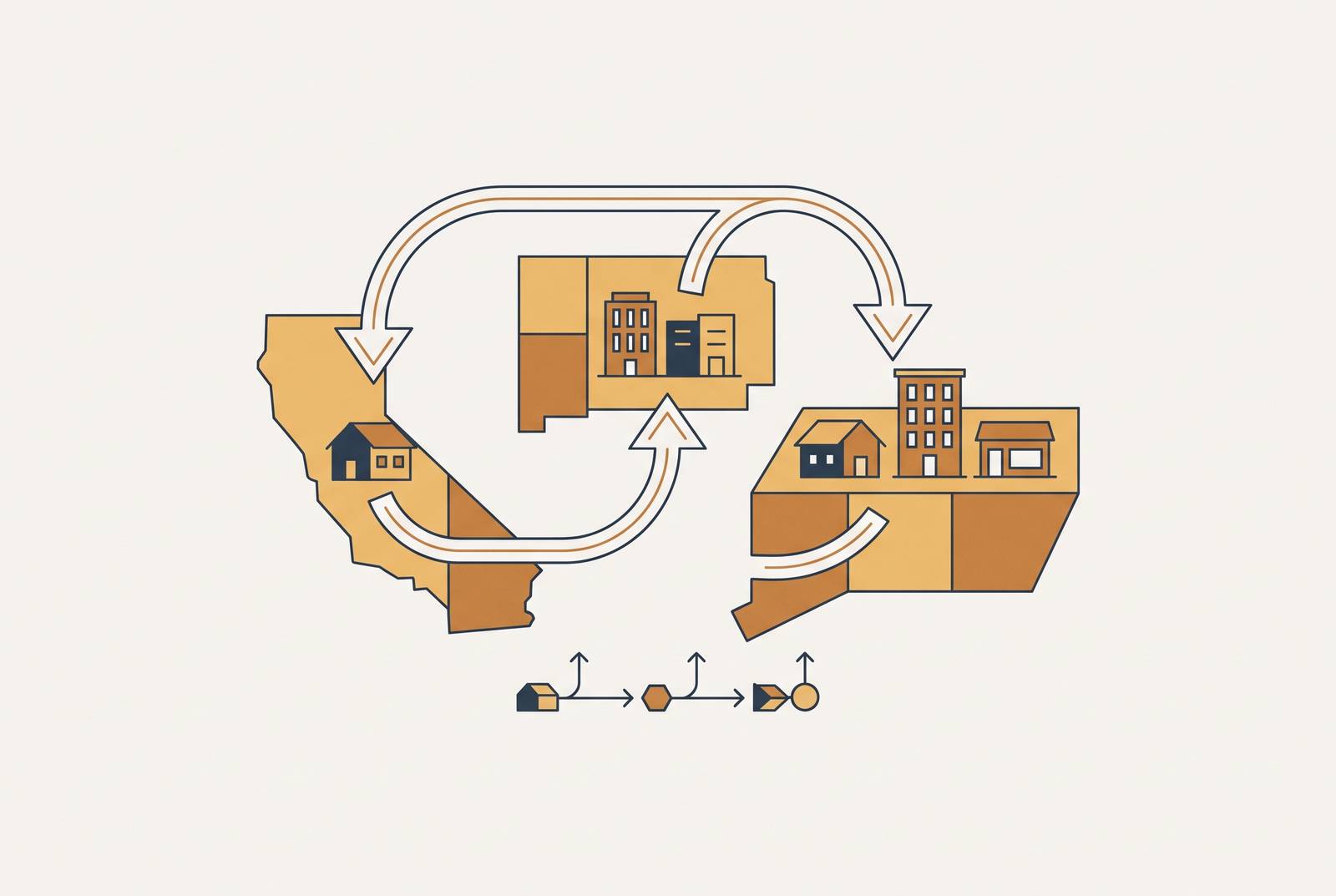
Geographic diversification through a 1031 exchange allows investors to move real estate capital across state lines without recognizing gain at the time of the exchange. Its strategic value is not simply a postponed tax bill, but the ability to redirect preserved equity into stronger markets. To get that value, investors must plan together for deadlines, state tax obligations, replacement-property identification, and how exchange funds are handled.
What a 1031 exchange actually does — and why "tax deferral" undersells it
Section 1031 of the Internal Revenue Code allows real property held for productive use or investment to be exchanged for other like-kind real property without immediate gain recognition. The deferred gain stays in the replacement property's cost basis. Deferral can cover federal capital gains, depreciation recapture, the 3.8% net investment income tax, and, in most states, state capital gains tax. The economic advantage is that equity otherwise paid in taxes remains invested in the next asset.
The range of qualifying replacements gives that preserved equity room to move. For real estate, like-kind does not mean identical use, so a single-family rental can be exchanged for raw land, a warehouse, or a commercial strip. The Tax Cuts and Jobs Act made exchanges available only for real property, leaving out personal property, equipment, and vehicles. The law already ruled out property held mainly for sale, including fix-and-flip inventory. Within those boundaries, investors can change the character of their holdings without surrendering capital to an immediate tax bill.
The two clocks and the rules that govern what you can identify
The operating constraints begin when the relinquished property closes, which is Day 0. Both the 45-day identification window and the 180-day completion window run from that date. Identification requires a written, signed notice naming replacement properties by address or legal description and delivered to the qualified intermediary. Before the sale closes, the intermediary must be in place, the exchange agreement signed, and the assignment language embedded in the sale contract.
The completion deadline also has a less obvious limit. Replacement property must be received within 180 days or by the tax return due date, including extensions, whichever is earlier. A late-year sale can therefore leave less than 180 days unless the investor obtains a return extension. Weekends and holidays count, and ordinary transaction delays do not create extra time. Deadline relief is limited to circumstances such as IRS relief for federally declared disasters.
The 3-property rule permits up to three properties of any value and is the most commonly used approach. The 200% rule permits any number if their combined fair market value does not exceed 200% of the relinquished property's sale price. The 95% rule permits any number at any combined value, but requires acquisition of at least 95% of the total identified value. That closing burden makes the last approach rarely used and particularly demanding to execute.
Why cross-state exchanges exist as a portfolio strategy, not just a convenience
A 1031 exchange has no geographic restriction within the United States. That freedom matters because a portfolio concentrated in one market shares one economic cycle, regulatory climate, and weather or natural-disaster risk profile. Buying a similar property nearby may preserve the tax benefit while leaving those exposures intact. Moving capital across markets, by contrast, can change the portfolio's underlying concentration. The relevant distinction is between replacing a property and repositioning the capital it represents.
Repositioning can involve either consolidation or diversification. Several smaller properties can become a single institutional-grade asset, while one large holding can become multiple properties in different markets. The same exchange can also change both where the property is and how it is used. A rental house can become a retail strip or warehouse. The strategic objective therefore governs the replacement search, rather than the search defaulting to whatever resembles the property being sold.
How state tax law complicates a cross-state move — and California's clawback as the clearest example
States set their own conformity rules, withholding requirements, and filing obligations, so an interstate exchange operates across more than one tax framework. California's clawback provision shows how the selling state's claim can survive the move. An investor exchanging California property for out-of-state replacement property must file California Form FTB 3840 annually until the deferred gain is recognized. When the replacement is eventually sold without another exchange, the deferred California tax becomes payable because the state follows the gain.
California's withholding requirements can reduce the proceeds at closing even when the exchange has the right documents, though the investor may be able to recover that money by filing a later non-resident return. That distinction matters because deferred tax and money withheld at closing are not the same thing. Other states impose their own requirements or limitations, which need to be verified with a tax advisor before the exchange is structured. Moving the replacement property does not by itself resolve obligations attached to the sale.
Buying in a no-income-tax state can still leave the investor with the same state tax burden. Residency remains relevant, independently of where the replacement asset sits. Property taxes and insurance costs can also offset an apparent tax advantage. Those costs belong in the property's underwriting and are separate from whether it meets the rules for federal exchange eligibility.
Identifying replacement properties across markets within the 45-day window
An unfamiliar market adds research time without adding identification time. Preparation must therefore begin before the relinquished property closes. Local brokers, property managers, or Delaware Statutory Trust sponsors can help compress the discovery process in target markets. Having at least one out-of-state candidate under contract before Day 45 reduces the pressure to conduct identification and due diligence simultaneously. The objective is to enter the window with actionable candidates.
The identification rule should fit how the investor plans to spread the capital. Naming three candidates across different markets provides alternatives without the aggregate-value constraint of the 200% rule. Where the plan involves more than three smaller replacements, the 200% rule offers greater breadth but requires careful tracking of combined fair market values. These alternatives must also be credible acquisitions because the list becomes fixed after Day 45. A failed deal cannot then be replaced with a newly discovered property in another state.
The document itself is the final operational checkpoint. A neighborhood or property type does not identify an asset unambiguously. The signed notice must reach the qualified intermediary, or another non-disqualified party to the exchange, before midnight on Day 45. Verbal discussions do not satisfy that requirement. Research produces options, but only timely, valid identification preserves them for the exchange.
What makes a target market worth the additional complexity of a cross-state exchange
A different state is not necessarily a better destination for capital. The move is strongest when the current market has peaked or faces regulatory headwinds that the target market does not. Those pressures can include the spread of rent control, unfavorable landlord-tenant law, or zoning restrictions. Different positions in the real estate cycle can strengthen the case further. Selling into a seller's market and buying into a buyer's market gives the exchange an economic purpose beyond tax preservation.
That advantage must be weighed against the added cost of execution. Small capital gains may not be worth the cost of preparing multi-state returns, recovering withholding, and doing due diligence in a market the investor does not know. The replacement can nevertheless offer a meaningful change in management burden as well as location. Moving from a high-maintenance residential portfolio to a net-lease commercial asset changes both dimensions in one transaction.
A planned residency change may form part of a broader strategy, but it remains a separate process. Bona fide residency in a no-income-tax state requires clear, documented connections and takes longer than executing the exchange itself. It cannot be inferred from the purchase of replacement property. Sequential moves allow investors to change allocations incrementally.
What to require from a qualified intermediary when the exchange crosses state lines
Intermediary selection begins with eligibility and independent evaluation. The QI industry has no federal licensing requirement, and only a small number of states impose bonding or registration requirements. A familiar professional is not automatically an eligible choice. An attorney, accountant, real estate agent, or investment banker who provided services to the investor within the prior two years cannot serve as the QI. The Certified Exchange Specialist designation from the Federation of Exchange Accommodators is a positive professional indicator.
Fund handling is the first substantive test. Investors should require segregated, client-specific accounts and verify how those accounts are titled. Exchange money must be kept apart from the intermediary's operating funds. Investors must also check how much deposit insurance covers and what protection they have if the bank fails, beyond a broad claim that the money is insured. Documented historical QI insolvencies make this a question of capital preservation.
Service continuity is equally important when several markets and time zones are involved. A named senior contact responsible from the first call through closing reduces handoff risk. Opening an exchange the same day, replying within hours, and offering support for extended hours seven days a week help investors meet the deadlines. Published interest rates make the treatment of held funds transparent, while a no-fee, interest-sharing model aligns compensation more closely with the investor's interests.
Common mistakes that collapse a cross-state exchange before it closes
Procedural failures can defeat an exchange before property selection has any bearing on the outcome. Constructive receipt of sale proceeds, even for a short time, voids the exchange, with no way to fix it afterward. Using a disqualified intermediary creates another preventable eligibility failure. In both cases, the critical work belongs before the relinquished property's closing.
The year-end filing trap is different because an investor can understand the headline deadlines and still miscalculate the available time. For a November or December sale, the tax return calendar affects when the replacement must close. Without a return extension, the earlier due date can truncate the expected acquisition window. That can be especially consequential when an out-of-state transaction already requires coordination among unfamiliar parties. The completion plan must account for the return deadline when counting forward 180 days.
A federally valid exchange can still carry withholding, reporting, or clawback obligations that were never modeled into the transaction. Discovering them late undermines the expected economics even where federal deferral survives. Thin backup identification and insecure fund custody compound the exposure by leaving little protection against a failed purchase or intermediary insolvency. The recurring pattern is not a lack of investment options, but a failure to preserve the legal, financial, and operational ability to acquire them.
Using the 1031 exchange as a long-term portfolio migration strategy, not a one-time event
The most powerful use of geographic exchange planning extends beyond any single replacement. Sequential exchanges can move capital from concentrated or lower-performing markets toward stronger geographies over decades without recognizing gain at each qualifying step. The purpose can change as the portfolio develops. Early exchanges might consolidate fragmented local holdings into an institutional-quality asset, while a later exchange distributes that holding across several states. The mechanism stays the same while the allocation evolves.
That path makes it useful to keep working with a QI over time. Dedicated senior support, clear information on how funds are handled, published rates, and quick exchange opening make it easier to carry out exchanges again when market conditions favor a move. More importantly, successive exchanges keep the equity otherwise lost to taxes deployed in the next asset. If property is held until death, heirs may receive a stepped-up basis that eliminates the accumulated deferred gain.